High-Score (Bugfree Users) Interview Experience: Intuit Staff SWE (TPI)
A concise, practical write-up of a high-scoring interview for Intuit (Staff Software Engineer, TPI). Key themes: AI fundamentals (applied, not heavy math), system design and architecture trade-offs, Kafka and event-driven systems at scale, plus monitoring/observability and a coding + LLD component. Includes prep tips focused on narration of real systems and ops at scale.
TL;DR
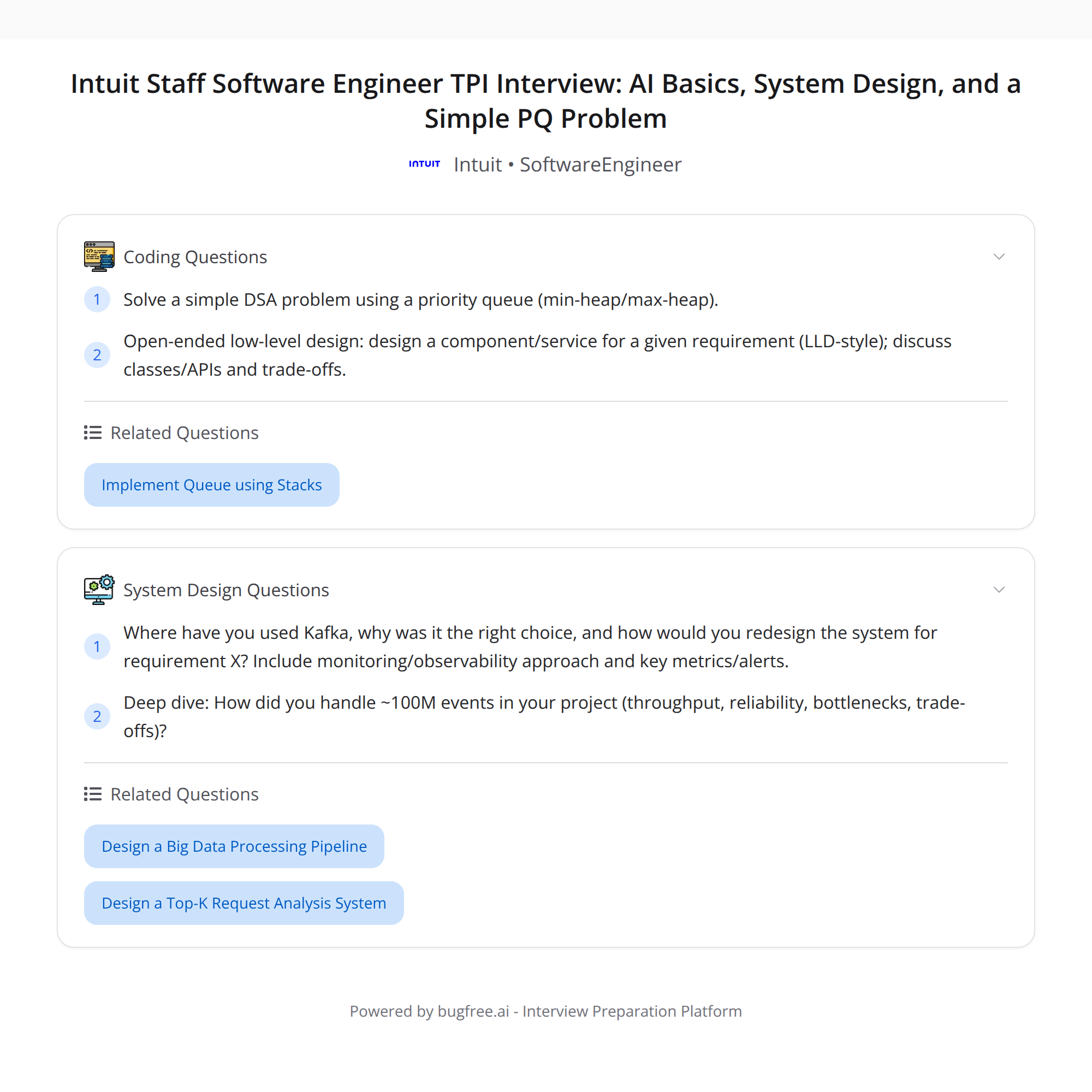
- Interview focus: practical AI basics, system design decisions, Kafka at scale, monitoring, resume deep-dive on handling ~100M events, a priority-queue coding problem, and a time-boxed low-level design (LLD) sketch.
- Coding: straightforward priority-queue (heap) + an open-ended LLD portion.
- Prep tip: narrate concrete numbers and operational details from your real systems (QPS, partitions, failures, runbooks).
Interview breakdown
AI fundamentals
- Emphasis on practical usage rather than heavy math proofs. Expect questions on how to integrate ML/LLM into production: inference latency, batching, model versioning, feature drift, and evaluation metrics.
- Talk trade-offs: on-device vs. server inference, caching responses, cost vs. latency, and safe-fallback strategies.
System design / architecture trade-offs
- Architecture choices, scaling approaches, consistency vs. availability trade-offs, and operational concerns (deployments, rollbacks, backward compatibility).
- Be explicit about constraints and why you chose a particular trade-off.
Kafka and event-driven systems at scale
- Deep dive into event volume, throughput, reliability, and bottlenecks.
- Expect questions on partitioning strategy, consumer group scaling, ordering guarantees, retention policies, compaction, and cross-datacenter replication.
Monitoring & observability
- Metrics, alerts, runbooks, and production troubleshooting. They focus on what you actually measured and how you reacted to incidents.
Resume deep-dive (~100M events)
- You’ll need to explain throughput, reliability strategies, the real bottlenecks, and what you did to detect/mitigate them.
Coding + LLD
- Coding: a priority-queue data structure problem — straightforward heap-based solution expected.
- LLD: open-ended design for a component or service; time-boxed, so provide a crisp sketch with components, APIs, data model, and scaling notes.
Kafka & event-driven systems — what to highlight
When discussing a system that handled ~100M events, narrate these concrete details:
- Traffic numbers: average and peak events/sec, message sizes, total write/read throughput.
- Topic & partition strategy: topic per resource or per tenant, number of partitions, and rationale (hot-key mitigation, parallelism).
- Durability & consistency: replication factor, in-sync replicas (ISR), leader placement, and retention/compaction decisions.
- Producer semantics: idempotence, retries, batching, compression.
- Consumer design: consumer lag patterns, parallelism with consumer groups, offset management, and ordering guarantees.
- Bottlenecks encountered: network bandwidth, disk throughput, GC pauses, broker CPU, or partition skew. Explain root cause analysis and remediation (repartitioning, batching, tuning JVM, adding brokers).
- Cross-cutting: schema evolution (Avro/Protobuf + schema registry), monitoring for under-replicated partitions, active controller count, and leader election rates.
Practical mitigations to mention:
- Increase partitions for throughput; watch partition count trade-offs (controller load, rebalances).
- Use idempotent producers and transactions for stronger delivery semantics if needed.
- Batch and compress messages to reduce network and broker load.
- Implement dead-letter queues and back-pressure strategies in consumers.
- Use MirrorMaker or Confluent Replicator for cross-dc replication with careful bandwidth planning.
Key Kafka metrics to call out:
- Bytes In/Out per broker, Requests/sec, Produce/Fetch latency, Under-replicated partitions, ISR size, Controller leader changes, Consumer lag.
Monitoring, alerts & on-call ops
- Define SLOs and SLAs: error budget, acceptable latencies, and throughput targets.
- Instrument everything: metrics, logs, traces. Correlate traces to find tail-latency causes.
- Alerts: actionable alerts (not just noise). Example alerts: consumer lag > X for Y minutes, under-replicated partitions, leader election spikes.
- Runbooks: step-by-step for common incidents (high lag, broker down, noisy GC). Document rollback paths and quick mitigation steps.
- Post-incident: root cause analysis, long-term fixes, and changes to monitoring.
The coding problem (priority queue)
Typical expectations:
- Implement a min/max priority queue using a binary heap (array-based heap). Core operations: insert (push), peek, pop (extract), and update-key if needed.
- Time complexity: O(log n) for insert/pop, O(1) for peek.
- Edge cases: empty queue behavior, duplicate priorities, stable ordering if required.
- Concurrency: if asked, discuss locking/sharding or lock-free approaches, and trade-offs of concurrent heaps vs. multiple partitions.
A short narrative for interview:
- State chosen data structure (binary heap), complexity, and memory usage.
- Walk through insertion and removal with an example.
- Mention alternatives (balanced BST, indexed heap for decrease-key) and why heap is simplest.
Low-level design (LLD) — how to time-box effectively
When given a time-boxed LLD prompt:
- Start with a one-sentence system goal and primary constraints (SLA, consistency, latency).
- Sketch the main components: API gateway, load balancer, workers/consumers, storage, cache, and monitoring.
- Define key APIs and a minimal data model (sample fields only).
- Explain how you scale each piece (sharding, horizontal scaling, partitioning) and handle failures (retries, idempotence, DLQ).
- Call out trade-offs briefly (e.g., strong ordering vs. throughput) and where you’d invest engineering time.
Example 5-minute structure:
- Quick requirements and constraints (1 min)
- High-level architecture diagram + components (2 min)
- Data model + key API signatures (1 min)
- Scaling & failure handling bullets (1 min)
How to narrate your real systems (prep tip)
Interviewers want clarity and ops experience. Use this pattern when describing any system:
- Context: What was the system? Business purpose.
- Scale: Concrete numbers (avg/peak QPS, message size, total events/day, storage size).
- Architecture: high-level components, data flow, and technologies used.
- Challenges: specific bottlenecks or incidents.
- Actions: what you changed (tuning, design, or process).
- Outcome: metrics after the change (reduced latency, fewer incidents, cost savings).
Sample lines to practice:
- "Our pipeline processed ~100M events per day (peak 10k E/sec). We used Kafka topics with 200 partitions to parallelize consumers."
- "We observed consumer lag spikes due to large GC pauses on a subset of brokers; mitigation involved JVM tuning and increasing partition count to spread load."
- "To guarantee at-least-once delivery with exactly-once processing semantics we used idempotent producers and consumer-side deduplication with compacted topics."
Practice telling two or three such stories from your resume with numbers and clear outcomes.
Final prep checklist
- Prepare 3 real-system stories with metrics and ops details.
- Review Kafka internals: partitioning, replication, rebalances, and key metrics.
- Practice a heap-based priority queue implementation and talk-through of complexity.
- Practice a 5-minute LLD sketch with components, APIs, and scaling notes.
- Be ready to discuss monitoring, runbooks, and incident responses with concrete examples.
If you want, I can:
- Turn one of your resume bullets into a practiced 2-minute narrative with numbers and ops details.
- Generate mock questions and ideal answer outlines for Kafka or the LLD portion.
#SystemDesign #Kafka #SoftwareEngineering
About the author
bugfree.ai is an advanced AI-powered platform designed to help software engineers master system design and behavioral interviews. Whether you’re preparing for your first interview or aiming to elevate your skills, bugfree.ai provides a robust toolkit tailored to your needs. Key Features:
150+ system design questions: Master challenges across all difficulty levels and problem types, including 30+ object-oriented design and 20+ machine learning design problems. Targeted practice: Sharpen your skills with focused exercises tailored to real-world interview scenarios. In-depth feedback: Get instant, detailed evaluations to refine your approach and level up your solutions. Expert guidance: Dive deep into walkthroughs of all system design solutions like design Twitter, TinyURL, and task schedulers. Learning materials: Access comprehensive guides, cheat sheets, and tutorials to deepen your understanding of system design concepts, from beginner to advanced. AI-powered mock interview: Practice in a realistic interview setting with AI-driven feedback to identify your strengths and areas for improvement.
bugfree.ai goes beyond traditional interview prep tools by combining a vast question library, detailed feedback, and interactive AI simulations. It’s the perfect platform to build confidence, hone your skills, and stand out in today’s competitive job market. Suitable for:
New graduates looking to crack their first system design interview. Experienced engineers seeking advanced practice and fine-tuning of skills. Career changers transitioning into technical roles with a need for structured learning and preparation.
Comments
Join the discussionNo comments yet. Be the first to comment.