Imposter Syndrome Before Interviews? Treat It Like a Bug, Not a Truth.
Imposter syndrome tends to peak in the minutes or hours before an interview. It shows up as a loud internal critic that confuses anxiety for fact. The good news: you can treat it like a bug in your thinking — not an absolute truth — and apply practical fixes.
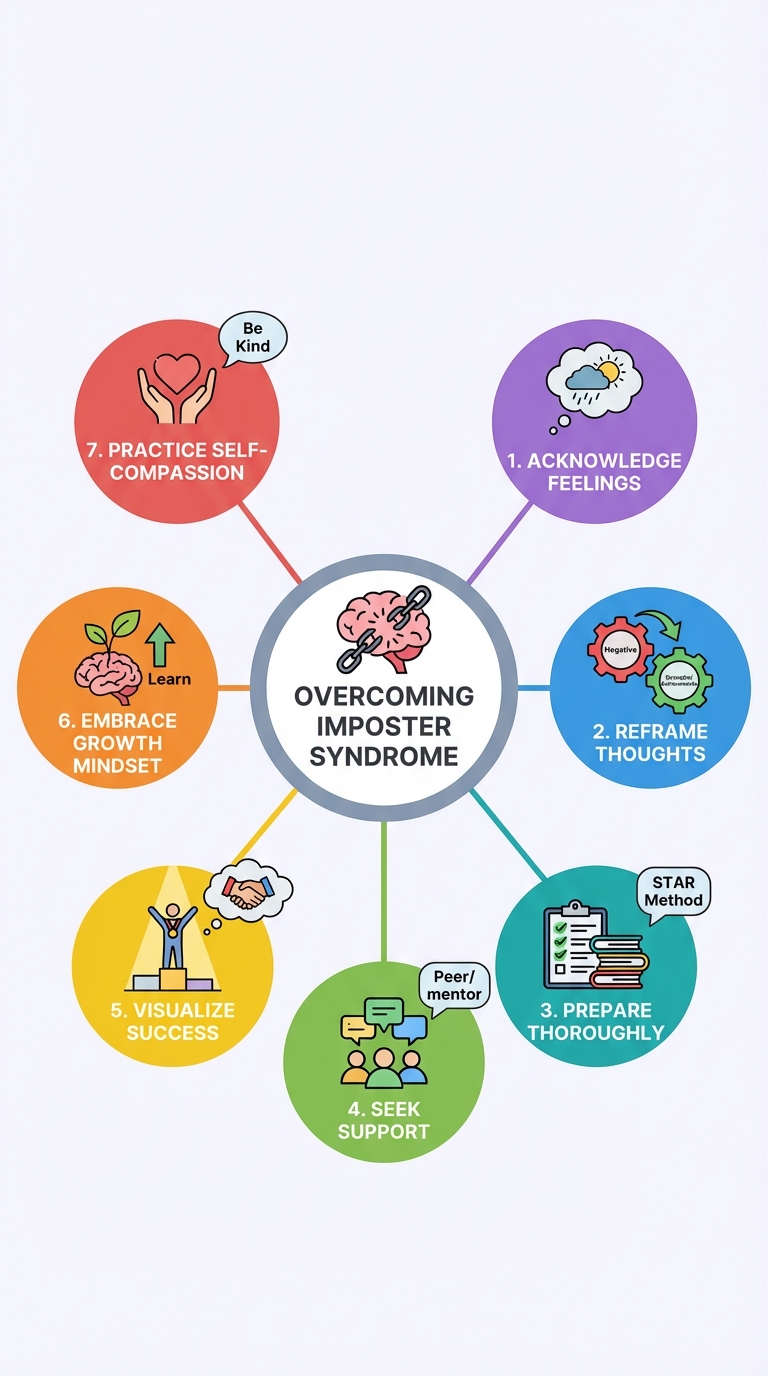
Below are seven concrete steps you can use immediately to quiet that voice and show up more confidently.
1) Name it: "This is imposter syndrome," not reality.
- When the thought arrives, label it. Saying "That's imposter syndrome" creates distance and reduces automatic belief.
- Quick script: "I'm noticing the thought that I don't deserve this role — that's imposter syndrome, not a fact."
2) Reframe: list 3 wins + 3 skills that match the role.
- Before the interview, write down three recent accomplishments (wins) and three concrete skills or experiences that map to the job description.
- Example: "Led data pipeline refactor (win); experience with ETL, Python, unit testing (skills)." Keep this as a one-page cheat-sheet you can glance at.
3) Prepare: practice behavioral answers with STAR.
- Use the STAR framework: Situation, Task, Action, Result.
- Prepare 4–6 stories that highlight common competencies: teamwork, problem solving, leadership, learning from failure.
- Short template: "S: context; T: goal; A: what I did (specific actions); R: measurable outcome or lesson." Aim for 1–2 minute answers.
4) Get support: ask a mentor to sanity-check your story.
- Share your resume and 2–3 STAR stories with a trusted mentor or peer. Ask them: "Does this sound believable/clear? What should I emphasize?"
- Feedback from someone outside your head helps recalibrate your internal narrative.
5) Visualize: rehearse calm, clear answers.
- Spend 5–10 minutes before the interview visualizing a steady, clear conversation: slow speaking, breathing between answers, and relaxed posture.
- Visualization reduces physiological anxiety and primes performance.
6) Growth mindset: interviews are fit-finding, not judgment.
- Reframe the interview as mutual discovery: it’s about finding the best fit, not a pass/fail moral test of your worth.
- This reduces stakes and opens you to curiosity — which is often more attractive to interviewers.
7) Self-compassion: aim for progress, not perfection.
- Accept that answers will be imperfect. If you stumble, use a rescue line: "Let me reframe that—here's a clearer version." Small recovery moments show resilience.
- Celebrate getting through difficult interviews as growth.
Quick prep checklist (10 minutes):
- Name the emotion aloud.
- Scan your 3 wins + 3 skills cheat-sheet.
- Run one STAR story out loud.
- Breathe and visualize a calm exchange.
Final note
Imposter syndrome is common; it’s not a reflection of your abilities. Treat it like a bug you debug with concrete steps: naming, reframing with evidence, focused practice, social support, visualization, a growth mindset, and self-compassion. Over time these habits reduce the volume of the voice and help your real strengths come through.
#InterviewPrep #BehavioralInterview #ImposterSyndrome #CareerGrowth #STARMethod
About the author
bugfree.ai is an advanced AI-powered platform designed to help software engineers master system design and behavioral interviews. Whether you’re preparing for your first interview or aiming to elevate your skills, bugfree.ai provides a robust toolkit tailored to your needs. Key Features:
150+ system design questions: Master challenges across all difficulty levels and problem types, including 30+ object-oriented design and 20+ machine learning design problems. Targeted practice: Sharpen your skills with focused exercises tailored to real-world interview scenarios. In-depth feedback: Get instant, detailed evaluations to refine your approach and level up your solutions. Expert guidance: Dive deep into walkthroughs of all system design solutions like design Twitter, TinyURL, and task schedulers. Learning materials: Access comprehensive guides, cheat sheets, and tutorials to deepen your understanding of system design concepts, from beginner to advanced. AI-powered mock interview: Practice in a realistic interview setting with AI-driven feedback to identify your strengths and areas for improvement.
bugfree.ai goes beyond traditional interview prep tools by combining a vast question library, detailed feedback, and interactive AI simulations. It’s the perfect platform to build confidence, hone your skills, and stand out in today’s competitive job market. Suitable for:
New graduates looking to crack their first system design interview. Experienced engineers seeking advanced practice and fine-tuning of skills. Career changers transitioning into technical roles with a need for structured learning and preparation.
Comments
Join the discussionNo comments yet. Be the first to comment.