
High-Scoring Meta Data Scientist Interview: Key Insights from Bugfree Users
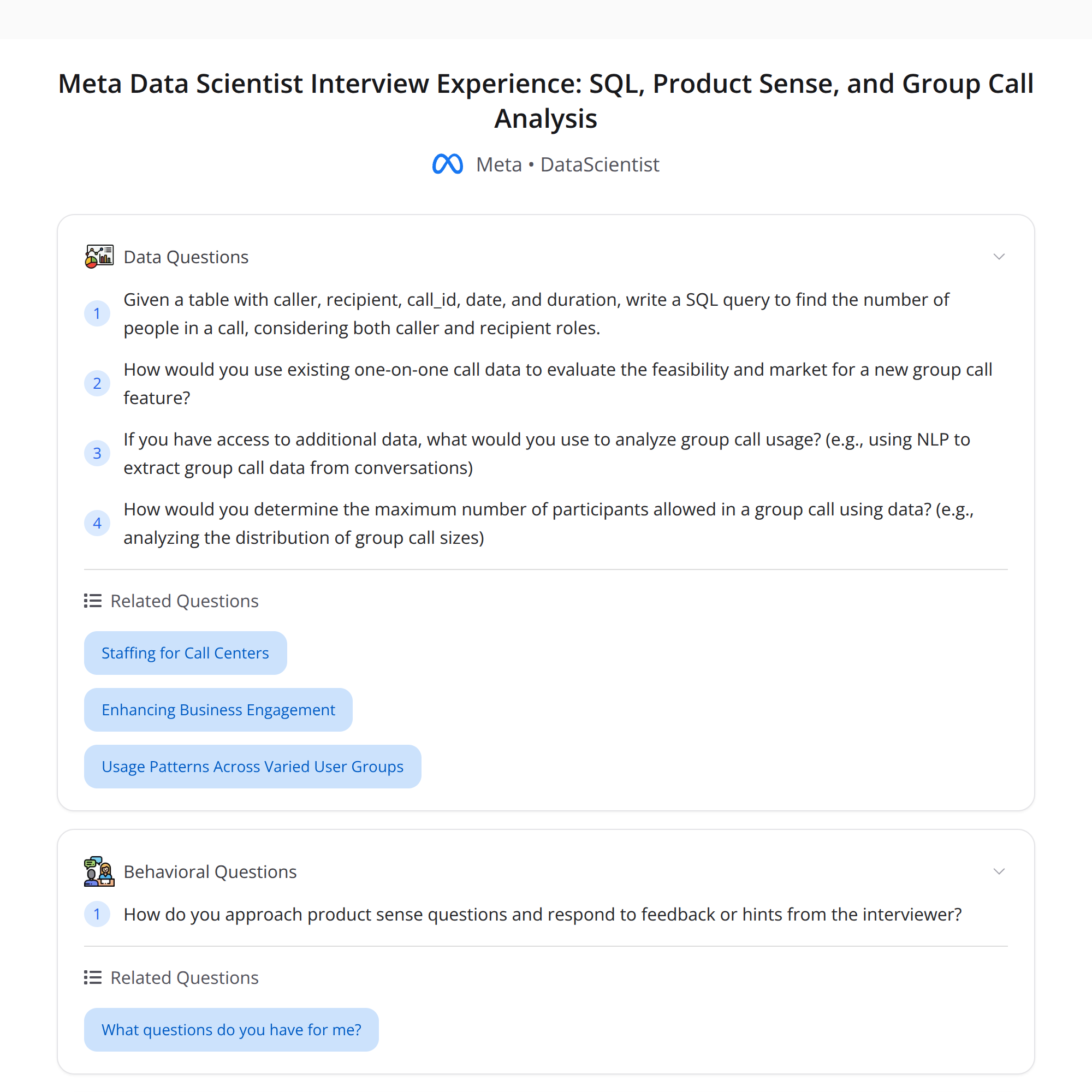
Bugfree users reported a standout interview experience for a Meta Data Scientist role. The interview combined a practical SQL problem with a product-sense/design question and covered experiment design and evaluation. Below are the distilled lessons, recommended approaches, and concrete tips to prepare.
Interview structure (as reported)
- SQL challenge: count unique call participants per call (or across sessions).
- Product-sense question: design/justify launching a group call feature using historical one-on-one call data.
- Follow-up: experiment design (A/B test) and metrics to evaluate success.
SQL challenge — how to think about it
Key goals: be clear about assumptions, data shape, and edge cases.
- Clarify data model: are participants stored as rows (call_id, participant_id) or as an array/JSON column?
- Handle duplicates: ensure you count distinct participant IDs.
- Think about time windows: do you aggregate across all time or within sessions?
Example simple SQL pattern (row-based participant table):
SELECT
  call_id,
  COUNT(DISTINCT participant_id) AS unique_participants
FROM call_participants
GROUP BY call_id;
If participants are in an array/JSON column, explain unnesting or JSON extraction and deduplication. Mention performance (indices, sharding) when relevant.
Product sense — launching a group call feature from 1:1 data
Approach the question like a data-driven PM + scientist:
Define the product objective
- What problem does group calling solve? Better retention, richer social interactions, content co-creation? State the primary business metric.
Analyze the network
- Build a call graph: nodes = users, edges = calls (weight by frequency/duration).
- Identify natural clusters/communities using connected components or community detection (Louvain, spectral clustering). These clusters can indicate likely group call participants.
Infer group intent with NLP
- Use call transcripts or text metadata (titles, messages) to detect topics and shared intent that suggest group calls will be valuable.
- Tag likely group conversations (study groups, team syncs, hobby clubs).
Determine participant limits using data
- Use empirical distributions of naturally occurring multi-party interactions (e.g., group chats, multi-call chains).
- A robust rule: consider the 95th percentile of historical active-participant counts to set default limits (helps avoid outliers driving product defaults).
Design friction and discoverability
- Provide easy-to-use flows to convert 1:1 relationships into group contexts (e.g., "Create group from recent contacts").
- Prototype and measure engagement across cohorts.
A/B testing — metrics and design
Don't optimize for call duration alone. Focus on sustained value and downstream impact.
Primary metrics to consider:
- Retention (DAU/WAU/MAU retention at 1/7/30 days) — primary signal of long-term value.
- Activation: % of users who create or join group calls within X days.
- Engagement quality: repeat group sessions per user, participant rejoin rate.
Secondary metrics and guards:
- Session length and messages/collaborative actions (but treat these as secondary).
- Abuse and moderation signals.
- System-level metrics: latency, dropped-call rate.
Experiment design tips:
- Define primary metric and minimum detectable effect before launching.
- Power calculations: ensure adequate sample size and run-time to capture retention effects (often longer than usage metrics).
- Segment analysis: test on likely-adopter cohorts (tight social clusters) vs. broad population.
- Use incremental rollouts and monitor for negative impacts.
Practical interview tips & mindset
- Explain your assumptions clearly and enumerate alternatives.
- Walk through tradeoffs (privacy, complexity, engineering cost).
- Tie proposals to concrete metrics — what success looks like and how you’ll measure it.
- Be resilient: if pushed on a corner case, admit it, propose experiments to resolve uncertainty, and iterate.
Quick checklist to prepare
- Practice SQL problems that include DISTINCT, UNNEST, window functions, and aggregation.
- Familiarize yourself with graph / network analysis basics and community detection.
- Review A/B testing fundamentals: metrics, power, sample size, and pitfalls.
- Practice explaining product decisions succinctly and backing them with data.
Final takeaway
A strong interview combines clear technical execution (SQL and data processing), product sense (using social graphs and NLP insights), and experiment-driven evaluation (focus on retention). Prepare examples, state assumptions, and always connect your reasoning to measurable outcomes.
Good luck — prepare, explain your logic, and stay resilient!
About the author
bugfree.ai is an advanced AI-powered platform designed to help software engineers master system design and behavioral interviews. Whether you’re preparing for your first interview or aiming to elevate your skills, bugfree.ai provides a robust toolkit tailored to your needs. Key Features:
150+ system design questions: Master challenges across all difficulty levels and problem types, including 30+ object-oriented design and 20+ machine learning design problems. Targeted practice: Sharpen your skills with focused exercises tailored to real-world interview scenarios. In-depth feedback: Get instant, detailed evaluations to refine your approach and level up your solutions. Expert guidance: Dive deep into walkthroughs of all system design solutions like design Twitter, TinyURL, and task schedulers. Learning materials: Access comprehensive guides, cheat sheets, and tutorials to deepen your understanding of system design concepts, from beginner to advanced. AI-powered mock interview: Practice in a realistic interview setting with AI-driven feedback to identify your strengths and areas for improvement.
bugfree.ai goes beyond traditional interview prep tools by combining a vast question library, detailed feedback, and interactive AI simulations. It’s the perfect platform to build confidence, hone your skills, and stand out in today’s competitive job market. Suitable for:
New graduates looking to crack their first system design interview. Experienced engineers seeking advanced practice and fine-tuning of skills. Career changers transitioning into technical roles with a need for structured learning and preparation.
Comments
Join the discussionNo comments yet. Be the first to comment.