High-Scoring LinkedIn Software Engineer Interview: Insights from a Bugfree User
A Bugfree user recently shared a detailed account of a high-scoring LinkedIn Software Engineer interview. The experience is a useful snapshot of what to expect in a competitive technical hiring process: a rigorous online assessment, deep technical phone screens, data-structures-and-algorithms (DSA) challenges, system design evaluation, and behavioral/team-fit rounds. Despite strong performance across rounds, the candidate was ultimately rejected — a reminder that interviews can be unpredictable.
Quick overview
- Role: Software Engineer (LinkedIn)
- Outcome: Strong performance across rounds, but rejected
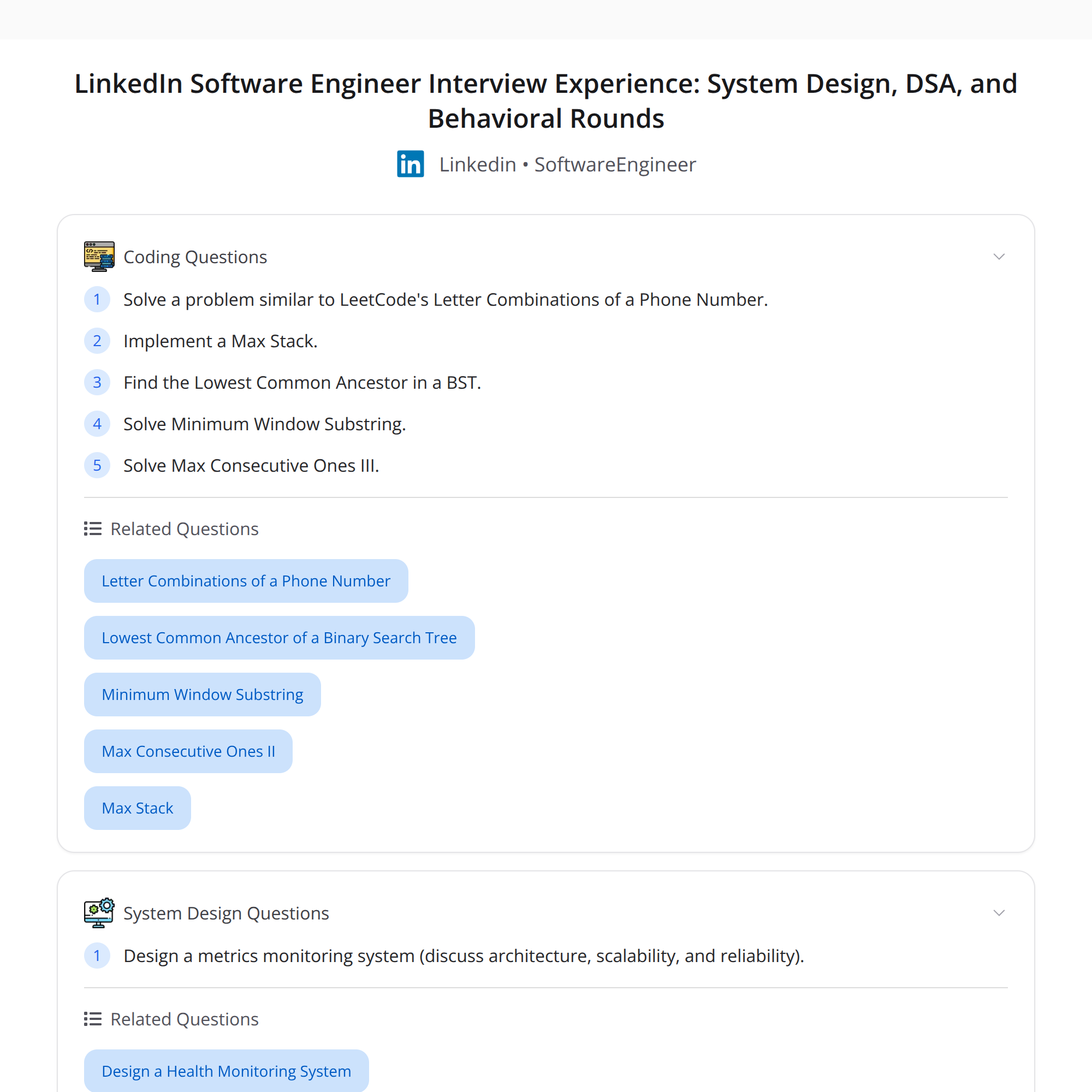
- Highlights: HackerRank OA, phone screen on OS/Java/networking, DSA rounds with problems like Max Stack and Minimum Window Substring, system design and manager/host rounds
The interview stages (what happened)
HackerRank Online Assessment (OA)
- A challenging OA that filters candidates early. Typically includes coding problems with strict time limits and edge-case testing.
- Tip: Practice timed HackerRank-style questions and test solutions thoroughly against edge cases.
Phone screen (technical deep dive)
- Covered operating systems, Java specifics, and networking fundamentals.
- Expect questions about thread safety, memory model, sockets, TCP vs UDP, and language-specific behavior.
- Tip: Review common OS concepts (process vs thread, scheduling, locks), Java concurrency and memory management, and basic networking stacks.
DSA rounds (onsite/virtual interviews)
- Included algorithmic problems such as Max Stack (design a stack supporting max retrieval) and Minimum Window Substring (substring search with sliding window and character counts).
- These rounds focused on correctness, complexity analysis, and clear communication of the approach.
- Tip: Practice explaining trade-offs (time/space), write clean pseudocode, and speak through test cases.
System design
- Tested architecture and scalability skills. Typical expectations: define components, data flow, storage choices, caching, and how to handle scale and failures.
- Tip: Structure answers: clarify requirements, outline high-level design, dive into components, and discuss scaling and bottlenecks.
Host/manager round (behavioral and teamwork)
- Focused on collaboration, problem-solving approach, and cultural fit.
- Tip: Use STAR (Situation, Task, Action, Result) to describe past experiences and emphasize ownership, communication, and impact.
Why this interview matters
- It shows how broad modern interviews are: language and OS theory, networking, algorithms, and system design all matter.
- Even a candidate who performs well technically across multiple rounds can face rejection — decisions depend on many factors beyond raw performance (team fit, role needs, comparative candidate pool, or hiring bandwidth).
Key takeaways & actionable tips
- Prepare holistically: don't focus solely on algorithms. Refresh OS, networking, and language-specific details.
- Practice common OA platforms (HackerRank, LeetCode) under timed conditions.
- For DSA rounds, prioritize clear communication, edge-case handling, and complexity trade-offs.
- For system design, practice scoping, sketching components, and reasoning about scale and failure modes.
- In behavioral rounds, share concrete examples showing collaboration, conflict resolution, and measurable impact.
- Accept uncertainty: rejection may not reflect your skill level. Use feedback (if available) and iterate.
Final reflection
This Bugfree user's experience is both encouraging and humbling: it confirms that careful preparation can produce strong performances across rounds, but outcomes are not guaranteed. Treat each interview as practice — analyze what went well, identify gaps, and continue building both technical depth and soft skills.
Have your own LinkedIn interview story or tips to share? Post them below — real experiences help everyone improve.
#SoftwareEngineering #InterviewExperience #Bugfree #LinkedIn #DSA #SystemDesign
About the author
bugfree.ai is an advanced AI-powered platform designed to help software engineers master system design and behavioral interviews. Whether you’re preparing for your first interview or aiming to elevate your skills, bugfree.ai provides a robust toolkit tailored to your needs. Key Features:
150+ system design questions: Master challenges across all difficulty levels and problem types, including 30+ object-oriented design and 20+ machine learning design problems. Targeted practice: Sharpen your skills with focused exercises tailored to real-world interview scenarios. In-depth feedback: Get instant, detailed evaluations to refine your approach and level up your solutions. Expert guidance: Dive deep into walkthroughs of all system design solutions like design Twitter, TinyURL, and task schedulers. Learning materials: Access comprehensive guides, cheat sheets, and tutorials to deepen your understanding of system design concepts, from beginner to advanced. AI-powered mock interview: Practice in a realistic interview setting with AI-driven feedback to identify your strengths and areas for improvement.
bugfree.ai goes beyond traditional interview prep tools by combining a vast question library, detailed feedback, and interactive AI simulations. It’s the perfect platform to build confidence, hone your skills, and stand out in today’s competitive job market. Suitable for:
New graduates looking to crack their first system design interview. Experienced engineers seeking advanced practice and fine-tuning of skills. Career changers transitioning into technical roles with a need for structured learning and preparation.
Comments
Join the discussionNo comments yet. Be the first to comment.