High-Score (Bugfree Users) Meta Data Engineer Onsite Interview Experience — What Really Gets Tested
A 4-year-experience data engineer shares a high-score, bugfree onsite run at Meta. This post breaks down the interview flow, the question types, how the interviewers dig in, and practical tips to maximize your score.
Interview flow (typical)
- Referral → HR screen → phone screen(s) → onsite
- Onsite: combination of behavioral, system design/data modeling, SQL, and Python/problem-solving rounds
What interviewers focus on
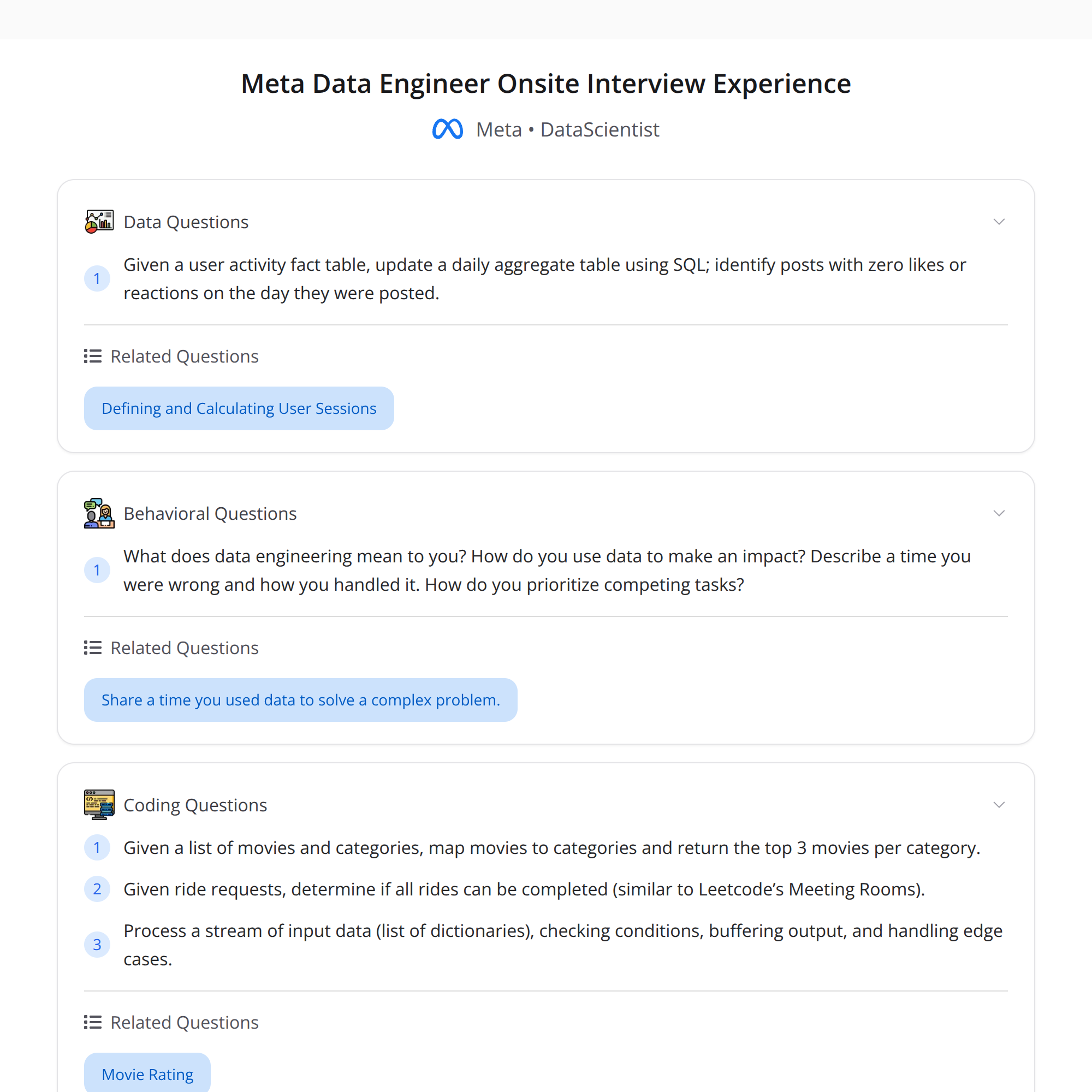
- Behavioral: impact, prioritization, and ownership. Expect deep follow-ups (e.g., "tell me about a time you were wrong"). Use STAR, be specific about metrics and trade-offs.
- System design & data modeling: end-to-end thinking, scale tactics, partitioning, and incremental aggregation strategies.
- SQL: correctness, edge cases (zero engagement), performance, GROUP BY/HAVING, and subqueries.
- Python: algorithmic thinking for practical problems (e.g., top-K per category, meeting-room style feasibility).
Behavioral: what to prepare
- Focus on impact: quantify outcomes (e.g., reduced latency by X ms, improved throughput by Y%).
- Prioritization: explain trade-offs and why you chose one approach.
- "Time I was wrong": show learning and corrective actions.
- Expect multiple deep follow-ups; justify assumptions and revisit them when challenged.
Tip: narrate decisions aloud. Interviewers evaluate your reasoning as much as the final answer.
System design & data modeling — common problems and how to approach them
Sample topics seen in this report:
- Video streaming platform design (chunking, adaptive bitrate, CDN, regional partitioning)
- Ride-share carpool matching (time windows, spatial partitioning, batching)
- Viral Facebook-post sharing model: count shares, track origin, multi-hop reshares
A useful approach for each problem:
- Clarify requirements: functional (what must work) and non-functional (scale, latency).
- Propose a high-level architecture and data model.
- Drill into bottlenecks and partitioning/sharding strategy.
- Describe incremental processing/aggregation for analytics.
Viral-share model — key considerations and a sketch:
- Requirements: count total shares, track origin post and first sharer, support multi-hop reshares, and produce daily aggregates.
- Data model (simplified):
- posts(post_id, author_id, created_at)
- shares(share_id, post_id, user_id, parent_share_id, created_at)
Scale tactics:
- Partition shares by post_id or by created_date (time-based partitions) depending on access patterns.
- For multi-hop tracking, maintain a "root_origin" field on share ingestion (propagate origin at write time) to avoid deep graph traversals online.
- Daily aggregates: write a streaming job that updates daily_counters(post_id, date, share_count) using incremental upserts.
- To reduce cross-shard joins, store frequently-queried aggregates co-located with the post shard.
Offline/nearline computation:
- Use periodic batch jobs to recompute or reconcile counts (MapReduce/ Spark/Beam) if small inconsistencies are acceptable.
SQL: patterns and pitfalls
Expect problems around daily aggregates, zero-engagement posts, and counting across joins.
Common patterns to show:
- Daily aggregate updates (upsert/merge pattern): write incremental counts into a date-partitioned table to avoid full-table scans.
- Handling zero-engagement posts: LEFT JOIN from posts to aggregate counts and COALESCE to zero.
Example (conceptual) queries:
Find posts with zero engagement on a given day:
SELECT p.post_id
FROM posts p
LEFT JOIN daily_shares ds
  ON p.post_id = ds.post_id AND ds.date = '2025-01-01'
WHERE ds.share_count IS NULL OR ds.share_count = 0;
Daily aggregate from raw shares (conceptual):
INSERT INTO daily_shares (post_id, date, share_count)
SELECT post_id, DATE(created_at) AS date, COUNT(*)
FROM shares
GROUP BY post_id, DATE(created_at))
ON CONFLICT (post_id, date)
  DO UPDATE SET share_count = daily_shares.share_count + EXCLUDED.share_count;
Use GROUP BY and HAVING when filtering aggregated results; use subqueries for complex filters (e.g., top posts by share growth week-over-week).
Python / algorithmic: what to expect
- Top-K per category: use heapq.nlargest or maintain a min-heap of size K per category for streaming inputs. Show O(N log K) reasoning.
- Meeting Rooms-style feasibility: interval scheduling (sort by start/end time), greedy algorithms to check overlaps or compute minimum rooms (use a sweep-line with sorted timestamps or a min-heap of end times).
Small pseudocode for Top-K per category (streaming):
from heapq import heappush, heappop
heaps = defaultdict(list)  # category -> min-heap
for item in stream:
    heap = heaps[item.category]
    heappush(heap, (item.score, item))
    if len(heap) > K:
        heappop(heap)
# result: heaps contain top-K per category
Time & communication strategy
- For coding puzzles, aim to finish the correct approach in <8 minutes for small tasks; if you need more time, outline the full solution first and implement critical parts.
- Narrate every step. If you get a hint, acknowledge it and incorporate it explicitly.
- Ask clarifying questions at the start (scale, data size, allowed technologies). Interviewers expect you to set assumptions.
- Leverage recruiter guidance: they often help calibrate expectations (e.g., language allowed, typical time limits, onsite logistics).
Final tips (quick hit list)
- Quantify impact in behavioral answers.
- Use STAR and be ready for deep follow-ups.
- For system design, always discuss partitioning, failure modes, and trade-offs.
- For SQL, cover correctness, edge cases (zeros), and performance.
- For Python/algorithms, state complexity and choose practical data structures.
- Use hints — they’re there to guide you, not to penalize you.
This condensed, experience-based guide should help you prepare strategically for a Meta Data Engineer onsite—focus on clear communication, measurable impact, and scalable designs.
#DataEngineering #SystemDesign #SQL
About the author
bugfree.ai is an advanced AI-powered platform designed to help software engineers master system design and behavioral interviews. Whether you’re preparing for your first interview or aiming to elevate your skills, bugfree.ai provides a robust toolkit tailored to your needs. Key Features:
150+ system design questions: Master challenges across all difficulty levels and problem types, including 30+ object-oriented design and 20+ machine learning design problems. Targeted practice: Sharpen your skills with focused exercises tailored to real-world interview scenarios. In-depth feedback: Get instant, detailed evaluations to refine your approach and level up your solutions. Expert guidance: Dive deep into walkthroughs of all system design solutions like design Twitter, TinyURL, and task schedulers. Learning materials: Access comprehensive guides, cheat sheets, and tutorials to deepen your understanding of system design concepts, from beginner to advanced. AI-powered mock interview: Practice in a realistic interview setting with AI-driven feedback to identify your strengths and areas for improvement.
bugfree.ai goes beyond traditional interview prep tools by combining a vast question library, detailed feedback, and interactive AI simulations. It’s the perfect platform to build confidence, hone your skills, and stand out in today’s competitive job market. Suitable for:
New graduates looking to crack their first system design interview. Experienced engineers seeking advanced practice and fine-tuning of skills. Career changers transitioning into technical roles with a need for structured learning and preparation.
Comments
Join the discussionNo comments yet. Be the first to comment.