High-Score (Bugfree Users) Google SWE Interview: LLD-Heavy Rounds + DSA Patterns to Master
Posted by Bugfree users — a high-score interview experience.
This Google SWE loop leaned heavily on low‑level design (LLD) and solid data-structures & algorithms (DSA) fundamentals. Below is a concise breakdown of what showed up, why it matters, and how to practice for these kinds of interviews.
Interview highlights
Phone screen
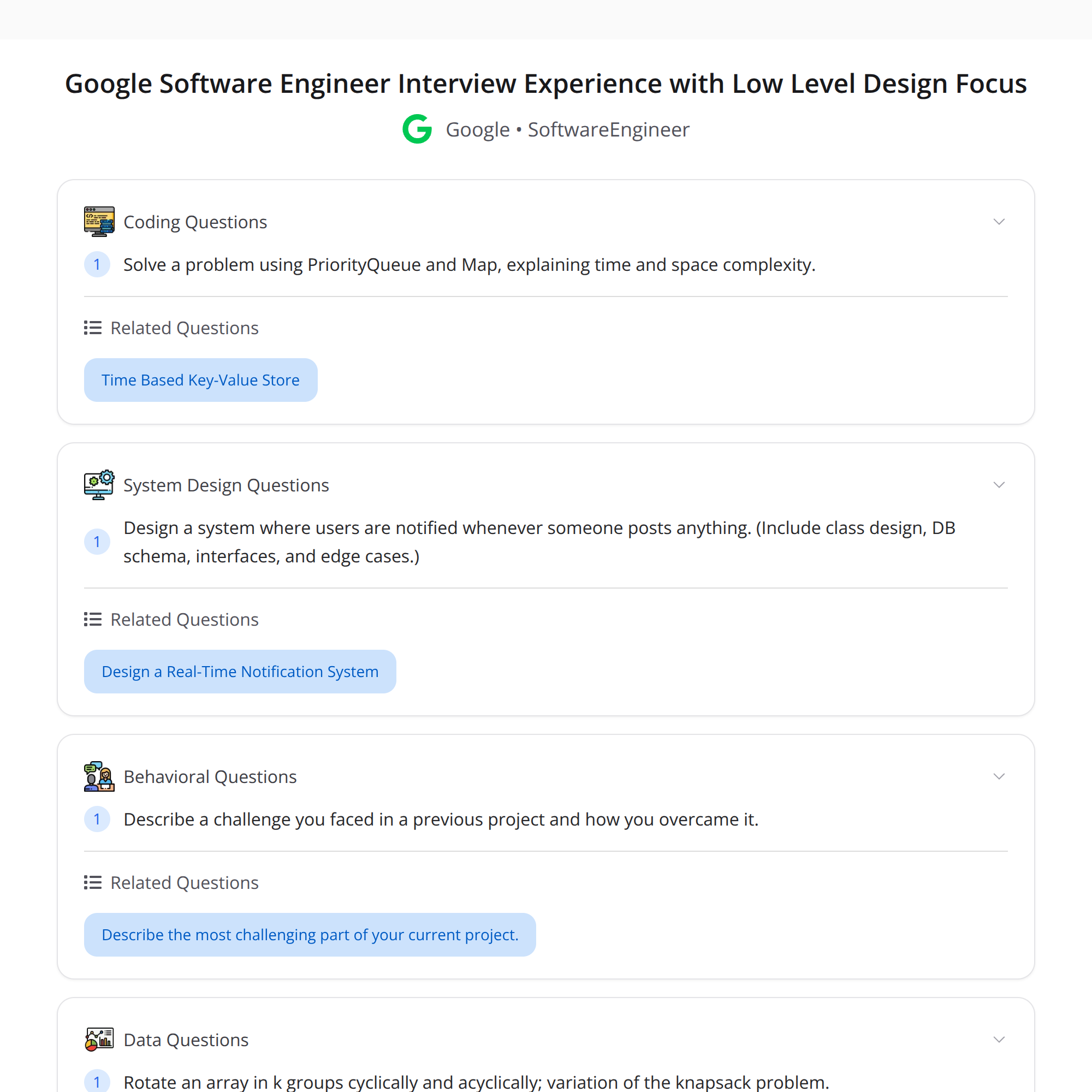
- Problem: coding with PriorityQueue + Map.
- Expectation: produce a correct solution and clearly explain time & space complexity and tradeoffs (e.g., heap vs balanced BST, when to use maps for frequency tracking).
LLD / System design
- Prompt: design a “notify users when someone posts” subsystem.
- Focus: component breakdown, DB schema, service interfaces, APIs, background jobs, and handling edge cases (rate limits, duplicate notifications, offline users).
DSA rounds
- Representative problems: rotating arrays in k-sized groups (both cyclic and acyclic approaches), knapsack variations.
- Emphasis: efficiency-focused implementations, in-place transformations, correct complexity analysis.
Behavioral
- Deep dives into projects, teamwork, setbacks, and takeaways. Be prepared to discuss technical choices and growth moments.
Concrete notes & suggestions
Phone screen (PriorityQueue + Map)
- Common pattern: frequency counting + top-k elements. Use a Min-Heap sized k or a Max-Heap depending on requirements. Alternative: maintain a TreeMap / balanced BST if you need ordered removals.
- Be explicit about complexities: building the map O(n), heap ops O(n log k) or O(k log n) depending on approach, and O(n) extra space for frequency map.
- Mention edge cases: ties in frequency, negative values, streaming input.
LLD: "Notify users when someone posts"
Components to propose:
- API Gateway / Ingress
- Post Service (writes posts)
- Notification Service (fan-out logic)
- User Preferences Service (opt-in, channels)
- Delivery workers / Push gateway (APNs / FCM / Email)
- Persistent store for notifications + dedup table
- Monitoring + dead-letter queues
Minimal DB schema example (simplified):
- users(id, preferences)
- posts(id, author_id, content, created_at)
- follows(follower_id, followee_id)
- notifications(id, user_id, post_id, status, created_at)
API surface (examples):
- POST /posts -> triggers fan-out
- POST /notifications/ack -> client acknowledges
- GET /notifications?userId= -> fetch pending notifications
Key design tradeoffs to discuss:
- Push (real-time) vs pull (polling) model
- Synchronous vs asynchronous fan-out (sync is simpler but won’t scale; async with queues is preferred)
- Consistency: eventual consistency is acceptable for notifications; explain why
- Deduplication: idempotent writes and idempotency keys for retries
- Rate limiting & backoff for abusive/flooding users
- Storage vs ephemeral: store notifications for history vs ephemeral push-only
Edge cases to call out:
- Extremely popular posts with millions of followers (use batching, sharded worker pools, or push receivers per shard)
- Offline users — queue for delivery and retry
- Users with custom filters/preferences
- Duplicate notifications due to retries — ensure idempotency
DSA: array rotations & knapsack
Rotate arrays in k groups:
- In-place reversal trick for rotate by k (reverse whole array, then reverse parts)
- For rotation by groups: treat each group and apply cyclic rotations or use temporary buffer per group
- Watch for gcd(n, k) when doing cycle-writes to avoid overwriting
- Time/space: aim for O(n) time and O(1) extra space where possible
Knapsack variations:
- 0/1 knapsack (DP over capacity)
- Unbounded knapsack (coin-change style)
- Meet-in-the-middle for n ~ 30
- Optimize for space with rolling arrays when possible
General DSA tips shown by the loop:
- Prefer clear, readable implementations with comments for invariants
- Explain complexity and why a proposed optimization is valid
- Consider numeric limits and overflow
Behavioral
- Be ready for deep dive questions about touted contributions. Interviewers will ask: what was your exact role, why a chosen design was used, and what you’d change.
- Discuss concrete setbacks and measurable outcomes (e.g., performance improved by X% after Y changes).
Key takeaway
Practice explaining tradeoffs as much as writing code. Interviewers look for clear communication, deliberate design decisions, and the ability to pick pragmatic solutions under constraints.
Practical prep checklist
- Master common DSA patterns: two pointers, sliding window, heaps + maps, graph DFS/BFS patterns, DP templates
- Practice LLD problems: notification/timeline services, rate limiter, URL shortener, file storage service
- Mock interviews focusing on explaining tradeoffs and assumptions
- Write small design docs and be ready to propose DB schemas & APIs
- Review complexity for each solution and articulate why an approach is chosen
Resources
- LeetCode/AlgoExpert for targeted DSA practice
- System Design Primer (GitHub) and real-world design talks for LLD concepts
- Mock interviews with peers or coaches
Good luck — focus on clarity, tradeoffs, and clean implementations.
#SoftwareEngineering #SystemDesign #InterviewPrep
About the author
bugfree.ai is an advanced AI-powered platform designed to help software engineers master system design and behavioral interviews. Whether you’re preparing for your first interview or aiming to elevate your skills, bugfree.ai provides a robust toolkit tailored to your needs. Key Features:
150+ system design questions: Master challenges across all difficulty levels and problem types, including 30+ object-oriented design and 20+ machine learning design problems. Targeted practice: Sharpen your skills with focused exercises tailored to real-world interview scenarios. In-depth feedback: Get instant, detailed evaluations to refine your approach and level up your solutions. Expert guidance: Dive deep into walkthroughs of all system design solutions like design Twitter, TinyURL, and task schedulers. Learning materials: Access comprehensive guides, cheat sheets, and tutorials to deepen your understanding of system design concepts, from beginner to advanced. AI-powered mock interview: Practice in a realistic interview setting with AI-driven feedback to identify your strengths and areas for improvement.
bugfree.ai goes beyond traditional interview prep tools by combining a vast question library, detailed feedback, and interactive AI simulations. It’s the perfect platform to build confidence, hone your skills, and stand out in today’s competitive job market. Suitable for:
New graduates looking to crack their first system design interview. Experienced engineers seeking advanced practice and fine-tuning of skills. Career changers transitioning into technical roles with a need for structured learning and preparation.
Comments
Join the discussionNo comments yet. Be the first to comment.