High-Score Interview Experience (Bugfree Users)
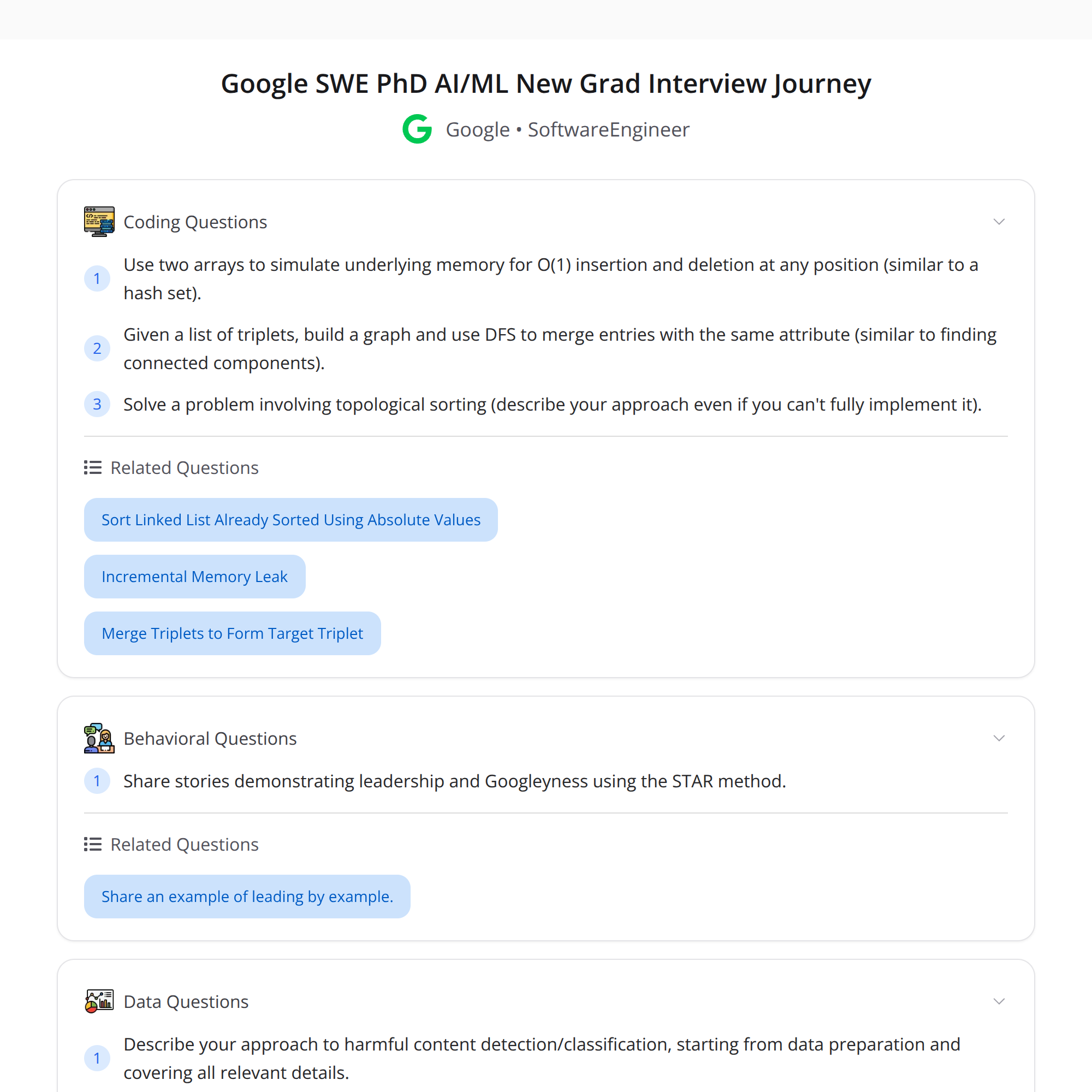
A PhD candidate (non-CS/ECE) who had a strong CV and GenAI research recently shared a detailed Google SWE (AI/ML) New Grad interview loop. The story is short, but the takeaways are sharp and highly actionable for anyone targeting similar roles.
The loop (what happened)
- Recruiter outreach → HR sync + mock interview
- Onsite: 2 coding rounds, 1 ML round, 1 behavioral (leadership) round
- After onsite: 2 extra coding rounds
Total: a fairly rigorous sequence with an emphasis on both ML fundamentals and classic SWE skills.
What helped this candidate succeed
- Research + CV: GenAI research and a polished CV opened the door and framed the candidate as an ML-focused SWE.
- ML fundamentals: Strong grounding in ML concepts mattered in the dedicated ML round.
- Leadership stories: Well-prepared leadership/behavioral stories made a real difference in the behavioral round.
What tripped people up (and what actually mattered most)
- Coding pacing: Running out of time was a common issue. Proper pacing and early testing of ideas helped score.
- Testing & correctness: Candidates who wrote quick tests or validated edge cases performed better.
- Reliance on hints: Interviewers will give nudges; leaning on hints too much hurts. Show independent reasoning first, accept hints to refine but not to drive the entire solution.
- Pattern disguise: Google rarely asks verbatim LeetCode problems. Expect disguised or combined patterns — focus on recognizing core patterns, not memorizing exact prompts.
Practical prep guidance (actionable plan)
Start early (a semester ahead) and carve focused weekly prep time. Suggested schedule for a semester (14–16 weeks):
- Weeks 1–4: ML fundamentals refresh (probability, linear algebra, optimization, model evaluation). Resources: Andrew Ng / Deep Learning Specialization, "Pattern Recognition and Machine Learning" (Bishop) overview, practical papers in your research area.
- Weeks 5–10: Coding + algorithms practice — 4–6 problems/week, alternating data structures (arrays, trees, graphs), DP, greedy, two pointers. Use LeetCode to learn patterns, not memorize prompts.
- Weeks 11–12: Systematic mock interviews (peer or professional) — focus on pacing, communication, and writing tests.
- Weeks 13–14: ML interview practice — whiteboard or shared doc walkthroughs of ML workflows, error analysis, trade-offs, model design choices.
- Final 1–2 weeks: Light problem solving, review leadership stories (STAR format), sleep and logistics.
Weekly time commitment (example):
- Coding practice: 6–8 hours
- ML fundamentals/practice: 4–6 hours
- Mock interviews & behavioral prep: 2–4 hours
Concrete interview tactics
- Clarify constraints first: input sizes, value ranges, memory/time bounds.
- Outline approach verbally before coding. Interviewers care about the plan.
- Start with a correct but simple solution; iterate to optimize.
- Test small examples and edge cases as you go — it demonstrates correctness checks.
- When hints appear, say how you would proceed without them, then incorporate the hint to refine.
- For ML questions: focus on evaluation metrics, failure modes, data issues, and practical trade-offs (latency, model complexity, data labeling cost).
- For behavioral: prepare 6–8 STAR-format stories covering leadership, conflict, impact, ambiguity.
Resources (shortlist)
- Algorithms & DS: LeetCode (pattern-based practice), "Elements of Programming Interviews" for structure.
- ML fundamentals: Andrew Ng (Coursera), CS231n notes, "Deep Learning" (Goodfellow), practical research papers in your area.
- Mock interviews: Pramp, Interviewing.io, peers/advisors.
TL;DR — Key takeaways
- ML fundamentals and clear leadership stories can make you stand out, especially for PhD/new-grad roles.
- Don’t rely on hints; use them only to refine. Demonstrate independent reasoning first.
- Google often disguises classic patterns — practice pattern recognition, not rote memorization.
- Start early (a semester ahead) and carve focused prep time for coding, ML, and mock interviews.
Good luck — focus on fundamentals, practice under time pressure, and polish your stories.
#SoftwareEngineering #MachineLearning #InterviewPrep
About the author
bugfree.ai is an advanced AI-powered platform designed to help software engineers master system design and behavioral interviews. Whether you’re preparing for your first interview or aiming to elevate your skills, bugfree.ai provides a robust toolkit tailored to your needs. Key Features:
150+ system design questions: Master challenges across all difficulty levels and problem types, including 30+ object-oriented design and 20+ machine learning design problems. Targeted practice: Sharpen your skills with focused exercises tailored to real-world interview scenarios. In-depth feedback: Get instant, detailed evaluations to refine your approach and level up your solutions. Expert guidance: Dive deep into walkthroughs of all system design solutions like design Twitter, TinyURL, and task schedulers. Learning materials: Access comprehensive guides, cheat sheets, and tutorials to deepen your understanding of system design concepts, from beginner to advanced. AI-powered mock interview: Practice in a realistic interview setting with AI-driven feedback to identify your strengths and areas for improvement.
bugfree.ai goes beyond traditional interview prep tools by combining a vast question library, detailed feedback, and interactive AI simulations. It’s the perfect platform to build confidence, hone your skills, and stand out in today’s competitive job market. Suitable for:
New graduates looking to crack their first system design interview. Experienced engineers seeking advanced practice and fine-tuning of skills. Career changers transitioning into technical roles with a need for structured learning and preparation.
Comments
Join the discussionNo comments yet. Be the first to comment.