
High-Score Interview Experience: Google ML SWE (PhD) Loop — What the Tough Follow-ups Really Test
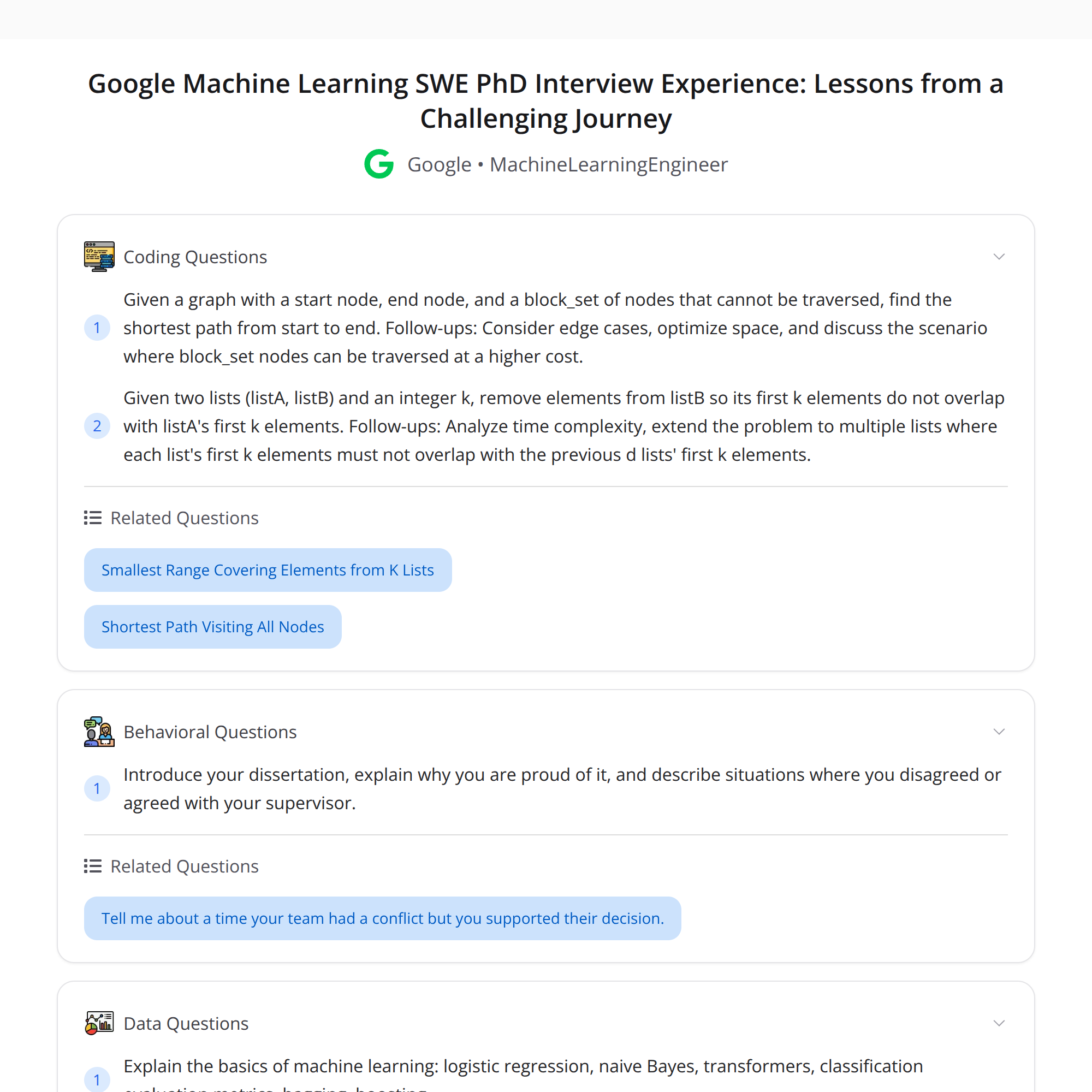
A candidate from a non-CS background shared a four-round Google ML SWE (PhD) loop experience from the Bugfree community. The loop covered ML fundamentals, behavioral questions focused on research impact, and two coding rounds where the immediate solution was straightforward but follow-ups made the problems substantially harder. Below is a concise breakdown, what each follow-up is testing, and practical tips to handle them.
Interview breakdown
ML fundamentals (theory)
- Topics covered: logistic regression, Naive Bayes, transformers, evaluation metrics, bagging vs boosting
- What they're testing: depth of foundational knowledge, ability to trade off models and metrics, and clarity about assumptions (e.g., independence in Naive Bayes, calibration vs discrimination in metrics).
Behavioral
- Focus: dissertation impact and handling disagreement with a supervisor
- What they're testing: ability to communicate research contributions succinctly, measurable impact, conflict resolution, intellectual independence, and collaboration style.
Coding — Round 1
- Prompt summary: shortest path with blocked nodes (initially a standard BFS)
- Follow-ups: space optimization; variant with higher traversal cost
- What follow-ups test:
- Space optimization: whether you can reduce memory footprint by trading off data structures or using in-place marking/bitmasks
- Higher traversal cost: whether you can generalize BFS to weighted graphs (Dijkstra or 0-1 BFS for limited integer costs)
Coding — Round 2
- Prompt summary: remove items from listB so the top-k selection doesn't overlap with listA
- Follow-ups: extend to multiple lists where an item must avoid appearing in the last d lists (i.e., "avoid last d lists" constraint)
- What follow-ups test:
- Handling de-duplication constraints efficiently across streams/lists
- Designing data structures (heaps + frequency maps, sliding windows, or indexed counters) to enforce recent-history constraints
Core lessons and interview strategy
- Solve the core problem fast and correctly. Interviewers expect a working baseline before asking follow-ups.
- Anticipate optimizations: after a correct solution, immediately analyze time/space complexity and mention where you'd optimize.
- When follow-ups arrive, verbalize trade-offs and pivot to the appropriate algorithm (e.g., BFS -> Dijkstra when costs appear).
- Write clean code, handle edge cases, and add a couple of quick tests (empty input, single-node, blocked-start/end, ties).
- For behavioral questions, frame your answers: context, action, measurable result, and what you learned.
Practical hints for the coding follow-ups
BFS with blocked nodes
- Baseline: BFS using a queue and a visited set; mark blocked nodes as impassable.
- Space optimization ideas:
- If the grid/list is mutable, mark visited in-place (overwrite) to avoid a separate visited set.
- Use bitsets (bit arrays) or compress coordinates into integers to reduce overhead.
- Higher traversal cost:
- Use Dijkstra for arbitrary positive weights (priority queue, O(E log V)).
- If weights are small integers (e.g., 0/1), use 0-1 BFS (deque) for O(V+E).
Removing items from listB so top-k doesn't overlap listA
- Baseline approach:
- Build a frequency map or set for listA.
- Iterate listB and collect candidates not in set(listA), then pick top-k using a heap.
- Multiple lists with "avoid last d lists":
- Maintain a sliding window of the last d lists as a frequency map or set of forbidden items.
- For each incoming list, filter out items present in the sliding window, update counts, and select top-k (or merge using a heap/priority queue).
- Performance tips:
- Use lazy deletion in heaps when removing stale/forbidden items.
- Use ordered containers only when you need top-k frequently; otherwise, collect and nth_element/select can be more efficient.
- Baseline approach:
High-level pseudocode sketches
BFS with blocked nodes (baseline):
function shortest_path(grid, start, end):
  if start blocked or end blocked: return -1
  queue = deque([(start, 0)])
  visited = set([start])
  while queue:
    node, dist = queue.popleft()
    if node == end: return dist
    for neighbor in neighbors(node):
      if neighbor not visited and not blocked:
        visited.add(neighbor)
        queue.append((neighbor, dist+1))
  return -1
If costs exist, replace BFS with Dijkstra (priority queue) or 0-1 BFS when weights are 0/1.
Top-k from listB avoiding listA (baseline):
for item in listB:
  if item not in set(listA):
    candidates.append(item)
return top_k(candidates)
For multiple lists with "avoid last d lists": maintain a rolling forbidden set (or map) of items from last d lists and update it as you advance.
Quick behavioral tips — dissertation impact & conflict with supervisor
- Dissertation impact: quantify (papers, citations, downstream systems), explain the problem, your method, and why it matters (clarity > breadth).
- Disagreement with supervisor: show empathy and structure: explain the technical disagreement, steps you took to validate your position (experiments, literature), compromise, and outcome.
Key takeaway
Get the correct core solution quickly, communicate complexity and edge cases, then systematically tackle follow-ups. Follow-ups often test your ability to generalize (weighted edges, recent-history constraints) and to optimize both time and space while keeping correctness.
Good luck — expect a straightforward core plus incremental, challenging variants.
#Tags
#MachineLearning #SoftwareEngineering #InterviewPrep
About the author
bugfree.ai is an advanced AI-powered platform designed to help software engineers master system design and behavioral interviews. Whether you’re preparing for your first interview or aiming to elevate your skills, bugfree.ai provides a robust toolkit tailored to your needs. Key Features:
150+ system design questions: Master challenges across all difficulty levels and problem types, including 30+ object-oriented design and 20+ machine learning design problems. Targeted practice: Sharpen your skills with focused exercises tailored to real-world interview scenarios. In-depth feedback: Get instant, detailed evaluations to refine your approach and level up your solutions. Expert guidance: Dive deep into walkthroughs of all system design solutions like design Twitter, TinyURL, and task schedulers. Learning materials: Access comprehensive guides, cheat sheets, and tutorials to deepen your understanding of system design concepts, from beginner to advanced. AI-powered mock interview: Practice in a realistic interview setting with AI-driven feedback to identify your strengths and areas for improvement.
bugfree.ai goes beyond traditional interview prep tools by combining a vast question library, detailed feedback, and interactive AI simulations. It’s the perfect platform to build confidence, hone your skills, and stand out in today’s competitive job market. Suitable for:
New graduates looking to crack their first system design interview. Experienced engineers seeking advanced practice and fine-tuning of skills. Career changers transitioning into technical roles with a need for structured learning and preparation.
Comments
Join the discussionNo comments yet. Be the first to comment.