High-Score (Bugfree Users) Interview Experience: Goldman Sachs Associate (2.3 YOE)
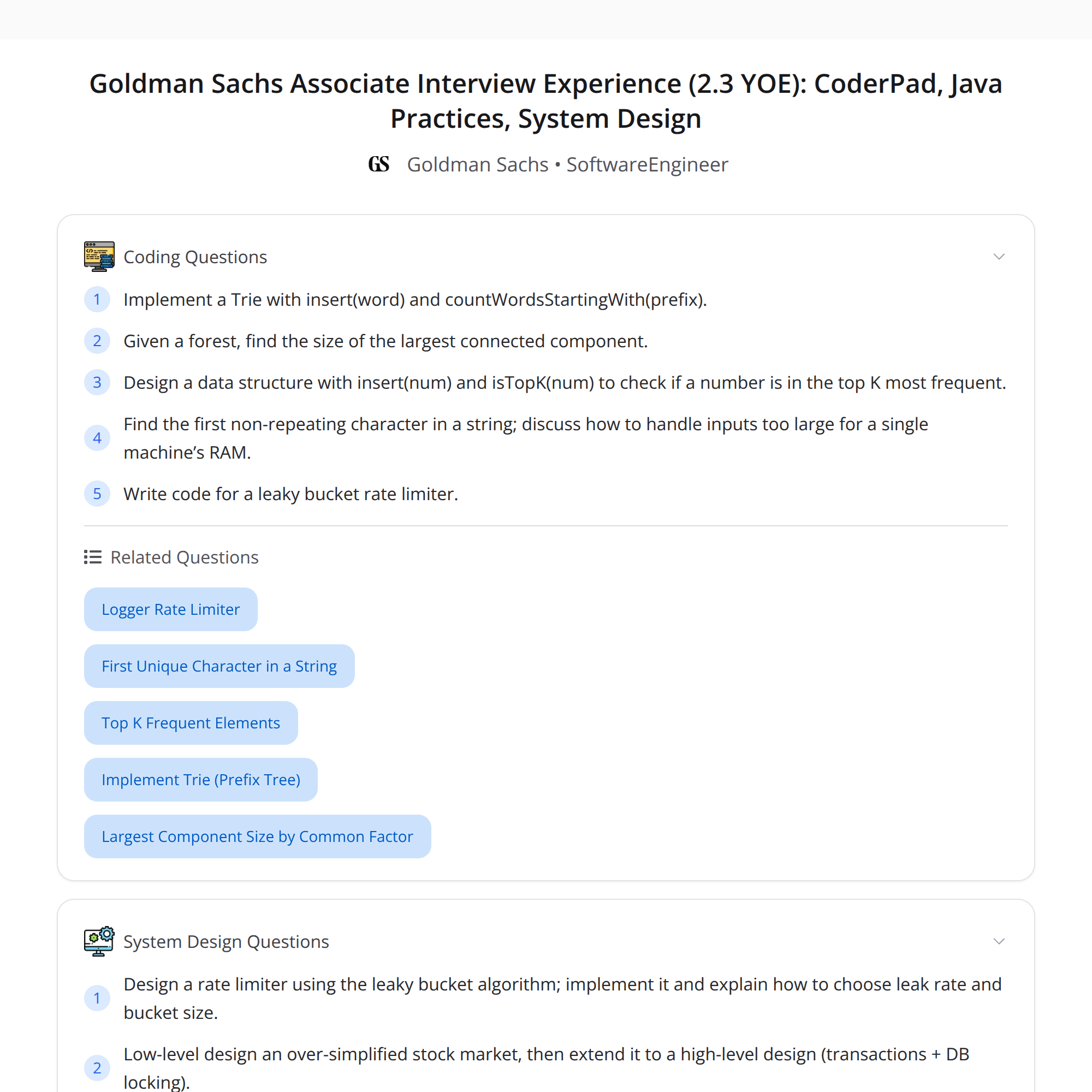
This is a concise, high-signal write-up of a successful Goldman Sachs Associate (2.3 years of experience) interview. The process included 2 live CoderPad rounds, 2 Java/SE practice rounds, and a system design interview. Below I summarize each stage, give problem breakdowns, key approaches, and practical tips.
Interview process (high level)
- 2x CoderPad problem rounds (algorithmic / data structure focus)
- 2x Java / Software Engineering rounds (language internals, debugging, design of small components)
- 1x System Design (start with low-level design for component, extend to HLD with transactions & DB locking)
CoderPad rounds — problems & how to approach them
1) Trie prefix counting
- Task: Build a Trie to support insert and count prefixes (how many words have a given prefix).
- Approach: Standard Trie node with a children map/array and a counter that increments on insertion; to count prefixes, traverse the prefix and return the count at the node.
- Complexity: Insert O(L), query O(L) where L is string length.
- Tip: Handle edge cases (empty string, uppercase vs lowercase) and choose array vs HashMap depending on alphabet size.
2) DSU / graph — largest connected component
- Task: Given pairs/edges, find the size of the largest connected component.
- Approach: Use Union-Find (DSU) with union by size/rank and path compression. Track component sizes in root array; after unions, find max size.
- Complexity: Almost O(α(n)) per op (effectively constant).
- Tip: Initialize DSU only for nodes that appear. If nodes are strings, map them to integers.
3) Top-K frequent structure (insert + isTopK)
- Task: Maintain a data structure that supports inserts of items and a query isTopK(item) telling whether item is in current top-K frequent elements.
- Approach: Combine a HashMap plus a min-heap (size K) that stores the top-K items by count. To support updates efficiently, either:
- Use a TreeSet (or balanced BST) keyed by (count, item) to both update and check ranking in O(log n), or
- Keep a min-heap and lazy-update entries with a map of current counts; when popping, verify entries are up-to-date.
- Complexity: O(log n) for updates in BST approach; heap approach gives amortized complexities but needs care.
- Tip: Be explicit about tie-breaking and how to keep the top-K structure consistent when counts change.
4) First non-repeating character, and scaling when data won’t fit RAM
- Task: Stream characters and return first non-repeating character at any time.
- In-memory approach: Use a doubly linked list + HashMap or an ordered map of counts + queue to track order of arrival. Keep counts in a byte/int map and nodes only for candidates with count == 1.
- Scaling when data won’t fit in RAM:
- Shard the stream by hashing characters/keys and send to multiple workers so each worker maintains its own counts for a subset. Merge by global ordering only when needed.
- Use external storage for counters (Redis, RocksDB) and keep a small in-memory LRU for hot items.
- Approximate approach: Use a Count-Min Sketch for frequencies; to approximate the first non-repeating, keep a small reservoir of recent candidates and verify with external store.
- Tip: Clarify accuracy requirements with the interviewer before proposing approximate solutions.
Java / Software Engineering (SE) rounds — topics & tips
1) Debug a Java snippet
- Expect to read code, find bugs (off-by-one, null checks, concurrency issues), and fix them. Talk through assumptions and test cases.
2) HashMap internals
- Be prepared to describe resizing, load factor, bucket structure (array of bins), handling collisions (treeify after threshold in newer JDKs), and complexity of get/put.
- Mention hashCode() quality and importance of equals() consistency.
3) Exception types
- Checked vs unchecked exceptions, when to use each, wrapping vs rethrowing, and best practices (don’t use exceptions for control flow; prefer informative messages).
4) Project deep dive
- Walk through a recent project: architecture, trade-offs, performance bottlenecks, and one bug and how you fixed it. Use metrics and concrete numbers where possible.
5) Leaky-bucket rate limiter (design & code + tuning)
- Task: Implement a leaky-bucket limiter that supports allowing or rejecting requests based on a fixed leak rate and bucket capacity.
- Approach (conceptual): Maintain currentTokens (or currentFill). For each request, compute elapsed time since last update and reduce currentFill by leakRate * elapsed; if currentFill + 1 <= capacity then accept and increment currentFill; else reject.
- Key parameters to tune: leakRate (requests per second) and bucketSize (burst capacity). Tune using expected QPS and allowable burst.
Simple Java sketch (pseudocode):
class LeakyBucket { final double leakRatePerSec; // tokens per second final double capacity; double currentFill = 0.0; long lastTimestampNano = System.nanoTime();
synchronized boolean allowRequest() { long now = System.nanoTime(); double elapsedSec = (now - lastTimestampNano) / 1e9; currentFill = Math.max(0.0, currentFill - elapsedSec * leakRatePerSec); lastTimestampNano = now; if (currentFill + 1.0 <= capacity) { currentFill += 1.0; return true; } return false; } }
Tuning examples:
- If steady QPS = 100 r/s and occasional bursts up to 500 for short intervals, set leakRate ~100 and capacity ~400 (allows bursts but drains back to 100 r/s steady state).
- For fairness across users, use a per-client bucket or token bucket with distributed counters (Redis) and TTLs.
Tip: Discuss thread-safety, clock resolution, distributed coordination (Redis/fixed windows vs sliding windows), and how to handle clock skew.
System Design — stock market LLD → HLD
1) Low-Level Design (LLD) for a stock market component
- Start small: design the order book for a single stock with limit and market orders.
- Key components: Order, OrderBook, MatchingEngine, Trade, and data structures to maintain bids/asks (two priority queues or TreeMaps: bids sorted descending by price, asks ascending).
- Matching logic: For each incoming order, match against the opposite side price levels until filled or no match. Emit trades and update order states.
- Edge cases: partial fills, cancelations, order modifications, and time-in-force (GTC, IOC, FOK).
2) High-Level Design (HLD) — scaling, transactions & DB locking
- Scale horizontally: shard by instrument symbol or by range of symbols. Each shard owns the order book for its symbols.
- Consistency: For a single symbol, keep matching in a single leader process to avoid conflicts (single-threaded matching is common in trading engines). Use replication for durability.
- Data persistence & transactions: Store orders/events in an append-only log (durable), and persist snapshots periodically. When using a relational DB, keep order states in rows and wrap multi-step updates in transactions to maintain atomicity.
- DB locking: Avoid long locks by keeping the matching critical section small. Prefer in-memory matching with durable write-ahead logs. If using DB for order state, use optimistic concurrency or row-level locks on order rows.
- Latency considerations: Aim for small critical path: network hop, serialization, matching, and I/O. Use binary protocols, minimal GC, and preallocated object pools.
Fault tolerance: Replicate leader to hot-standby, use leader election for failover, and ensure replayability of logs.
Tip: Clarify requirements first (e.g., peak orders/sec, consistency model, allowed latency), then sketch LLD for a single shard and extend to HLD for scale and durability.
Interview strategy & general tips
- Ask clarifying questions before coding or designing: input ranges, constraints, expected scale, and exact semantics.
- Talk through trade-offs: space vs time, accuracy vs performance, and single-node vs distributed solutions.
- For coding rounds: write clean, correct code first; then optimize. Run through simple test cases and edge cases out loud.
- For SE / Java rounds: be clear on threading, memory, and Java specifics. Give examples from real projects where you used similar patterns.
- For system design: anchor designs with numbers. Explain bottlenecks and how you would benchmark and improve performance.
Resources to practice
- CoderPad-style problems: LeetCode, HackerRank, and custom DSU/trie problems
- Java internals: "Java Concurrency in Practice", JDK source overview, and articles on HashMap internals
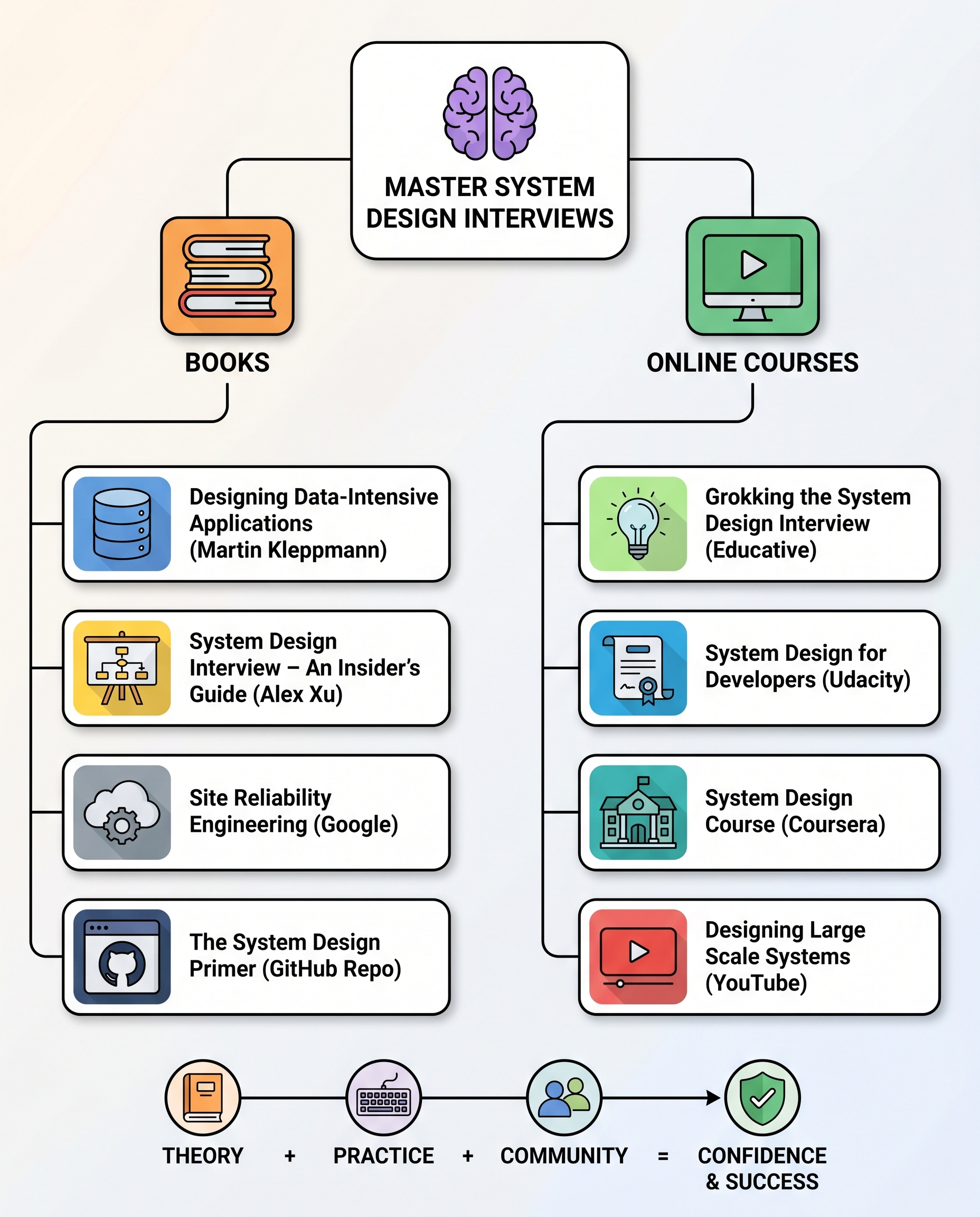
- Rate limiting & distributed systems: Redis-based token bucket tutorials, and "Designing Data-Intensive Applications" (Kleppmann)
- System design: Grokking the System Design Interview, real-world exchange architecture papers
If you want, I can:
- Expand any of the CoderPad problems into a full solution with runnable Java code,
- Provide a detailed LLD for the order book with sample APIs, or
- Create a checklist of Java internals questions and short model answers.
Good luck — practice with focused problems, clarify constraints during interviews, and communicate trade-offs clearly.
#SystemDesign #Java #InterviewPrep
About the author
bugfree.ai is an advanced AI-powered platform designed to help software engineers master system design and behavioral interviews. Whether you’re preparing for your first interview or aiming to elevate your skills, bugfree.ai provides a robust toolkit tailored to your needs. Key Features:
150+ system design questions: Master challenges across all difficulty levels and problem types, including 30+ object-oriented design and 20+ machine learning design problems. Targeted practice: Sharpen your skills with focused exercises tailored to real-world interview scenarios. In-depth feedback: Get instant, detailed evaluations to refine your approach and level up your solutions. Expert guidance: Dive deep into walkthroughs of all system design solutions like design Twitter, TinyURL, and task schedulers. Learning materials: Access comprehensive guides, cheat sheets, and tutorials to deepen your understanding of system design concepts, from beginner to advanced. AI-powered mock interview: Practice in a realistic interview setting with AI-driven feedback to identify your strengths and areas for improvement.
bugfree.ai goes beyond traditional interview prep tools by combining a vast question library, detailed feedback, and interactive AI simulations. It’s the perfect platform to build confidence, hone your skills, and stand out in today’s competitive job market. Suitable for:
New graduates looking to crack their first system design interview. Experienced engineers seeking advanced practice and fine-tuning of skills. Career changers transitioning into technical roles with a need for structured learning and preparation.
Comments
Join the discussionNo comments yet. Be the first to comment.