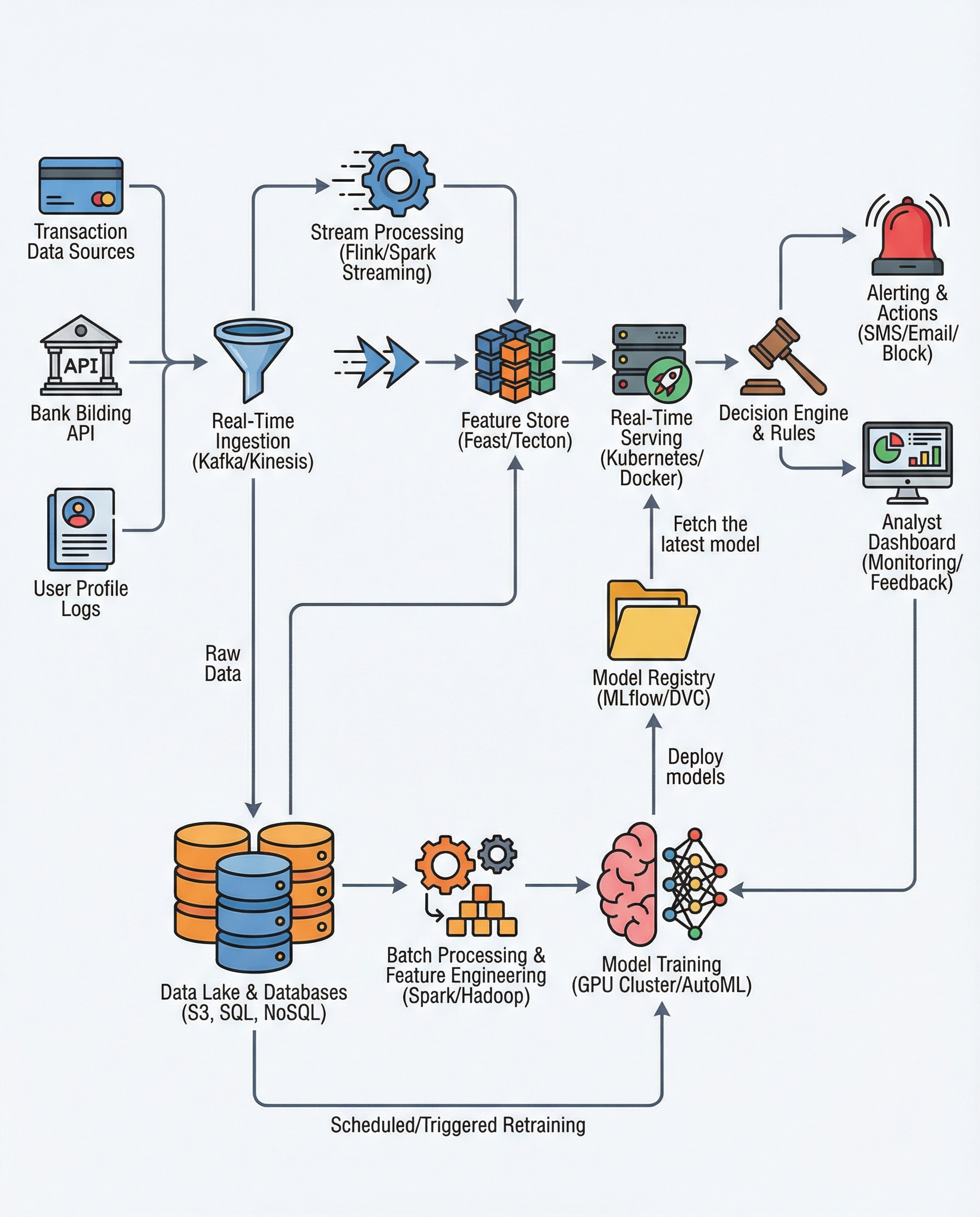
Stop handing ROC-AUC as the answer in fraud-detection interviews
In real-time fraud detection your data is heavily imbalanced: fraud is rare, legitimate transactions are common. That imbalance makes ROC-AUC a trap in interviews — it can look “good” even when your model misses most fraud.
Why ROC-AUC misleads
- ROC-AUC measures ranking quality using true positive rate vs false positive rate. When negatives dominate, small absolute changes in false positives barely move the false positive rate, so a model can score high AUC while still producing too many missed frauds or too many false alarms in absolute terms.
- ROC-AUC is threshold-independent and symmetric between classes. Fraud detection is not symmetric: the positive class (fraud) is what you must catch.
Lead with Precision/Recall and AUC-PR
- Precision/Recall focuses on the positive class. AUC-PR (area under the precision-recall curve) better reflects performance when positives are rare.
- Precision answers: “If I block or flag this transaction, how likely is it truly fraud?”
- Recall answers: “Of all frauds, how many did I catch?”
In interviews, state that you'll evaluate models with precision, recall, PR curve and AUC-PR. Mention complementary metrics like precision@k or lift if the business reviews only the top-scoring transactions.
Decision rule: pick a threshold based on business loss — not 0.5
Scores from a model are probabilities or relative ranks. The operational question is a business decision: what cutoff triggers a block, challenge, or manual review?
Choose the threshold that minimizes expected business loss:
Expected loss per transaction = (Cost_FN FN_rate) + (Cost_FP FP_rate)
- Cost_FN = expected cost of a missed fraud (chargeback, reimbursement, fraud spread, reputational loss)
- Cost_FP = expected cost of a false alarm (customer friction, lost conversion, manual review cost)
Tune the threshold on a validation set (temporal split) to minimize this expected loss. If chargebacks are expensive, tune for higher recall. If customer experience or conversion is critical, tune for higher precision.
Example (illustrative):
- Chargeback cost = $200 (Cost_FN)
- Manual review cost = $10 (Cost_FP)
- If threshold A yields FN_rate=0.001 and FP_rate=0.01 → Expected loss = 2000.001 + 100.01 = 0.2 + 0.1 = $0.30 per tx
- If threshold B is more conservative with FN_rate=0.0005 and FP_rate=0.02 → Loss = 2000.0005 + 100.02 = 0.1 + 0.2 = $0.30 per tx Both thresholds have the same expected loss; pick the one that aligns with operational constraints (review capacity, UX tolerance).
Practical interview talking points
- State your preferred metrics up front: precision, recall, PR curve, AUC-PR, precision@k, and business loss.
- Explain how you’ll choose thresholds using a cost-based objective and show a simple expected-cost calculation.
- Show calibration and score distributions; a well-calibrated score makes thresholding more interpretable.
- Use time-based validation (train on past, validate on future) and sample the rare positives correctly.
- Present confusion matrix and precision/recall at the chosen threshold — numbers matter in interviews.
Additional tips and alternatives
- If you only have capacity to investigate the top N alerts, use precision@N or lift.
- For continuous decisions (e.g., dynamic review policies), consider optimizing for expected utility across segments.
- When communicating to product/stakeholders, translate model metrics into business KPIs: chargebacks avoided, review cost, or conversion impact.
In short: in fraud settings, lead with precision/recall and AUC-PR, then pick a threshold from a business-loss perspective. That shows you understand both the ML and the real-world trade-offs.
#MachineLearning #DataScience #MLOps
About the author
bugfree.ai is an advanced AI-powered platform designed to help software engineers master system design and behavioral interviews. Whether you’re preparing for your first interview or aiming to elevate your skills, bugfree.ai provides a robust toolkit tailored to your needs. Key Features:
150+ system design questions: Master challenges across all difficulty levels and problem types, including 30+ object-oriented design and 20+ machine learning design problems. Targeted practice: Sharpen your skills with focused exercises tailored to real-world interview scenarios. In-depth feedback: Get instant, detailed evaluations to refine your approach and level up your solutions. Expert guidance: Dive deep into walkthroughs of all system design solutions like design Twitter, TinyURL, and task schedulers. Learning materials: Access comprehensive guides, cheat sheets, and tutorials to deepen your understanding of system design concepts, from beginner to advanced. AI-powered mock interview: Practice in a realistic interview setting with AI-driven feedback to identify your strengths and areas for improvement.
bugfree.ai goes beyond traditional interview prep tools by combining a vast question library, detailed feedback, and interactive AI simulations. It’s the perfect platform to build confidence, hone your skills, and stand out in today’s competitive job market. Suitable for:
New graduates looking to crack their first system design interview. Experienced engineers seeking advanced practice and fine-tuning of skills. Career changers transitioning into technical roles with a need for structured learning and preparation.
Comments
Join the discussionNo comments yet. Be the first to comment.