Feature Engineering in Interviews: Say This, Not That
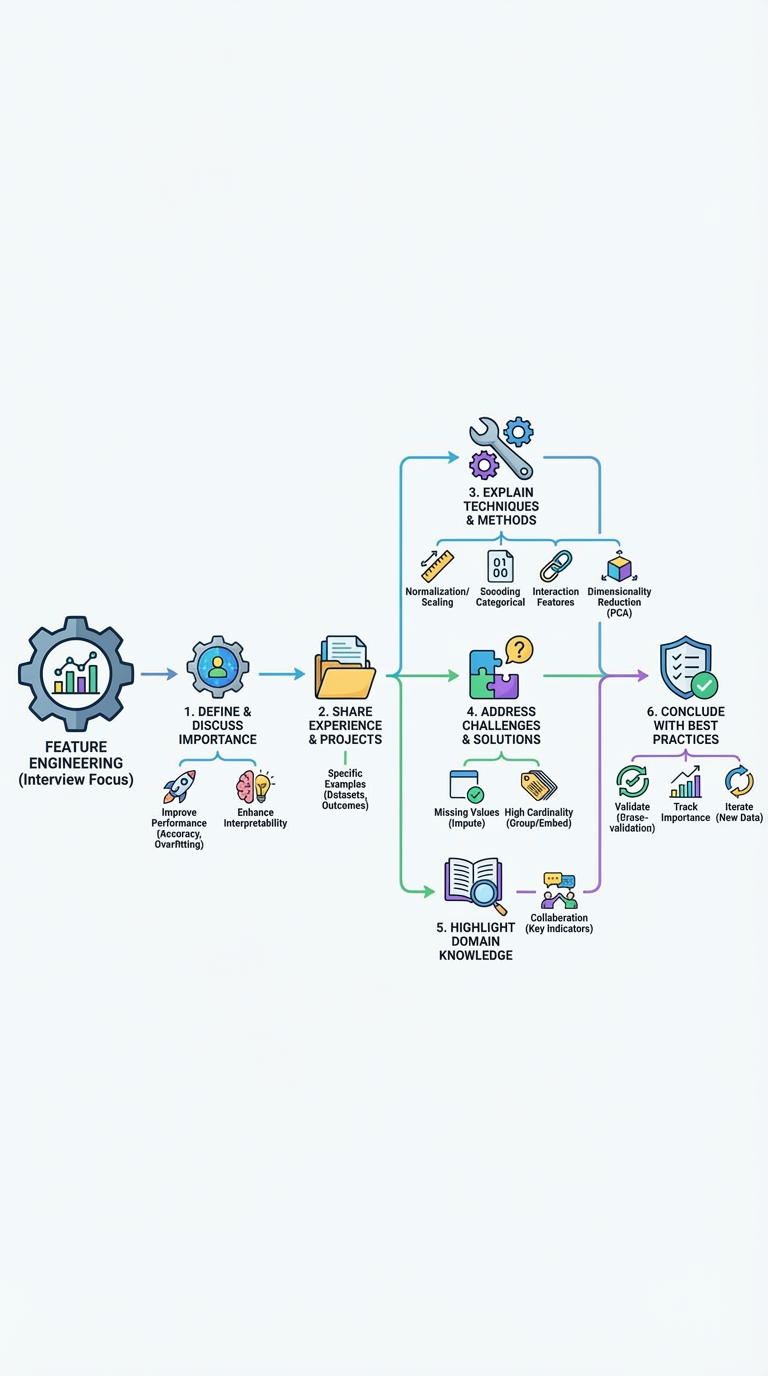
Feature engineering is often where models win or lose. In interviews you should both define it crisply and prove you can deliver impact. Below is a compact, interview-friendly guide: a clear definition, a one-project story template, the core techniques to discuss, common pitfalls with concrete fixes, and a short checklist of things to say (and avoid).
Quick definition to say
Feature engineering = using domain knowledge and data understanding to select, transform, or create input variables that help a model learn better. Emphasize that it's about improving signal-to-noise for the learner, not arbitrary transformations.
Example phrasing: “I use domain knowledge and exploratory analysis to design features that expose predictive signal, then validate their impact with cross-validated metrics.”
One-project story template (data → features → metric lift)
Interviewers want a concise example that proves impact. Use this template and keep it to 2–3 sentences:
- Context: what data and problem (1 sentence).
- What you did: key feature(s) engineered and why (1 sentence).
- Impact: metric lift and how you validated it (1 sentence).
Example:
- Context: “On a churn problem for a subscription product I had user activity logs and billing data.”
- What I did: “I engineered rolling activity statistics (7/30/90-day counts), time-since-last-active, and an interaction between plan-type and feature-usage rate to capture engagement trends.”
- Impact: “These features improved AUC by 0.03 in stratified cross-validation and reduced calibration error; they were retained by model-based feature importance and increased early-detection recall by 8% in a holdout.”
Keep numbers precise and state that you used CV/holdout to rule out leakage.
Core techniques to be ready to explain
- Scaling: why and when to standardize or normalize (e.g., distance-based models, gradient-based optimization).
- Categorical encoding: one-hot, target/mean encoding, ordinal mapping — trade-offs in bias and leakage risk.
- Interaction features: pairwise or domain-driven interactions to expose non-linear relationships for linear models.
- Aggregations/time windows: rolling stats, counts, rates for temporal data.
- Date/time features: day-of-week, hour, time-since-event to capture temporal patterns.
- Dimensionality reduction (PCA, SVD): when features are many, noisy, and you need compact decorrelated inputs (state when you’d avoid it).
If asked, explain why you chose a technique and how you validated it.
Common challenges and realistic fixes
- Missing values: don’t just drop rows. Impute sensibly (mean/median for numeric if missing-at-random; indicator variables when missing itself is informative; domain-specific fills). Validate by comparing distributions and model performance.
- Leakage: define leakage, give an example (using future data or labels-derived aggregates), and explain the prevention: feature windows aligned with prediction time, strict train/validation splits, and backtesting for time series.
- High-cardinality categoricals: options include target/mean encoding with regularization and CV to avoid leakage, hashing, or frequency-based grouping (top-K + other).
- Multicollinearity / redundancy: detect with correlation or VIF; prune, aggregate, or use regularized models.
Always mention how you detect the issue (EDA, feature importance, validation) and how you confirmed the fix (CV or holdout).
Collaboration and best practices to highlight
- Domain collaboration: say you partnered with product/ops to surface useful signals and validate feature definitions.
- Validation: emphasize cross-validation or forward-chaining for temporal problems; always use holdouts for the final check.
- Experimentation: track A/B or uplift when features change user-facing behavior.
- Monitoring: once in production, monitor feature distributions and model performance for drift.
- Reproducibility: version features (feature store or notebook + pipeline), log transformations, and keep tests for feature generation.
Short “Say this, not that” cheat-sheet
Say this:
- “I design features from domain knowledge, validate via CV, and measure uplift on a holdout.”
- “I use target encoding with K-fold regularization for high-cardinality columns and check for leakage.”
- “I track feature importance and monitor feature drift in production.”
Don’t say this:
- “I just feed everything to a tree model and let it figure out features.” (OK for some baselines, but explain why you still engineered features.)
- “I used future data accidentally.” (Admit mistakes if asked, but explain detection and fix.)
- “I don’t validate features separately.” (Always show validation method.)
Final interview checklist (30–60 seconds to walk through)
- Define feature engineering in one sentence.
- State one project with: dataset → feature(s) → metric lift (with validation method).
- Name 3 core techniques you used and why.
- Describe one real problem you solved (leakage, missing data, or high-cardinality) and your fix.
- Mention collaboration, reproducibility, and monitoring.
Wrap up by reinforcing that strong feature work is measured: not by clever transforms alone but by reproducible, validated metric improvements.
#MachineLearning #DataScience #MLOps
About the author
bugfree.ai is an advanced AI-powered platform designed to help software engineers master system design and behavioral interviews. Whether you’re preparing for your first interview or aiming to elevate your skills, bugfree.ai provides a robust toolkit tailored to your needs. Key Features:
150+ system design questions: Master challenges across all difficulty levels and problem types, including 30+ object-oriented design and 20+ machine learning design problems. Targeted practice: Sharpen your skills with focused exercises tailored to real-world interview scenarios. In-depth feedback: Get instant, detailed evaluations to refine your approach and level up your solutions. Expert guidance: Dive deep into walkthroughs of all system design solutions like design Twitter, TinyURL, and task schedulers. Learning materials: Access comprehensive guides, cheat sheets, and tutorials to deepen your understanding of system design concepts, from beginner to advanced. AI-powered mock interview: Practice in a realistic interview setting with AI-driven feedback to identify your strengths and areas for improvement.
bugfree.ai goes beyond traditional interview prep tools by combining a vast question library, detailed feedback, and interactive AI simulations. It’s the perfect platform to build confidence, hone your skills, and stand out in today’s competitive job market. Suitable for:
New graduates looking to crack their first system design interview. Experienced engineers seeking advanced practice and fine-tuning of skills. Career changers transitioning into technical roles with a need for structured learning and preparation.
Comments
Join the discussionNo comments yet. Be the first to comment.