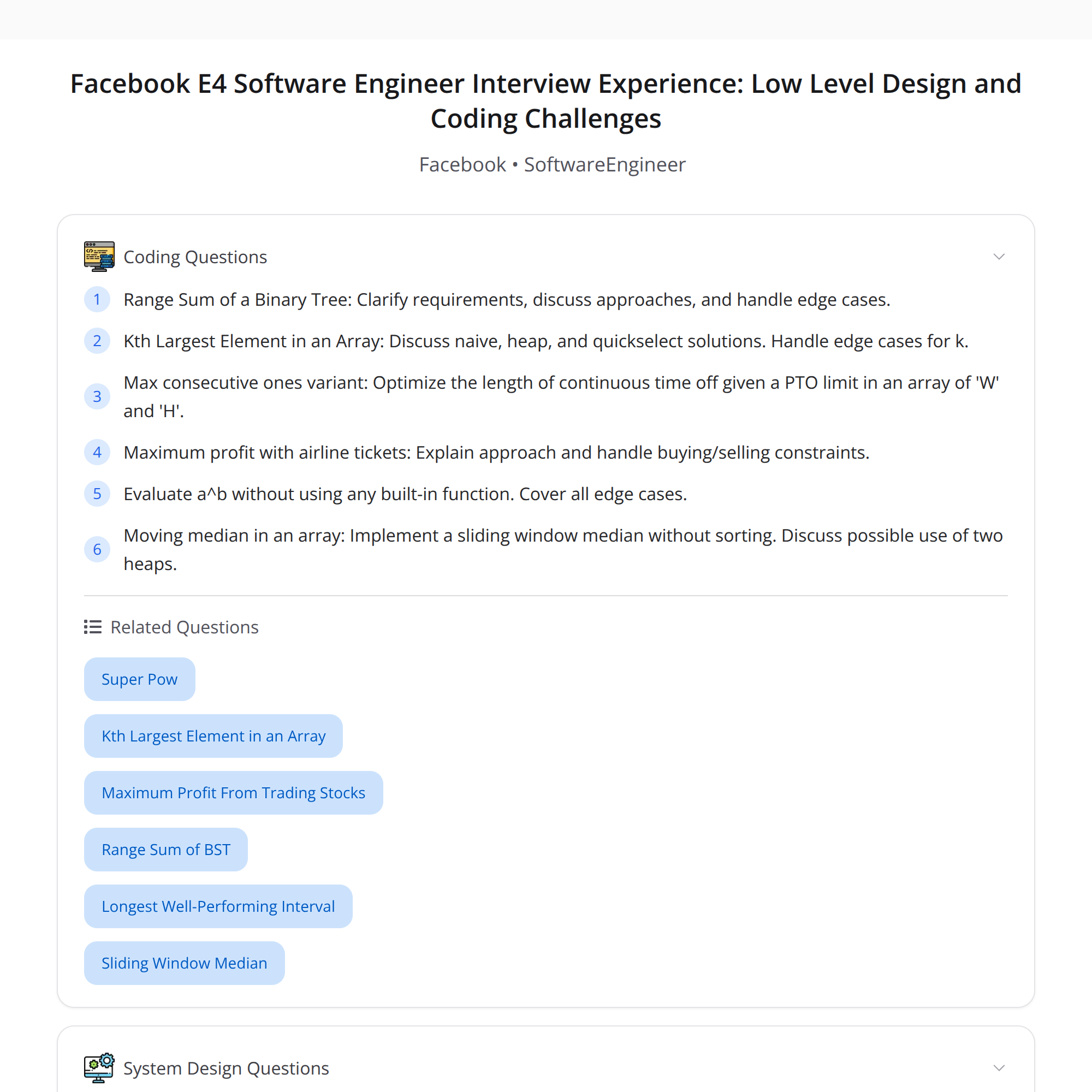
A high-score Facebook E4 Software Engineer interview recap from a "Bugfree users" candidate — focused on what worked across coding, low-level/system design, and behavioral rounds.
Overview
This interview had multiple back-to-back rounds: coding, low-level/system design (LLD), and behavioral. The candidate stood out by clarifying requirements, calling out edge cases, narrating trade-offs, and staying calm after small mistakes. The News Feed design discussion highlighted scalability, consistency, and UX trade-offs. Behavioral rounds were conversational and centered on handling challenges.
Below are distilled lessons, concrete tactics, and short examples you can use to prepare.
Round-by-round lessons
Coding
- Clarify assumptions immediately: ask about input sizes, data types, allowed complexity, and required behavior on invalid inputs.
- Example: “Do we expect negative numbers or duplicates? What’s the input size limit — should I target O(n) or is O(n log n) fine?”
- Call out edge cases before coding: empty inputs, single-element arrays, very large numbers, ties in ranking, etc.
- Narrate trade-offs as you design a solution: explain why you pick a greedy, DP, or divide-and-conquer approach.
- Recover gracefully from hiccups: if you overcomplicate a problem or pick the wrong index, pause, state the issue, propose a simpler approach, and continue.
- Example recovery line: “I realize this indexing is making the solution complex. I’ll simplify by converting to a 0-based index and re-evaluating the loop invariant.”
- Write clear, testable steps: outline approach, pseudocode, then code. Test with a couple of hand examples, including edge cases.
Common interview mistakes to avoid:
- Starting to code without confirming input constraints.
- Ignoring off-by-one and boundary conditions.
- Not explaining why one approach is preferred.
Low-Level / System Design (News Feed example)
- Start by defining scope and requirements: functional (post creation, retrieval, feed ranking, pagination) and non-functional (throughput, latency, consistency, storage, SLA).
- Propose a high-level architecture: ingestion, storage, ranking, cache, API layer.
- Discuss scale and trade-offs explicitly:
- Fan-out on write vs fan-out on read: fan-out-on-write (push) reduces read latency but increases write complexity; fan-out-on-read (pull) simplifies writes but can cause higher read latency for heavy users.
- Consistency vs freshness: eventual consistency scales well but might show slightly stale feeds; strong consistency increases coordination and latency.
- Ranking: offline batch ranking vs online signals. Consider hybrid approaches (precompute heavy signals, compute recency online).
- Talk about storage and indexing: timeline sharding, denormalized user timelines, TTL for old posts, secondary indices for efficient queries.
- Caching and throttling: edge caches for hot timelines, rate limiting for abusive read patterns.
- UX considerations: infinite scroll pagination, how to handle duplicates or missing items, pull-to-refresh for freshness.
Quick checklist for LLD interviews:
- Ask traffic estimates and SLAs.
- Choose storage/data model and justify it.
- Explain how you’ll handle scale (sharding, batching, async processing).
- Call out failure modes and mitigation (retries, backpressure, data loss scenarios).
Behavioral
- Keep it conversational and use the STAR framework (Situation, Task, Action, Result) concisely.
- Focus on concrete outcomes and what you learned.
- For challenge/failure questions, highlight the recovery and what you would do differently.
- Be ready to discuss trade-offs made in previous designs or code and why you accepted them.
Useful behavioral lines:
- “When we hit X, I first checked Y, then did Z to reduce risk. The outcome was A and taught me B.”
- “I prioritized features based on user impact and technical risk by…"
Practical takeaways and prep tips
- Treat each round independently: reset mentally between rounds, don’t let a mistake in one round affect the next.
- Communicate clearly: narrate your thought process, call out assumptions, and summarize decisions.
- Stay calm and structured after mistakes: acknowledge, simplify, and move forward.
- Practice mock interviews that simulate consecutive rounds to build stamina and mental resets.
Quick prep checklist:
- Practice clarifying questions and edge case enumeration.
- Work system design problems with explicit trade-off discussions.
- Rehearse concise STAR stories for behavioral rounds.
- Do timed coding practice with explanation aloud.
Final note
This candidate’s success hinged less on flawless answers and more on clarity, calm, and clear trade-offs. If you do the same — ask the right questions, call out edge cases, explain trade-offs, and recover smoothly when things go sideways — you’ll be well positioned for high-score interviews.
#SoftwareEngineering #SystemDesign #InterviewPrep
About the author
bugfree.ai is an advanced AI-powered platform designed to help software engineers master system design and behavioral interviews. Whether you’re preparing for your first interview or aiming to elevate your skills, bugfree.ai provides a robust toolkit tailored to your needs. Key Features:
150+ system design questions: Master challenges across all difficulty levels and problem types, including 30+ object-oriented design and 20+ machine learning design problems. Targeted practice: Sharpen your skills with focused exercises tailored to real-world interview scenarios. In-depth feedback: Get instant, detailed evaluations to refine your approach and level up your solutions. Expert guidance: Dive deep into walkthroughs of all system design solutions like design Twitter, TinyURL, and task schedulers. Learning materials: Access comprehensive guides, cheat sheets, and tutorials to deepen your understanding of system design concepts, from beginner to advanced. AI-powered mock interview: Practice in a realistic interview setting with AI-driven feedback to identify your strengths and areas for improvement.
bugfree.ai goes beyond traditional interview prep tools by combining a vast question library, detailed feedback, and interactive AI simulations. It’s the perfect platform to build confidence, hone your skills, and stand out in today’s competitive job market. Suitable for:
New graduates looking to crack their first system design interview. Experienced engineers seeking advanced practice and fine-tuning of skills. Career changers transitioning into technical roles with a need for structured learning and preparation.
Comments
Join the discussionNo comments yet. Be the first to comment.