Dropbox Design Interviews: Why Chunked Upload Is Non‑Negotiable
In a production file-storage system, chunked upload is not an "optimization" — it's the reliability contract. When networks are flaky, chunking turns a full restart into a resume-from-last-success. If you can't explain this flow crisply in a system-design interview, you're not ready.
The core idea
- Split large files into chunks.
- Upload each chunk independently with a checksum.
- Allow retries per chunk and make chunk upload idempotent.
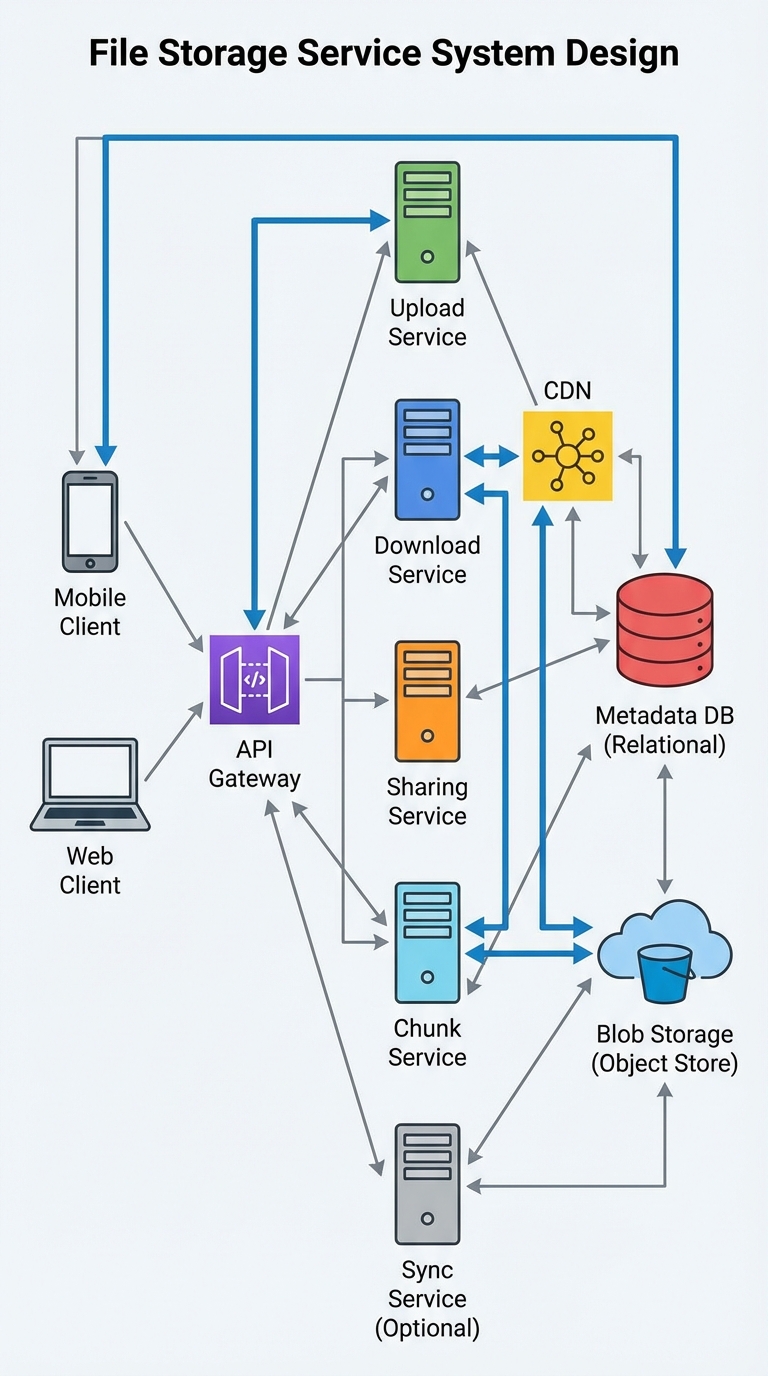
- Keep an ordered manifest in metadata; store the actual chunks immutably in blob storage.
This transforms a brittle transfer into a robust, resumable process.
Recommended API flow
- initiate-upload (returns upload_id, chunk size, auth token)
- upload-chunk (upload_id, chunk_index, data, checksum) — idempotent
- complete-upload (upload_id) — verify manifest and seal the file
Why this matters:
- upload-chunk must accept retries without corrupting state. Either overwrite the same immutable chunk or use content-addressed storage and record the reference.
- Checksums (per chunk) detect corruption and avoid replaying invalid data.
- The client can parallelize chunk uploads and retry only failed chunks.
Storage model
- Metadata DB: stores upload session state and the ordered list of chunk references (manifest). This is the single source of truth for ordering and assembly.
- Blob storage: stores immutable chunk objects (ideally content-addressed). Immutable chunks make retries, dedup, and verification straightforward.
On complete-upload, the server verifies the manifest, optionally composes chunks into a final object (or serves the file by streaming chunks in order), and marks the upload finished.
Important properties to call out in an interview
- Idempotency: upload-chunk must be idempotent so retries don't create inconsistent state.
- Integrity: checksums per chunk (and optionally an overall checksum) ensure bit-exact reconstruction.
- Resume capability: the client should be able to query which chunks succeeded and continue from the next failed chunk.
- Parallelism: independent chunk uploads allow faster transfers and better utilization of bandwidth.
- Security & auth: short-lived upload tokens and per-request auth minimize abuse surface.
- Garbage collection: abandoned uploads need TTL and cleanup of orphaned chunks.
Edge cases and implementation notes
- Duplicate chunks: if using content-addressed storage dedupe duplicates naturally; otherwise replace consistently.
- Reordering: the manifest records chunk indices; assembly ignores upload order.
- Partial fails during complete-upload: treat complete as a final transaction — verify all chunks first, then flip state.
- Large scale: use multi-part manifests sharded by range if manifests grow huge.
Quick interview checklist
- Describe initiate → upload-chunk → complete flow clearly.
- Explain per-chunk checksum, idempotency, and retry behavior.
- Mention where ordering and immutability live (metadata DB vs blob store).
- Call out GC, auth, and how to resume/parallelize uploads.
Chunked uploads are not a "nice to have." They are the fundamental reliability pattern for robust file storage. If you can explain the flow end-to-end and justify each design choice, you’ll demonstrate the system-thinking interviewers are looking for.
#SystemDesign #CloudComputing #SoftwareEngineering
About the author
bugfree.ai is an advanced AI-powered platform designed to help software engineers master system design and behavioral interviews. Whether you’re preparing for your first interview or aiming to elevate your skills, bugfree.ai provides a robust toolkit tailored to your needs. Key Features:
150+ system design questions: Master challenges across all difficulty levels and problem types, including 30+ object-oriented design and 20+ machine learning design problems. Targeted practice: Sharpen your skills with focused exercises tailored to real-world interview scenarios. In-depth feedback: Get instant, detailed evaluations to refine your approach and level up your solutions. Expert guidance: Dive deep into walkthroughs of all system design solutions like design Twitter, TinyURL, and task schedulers. Learning materials: Access comprehensive guides, cheat sheets, and tutorials to deepen your understanding of system design concepts, from beginner to advanced. AI-powered mock interview: Practice in a realistic interview setting with AI-driven feedback to identify your strengths and areas for improvement.
bugfree.ai goes beyond traditional interview prep tools by combining a vast question library, detailed feedback, and interactive AI simulations. It’s the perfect platform to build confidence, hone your skills, and stand out in today’s competitive job market. Suitable for:
New graduates looking to crack their first system design interview. Experienced engineers seeking advanced practice and fine-tuning of skills. Career changers transitioning into technical roles with a need for structured learning and preparation.
Comments
Join the discussionNo comments yet. Be the first to comment.