High-Score DoorDash SWE Interview Experience (Bugfree Users)
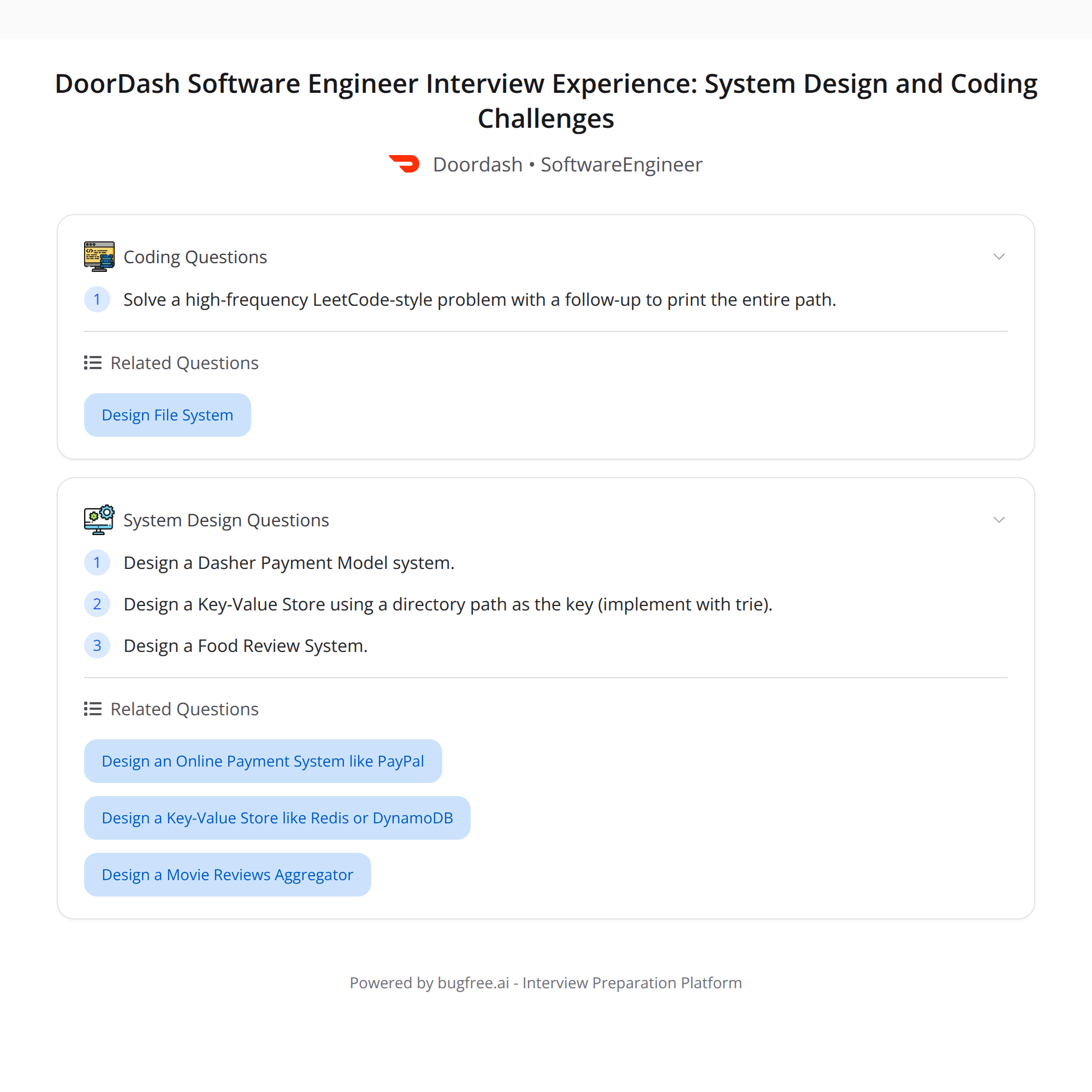
This DoorDash Software Engineer interview report from Bugfree users combines a practical system-design round with focused LeetCode-style coding problems. It’s a balanced loop between high-level architecture thinking and detail-oriented algorithmic implementation — a useful blueprint for anyone preparing for SWE interviews at product companies.
Quick Summary
- Format: System design + multiple coding problems.
- System design focus: real-world components such as a scalable file system and a flexible menu tree (data modeling, storage/retrieval efficiency, scalability, and edge cases).
- Coding focus: LeetCode-style problems including:
- Trie (Prefix Tree) implementation
- Koko Eating Bananas (binary-search-on-answer)
- Shortest Distance from All Buildings (multi-source BFS / accumulation)
- Max tree path sum restricted to "alive" nodes (tree DP / DFS)
- Overall impression: Challenging but fair; emphasizes clean logic, correctness, and time/space optimization.
System Design Round — What Was Covered
The system design part emphasized designing components you would actually ship. Key topics and expectations included:
Scalable file system:
- Data modeling: how files, directories, metadata are represented.
- Storage and retrieval efficiency: indexing, partitioning, and how to quickly look up and stream large files.
- Scalability: sharding strategies, horizontal scaling, and capacity planning.
- Fault tolerance and consistency: replication, leader/follower choices, and trade-offs between availability and consistency.
Flexible menu tree (typical for food-delivery apps):
- Modeling hierarchical menu items, variants, and pricing rules.
- Efficient reads for high-traffic paths (e.g., caching menu structure, CDN for images).
- Updates and propagation: how to roll out menu changes without downtime and how to handle localization/versioning.
Cross-cutting considerations:
- API design and client contracts
- Caching and cache invalidation strategies
- Monitoring, observability, and SLO/SLI thinking
- Edge cases: permissions, large-scale migrations, network partitions, and partial failures
Interviewers expected clear trade-off discussions, capacity estimates, and concrete choices (e.g., when to pick eventual vs. strong consistency, what indices to add, and how to partition data).
Coding Round — Problems & Approaches
These coding questions mirrored common LeetCode problems. Below are concise notes on each problem and the typical efficient approach.
1) Trie (Prefix Tree)
- Goal: implement insert, search, and startsWith (prefix) operations.
- Approach: node class with a fixed-size children array or a hashmap, boolean isEnd flag.
- Complexity: insert/search O(L) where L is word length; space depends on total characters stored.
- Interview tips: discuss memory vs. speed trade-offs (array vs. hash map), and support for delete or frequency counts if asked.
2) Koko Eating Bananas
- Problem class: search-on-answer using binary search on time or rate.
- Approach: binary search over minutes/per-banana speed and simulate whether Koko can finish within the candidate time (greedy accumulation).
- Complexity: O(n log M) where M is range of speeds/answer space and n is number of piles.
- Interview tips: explain correctness of binary search bounds and off-by-one decisions.
3) Shortest Distance from All Buildings (multi-source BFS variant)
- Typical goal: find a grid cell minimizing sum of distances to all buildings.
- Approach: run BFS from each building, accumulate distances and reach counts in arrays; filter unreachable cells.
- Complexity: O(k m n) where k is number of buildings; optimize by early pruning and reusing visited arrays carefully.
- Interview tips: explain why BFS from buildings (not from empty cells) is more efficient in this problem and how to detect unreachable situations.
4) Max Tree Path Sum from Alive Nodes (tree DP)
- Problem gist: compute maximum path sum considering only nodes marked "alive" (skip dead nodes or treat them as blockers).
- Approach: DFS that returns the best downward path from a node; combine two best child contributions to update global max path. If node is dead, it contributes zero or blocks paths depending on exact problem constraints.
- Complexity: O(n) time and O(height) recursion stack.
- Interview tips: discuss base cases for dead nodes and how to handle negative values or all-dead subtrees.
Across these problems, interviewers looked for clean logic, clear time/space complexity analysis, and correct edge-case handling.
What Interviewers Care About
- Correctness & edge cases: empty inputs, single-node trees, unreachable/invalid states.
- Time & space complexity: justify algorithmic choices and trade-offs.
- Clean, maintainable code: clear variable names, modular helper functions, and concise recursion/iteration.
- System design trade-offs: explain scalability, reliability, and monitoring decisions rather than only describing components.
Preparation Blueprint (How to Use This Report)
- Practice the exact problem types: Trie, binary-search-on-answer, BFS grid accumulation, and tree DP.
- Mock design interview: design a small distributed component (menu service or file store) and practice capacity estimates and failure modes.
- Strengthen fundamentals: data structures (trees, graphs, tries), algorithms (BFS/DFS, binary search), and complexity analysis.
- Talk through trade-offs: during system design, say why you choose caching, sharding, or eventual consistency.
- Time management: for coding rounds, aim to produce a working solution first, then optimize and handle edge cases.
Quick Study Checklist
- Trie: insert/search/startsWith, memory optimizations
- Binary search on answer: setting bounds and simulation checks
- Multi-source BFS: distance accumulation and unreachable detection
- Tree DP: combining child paths and handling blockers/dead nodes
- System design: data modeling, API surface, scaling strategies, caching, and monitoring
Final Thoughts
This DoorDash interview example is a strong representation of what modern SWE interviews expect: a mix of practical system-design thinking and solid algorithmic coding. It’s challenging but fair — a great blueprint for focused prep.
Good luck, and build mock interviews around these exact themes to close the loop between design intuition and coding precision.
About the author
bugfree.ai is an advanced AI-powered platform designed to help software engineers master system design and behavioral interviews. Whether you’re preparing for your first interview or aiming to elevate your skills, bugfree.ai provides a robust toolkit tailored to your needs. Key Features:
150+ system design questions: Master challenges across all difficulty levels and problem types, including 30+ object-oriented design and 20+ machine learning design problems. Targeted practice: Sharpen your skills with focused exercises tailored to real-world interview scenarios. In-depth feedback: Get instant, detailed evaluations to refine your approach and level up your solutions. Expert guidance: Dive deep into walkthroughs of all system design solutions like design Twitter, TinyURL, and task schedulers. Learning materials: Access comprehensive guides, cheat sheets, and tutorials to deepen your understanding of system design concepts, from beginner to advanced. AI-powered mock interview: Practice in a realistic interview setting with AI-driven feedback to identify your strengths and areas for improvement.
bugfree.ai goes beyond traditional interview prep tools by combining a vast question library, detailed feedback, and interactive AI simulations. It’s the perfect platform to build confidence, hone your skills, and stand out in today’s competitive job market. Suitable for:
New graduates looking to crack their first system design interview. Experienced engineers seeking advanced practice and fine-tuning of skills. Career changers transitioning into technical roles with a need for structured learning and preparation.
Comments
Join the discussionNo comments yet. Be the first to comment.