High-Score DoorDash SWE Interview Experience (Bugfree User)
A Bugfree community user shared a high-score DoorDash SWE interview loop with clear, actionable takeaways. This recap highlights the major rounds, the important design trade-offs, and practical tips to help you prepare better.
Quick highlights
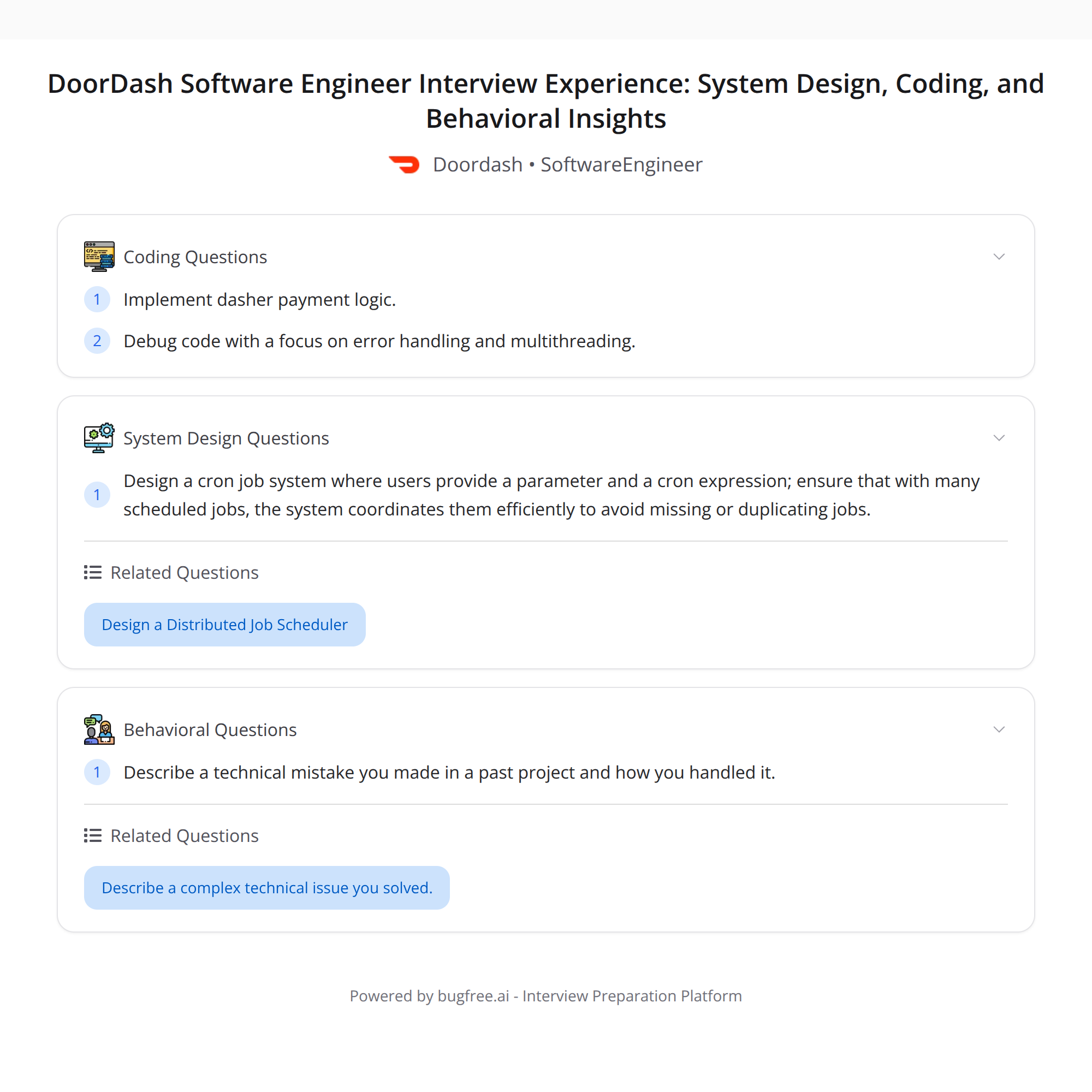
- System design: build a cron-job platform where users submit parameters + cron expressions. The challenge: coordinate at scale so scheduled jobs run exactly once (no misses, no duplicates).
- Coding: a “dasher payments” style problem — finished confidently after handling edge cases.
- Debugging: focused on error handling and multithreading — straightforward but required careful thinking about race conditions.
- Behavioral: asked to explain a technical mistake. Owning a design flaw and clearly explaining remediation mattered — one red flag can outweigh strong performance elsewhere.
Key lesson: every round matters. Interviewer dynamics and how you handle a hard prompt or a mistake can change the outcome.
System design: Cron platform (deep dive)
The system-design round was the crux. The prompt: design a cron-job platform that accepts cron expressions + parameters, and guarantees coordination so jobs run exactly once at the scheduled times (no misses, no duplicates). Here are the major considerations, trade-offs, and a sample architecture.
Clarifying questions to ask first
- Expected scale: jobs/sec, number of distinct cron jobs, average run-time, payload size.
- Latency/SLAs: how strict is "on time"? (tolerances for jitter)
- Failure model: what happens if a job fails? retry policy? external side effects idempotent?
- Multi-region support and clock synchronization expectations.
- Are cron expressions dynamic (users can update/delete jobs)?
Asking these early helps scope the design and surface prep gaps.
Core requirements and constraints
- Exactly-once execution across a distributed cluster.
- Fault tolerance to node crashes, network partitions, and clock skew.
- Scalability to millions of jobs and bursts at schedule boundary times.
- Efficient storage and retrieval of next-run times.
High-level architecture
- Persistent job store: store job metadata (cron expression, params, owner, next-run timestamp, retry policy) in a durable, strongly-consistent store (e.g., Spanner/Cockroach/primary DB or a partitioned RDBMS).
- Scheduler service(s): a lightweight service that computes next-run times and writes them to the job store.
- Worker executors: consume jobs due for execution and run them.
- Coordination layer: ensure only one executor runs a given job at a scheduled time. Options:
- Lease-based approach: executors attempt to acquire a distributed lease for a job (via DB compare-and-set, ZooKeeper, etcd). If lease acquired, executor runs job and renews heartbeat.
- Sharding by job id: partition jobs by consistent hashing so that only workers responsible for a shard will execute jobs in that shard. Then ensure shard ownership via leader election.
- Queue + visibility window: push scheduled runs into a durable queue (Kafka/Rabbit/SQS). Consumers use an at-least-once model, with idempotent job handlers or dedup keys to achieve effectively-once behavior.
Exactly-once strategies and trade-offs
- Strong coordination: achieve true exactly-once by ensuring a single authoritative coordinator per job-run (e.g., leader per job partition). This is simpler conceptually but requires robust leader election and rebalancing.
- At-least-once + idempotency: simpler to scale and more robust to partial failures. Require idempotent operations or deduplication keys stored in the DB to ignore duplicates.
- Lease + heartbeat: good middle ground. A worker acquires a lease (with TTL) via the DB or a KV store; if it holds the lease, it runs the job. If the worker dies, the lease auto-expires and another worker can pick it up after a safety window. Watch out for clock skew and lease TTL tuning.
Operational details to design
- Next-run scheduling: compute the next-run timestamp deterministically when a job is created/finished. Store sorted indexes for efficient scanning.
- Scale: use time-bucketed scanning (e.g., workers claim all jobs in the next N seconds via a partitioned query) to avoid hotspots.
- Failures and retries: persisted run state, retries with backoff, poison-queue handling, dead-letter topics.
- Clock sync and drift mitigation: rely on NTP and build tolerance into scheduling (e.g., small safety window). Consider epoch-based logical clocks for ordering if needed.
- Testing: simulate node failures, network partitions, clock skew, and burst loads.
Communication and interview tips for this prompt
- Quantify assumptions (how many jobs, what latency). Interviewers often probe your answers based on these numbers.
- Discuss failure scenarios explicitly and how the system recovers.
- Explain your trade-offs: why choose leases vs. queue+idempotency vs. partition leader.
- If pressed on "exactly once," admit practical constraints and propose a pragmatic plan (e.g., aim for at-least-once with strict idempotency guarantees, or use a single authoritative coordinator per partition for true exactly-once).
Coding: "Dasher payments" problem
The coding round was described as a classic "dasher payments" problem — likely computing payouts or splitting earnings with constraints.
Tips that helped here:
- Clarify input sizes and numeric ranges (watch for overflow).
- Identify edge cases up front (zero deliveries, ties, rounding rules, negative fees).
- Outline algorithm and complexity before coding.
- Write a few quick unit tests or examples to validate logic.
The candidate reported finishing confidently after handling edge cases and communicating the approach clearly.
Debugging: multithreading & error handling
This round focused on debugging concurrent code and solid error handling. Common pitfalls and how to handle them:
- Race conditions: identify shared mutable state and protect it using locks, atomic ops, or thread-safe data structures.
- Deadlocks: avoid nested locks; prefer lock ordering or try-lock with fallback.
- Visibility issues: ensure proper memory barriers or use concurrent collections.
- Error propagation: surface errors clearly and avoid swallowing exceptions silently.
- Reproducible tests: add stress tests that flip thread scheduling to expose races.
The candidate solved the debugging tasks by systematically reasoning about the shared state and ensuring thread-safety.
Behavioral: owning a mistake matters
A behavioral round asked the candidate to explain a technical mistake. The interviewer looked for:
- Clear description of the mistake and root cause (not just symptoms).
- Ownership: what the candidate did to fix it and how they prevented it from happening again.
- Impact assessment and communication: who was affected and how they informed stakeholders.
Important note: a single red flag (e.g., minimizing a serious mistake or failing to learn from it) can outweigh strong technical rounds. Be candid, show learning, and propose concrete mitigations.
Final takeaways and preparation checklist
- Every round counts: a weak behavioral answer can hurt even after strong technical rounds.
- For system design: always clarify scale and failure modes. Explain trade-offs and be explicit about where you’d accept practical compromises.
- For coding: clarify assumptions, handle edge cases, and test small examples.
- For debugging: think about concurrency hazards and make fixes that are both correct and explainable.
- For behavioral: own mistakes, explain root cause, remediation, and monitoring/guardrails put in place.
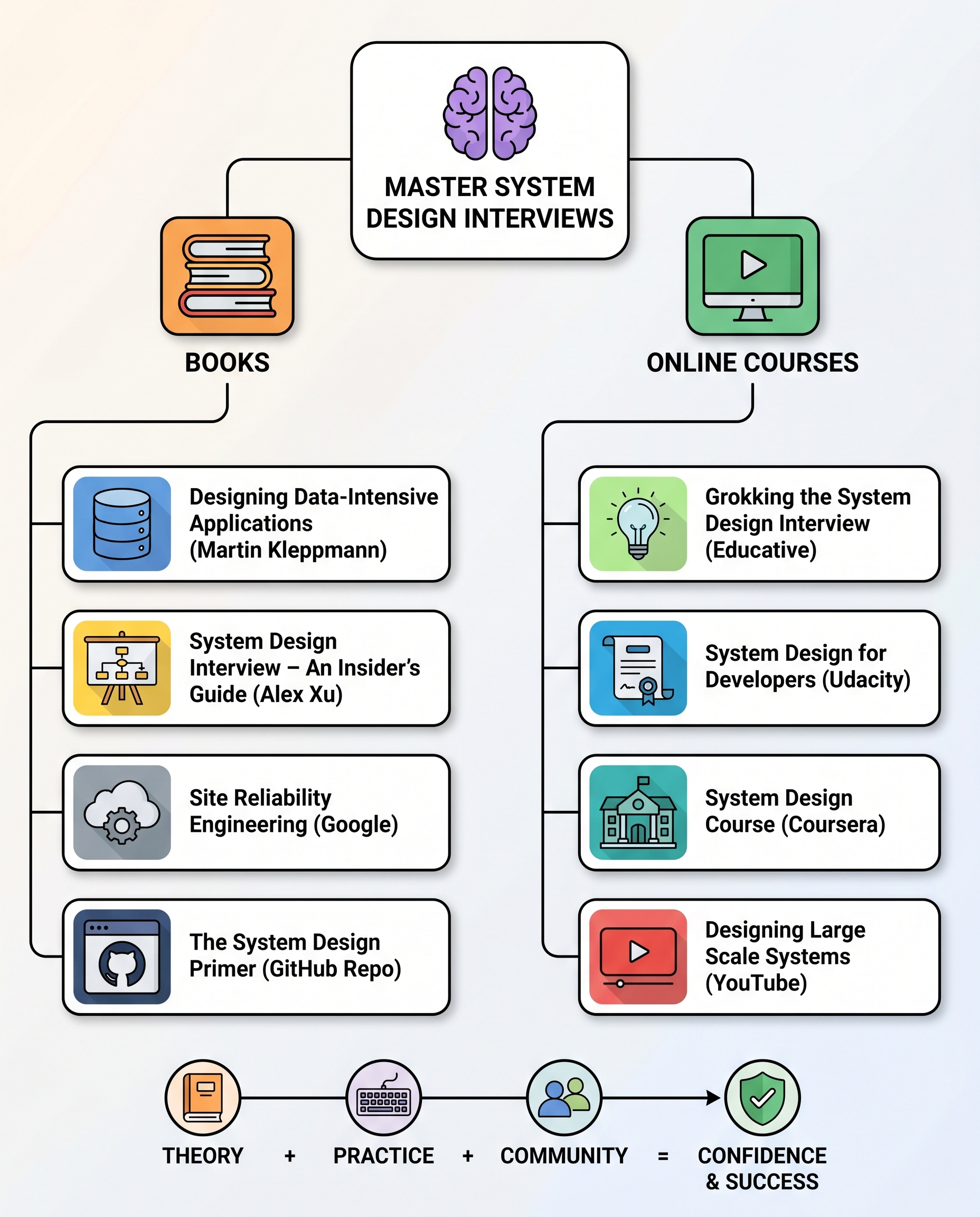
Suggested practice resources:
- System design: "Designing Data-Intensive Applications" (Martin Kleppmann), and real-world system design prompts.
- Distributed coordination: read about leases, ZooKeeper, etcd, and leader-election patterns.
- Concurrency: "Java Concurrency in Practice" or equivalent material for your platform.
- Mock interviews: practice clarifying questions and failure scenarios out loud.
Got an interview story of your own or want a mock question for the cron system? I can generate practice prompts and a checklist tailored to your experience level.
#SystemDesign #SoftwareEngineering #InterviewPrep
About the author
bugfree.ai is an advanced AI-powered platform designed to help software engineers master system design and behavioral interviews. Whether you’re preparing for your first interview or aiming to elevate your skills, bugfree.ai provides a robust toolkit tailored to your needs. Key Features:
150+ system design questions: Master challenges across all difficulty levels and problem types, including 30+ object-oriented design and 20+ machine learning design problems. Targeted practice: Sharpen your skills with focused exercises tailored to real-world interview scenarios. In-depth feedback: Get instant, detailed evaluations to refine your approach and level up your solutions. Expert guidance: Dive deep into walkthroughs of all system design solutions like design Twitter, TinyURL, and task schedulers. Learning materials: Access comprehensive guides, cheat sheets, and tutorials to deepen your understanding of system design concepts, from beginner to advanced. AI-powered mock interview: Practice in a realistic interview setting with AI-driven feedback to identify your strengths and areas for improvement.
bugfree.ai goes beyond traditional interview prep tools by combining a vast question library, detailed feedback, and interactive AI simulations. It’s the perfect platform to build confidence, hone your skills, and stand out in today’s competitive job market. Suitable for:
New graduates looking to crack their first system design interview. Experienced engineers seeking advanced practice and fine-tuning of skills. Career changers transitioning into technical roles with a need for structured learning and preparation.
Comments
Join the discussionNo comments yet. Be the first to comment.