High-Score (Bugfree Users) DoorDash SWE Interview — Coding + VO Deep Dive
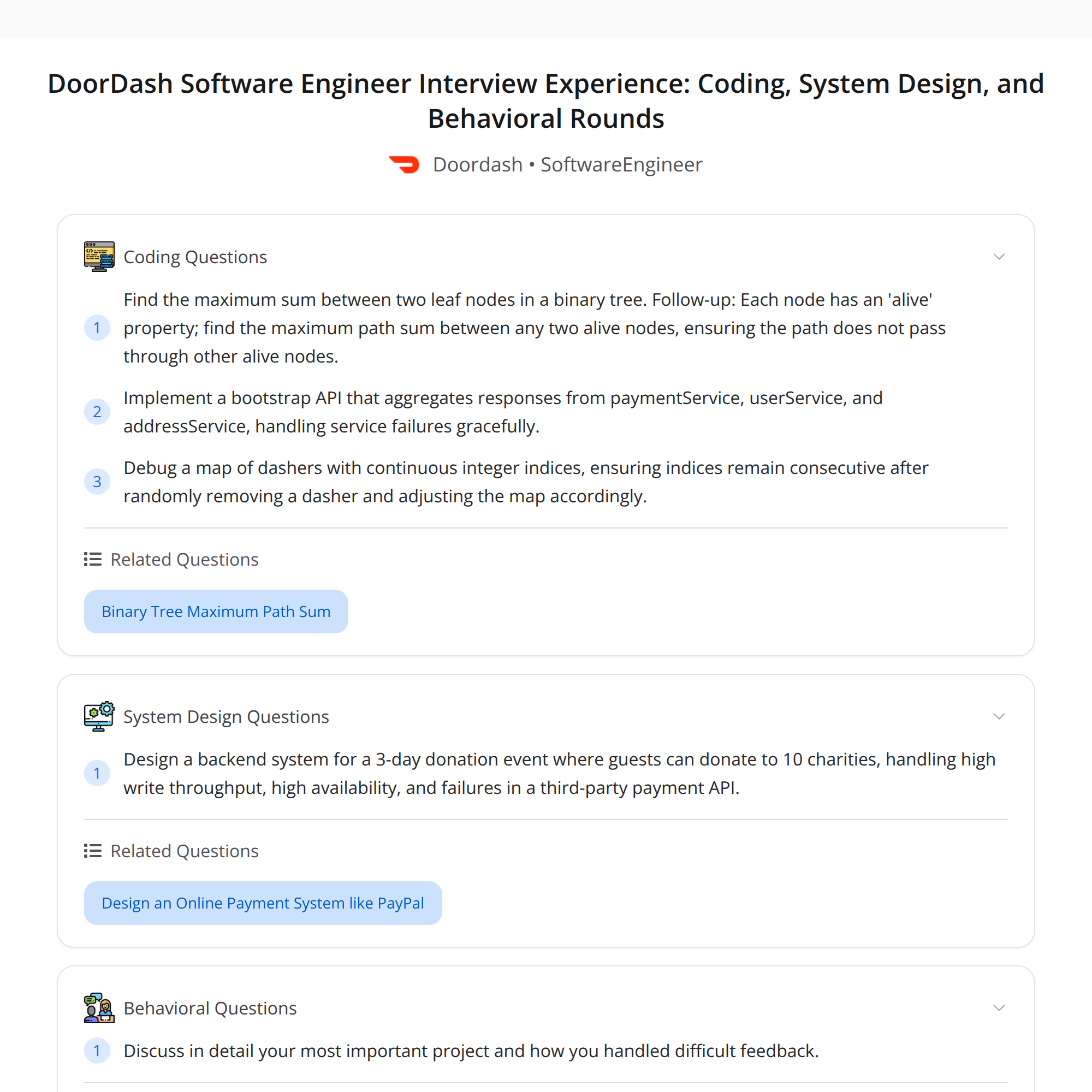
This post distills a high-scoring DoorDash SWE loop reported by Bugfree users. The loop combined solid fundamentals with real-world engineering: an online coding problem and follow-ups, a voice-of-code (VO) API design/craft question, debugging and concurrency scenarios, a high-write system design, and behavioral discussions on ownership and feedback.
Below you'll find the problems, suggested approaches, practical notes, and interview tips.
Highlights (at a glance)
- Online Coding: Max path sum between two leaf nodes in a binary tree (DFS + global max). Follow-up: max sum between alive nodes without passing through another alive node.
- VO Code Craft: Design a bootstrap/aggregate API that composes payment/user/address services; handle 500s via timeouts, retries, fallbacks and clear exception strategy.
- Debugging: Keep continuous indices in a dasher map after random removals; discuss thread safety and handling async remote failures.
- System Design: Design a high-write, highly available donation event; archive failed 3rd-party payments for offline processing and perform end-of-event aggregation.
- Behavioral: Demonstrate deep project ownership and handle tough feedback conversations.
1) Online Coding: Max path sum between two leaf nodes
Problem summary:
- Given a binary tree with numeric values, compute the maximum sum path between two leaf nodes.
Core approach:
- Use a post-order DFS that returns the maximum root-to-leaf sum for each subtree.
- Maintain a global maximum answer. For a node with both left and right children, consider left_max + node.val + right_max as a candidate for the global max.
- Edge cases: if the tree doesn't have two leaves (e.g., a single node), handle accordingly.
Pseudocode (conceptual):
- DFS(node):
- if node is null: return -inf
- left = DFS(node.left)
- right = DFS(node.right)
- if node.left and node.right exist:
- global_max = max(global_max, left + node.val + right)
- return node.val + max(left, right)
Follow-up: "alive" nodes only; compute max sum between alive nodes without passing through another alive node
Interpretation and approach:
- Treat "alive" nodes as endpoints for allowed paths. You want the max-sum path that starts and ends at alive nodes and does not have an alive node strictly inside the path.
- Modify DFS to return the maximum path sum from the current node down to the nearest alive node in its subtree (or -inf if none).
- When combining children at node u:
- If both children can reach alive nodes, candidate = left + u.val + right, update global.
- If u itself is alive, when returning upward, return u.val (you cannot propagate a path through an alive node—alive nodes terminate propagation).
- Otherwise, return u.val + max(left, right).
Key tip: carefully handle propagation and termination: an alive node is an endpoint, not a pass-through.
Interview tips:
- State assumptions (what constitutes a leaf, or how "alive" is defined).
- Handle nulls and one-child nodes explicitly.
- Describe runtime O(N) with O(H) recursion stack and why this is optimal.
2) VO Code Craft: Aggregating a Bootstrap API (payments / users / address)
Scenario:
- Build an API that aggregates data from payment, user, and address services to produce a bootstrapped payload for a client.
- Services may return 500s or be flaky.
Design goals:
- Fast responses for the happy path.
- Resilience to downstream failures.
- Clear semantics for partial data and retries.
Practical approach and patterns:
- API contract: return a composite object with fields for user, payment, address, and a metadata block indicating which subservices succeeded/failed and any timestamps.
- Timeouts: use conservative timeouts for each downstream call to avoid cascading delays.
- Parallel calls: call services in parallel to reduce tail latency.
- Fallbacks and defaults: decide sensible defaults for non-critical fields; for critical fields fail fast with meaningful error codes.
- Retries: use limited retries with exponential backoff and jitter. Prefer client-side idempotency keys for retries where writes are involved.
- Circuit breaker: protect the aggregator from repeatedly calling failing services.
- Partial responses: return partial data + a status object so the client can decide if a retry or degraded mode is acceptable.
- Observability: log latencies, error rates, and include trace IDs in responses.
Exception strategy (example):
- If payments fail with 5xx: mark payments as unavailable in the response, return user + address. Enqueue a background job to retry or schedule reconciliation.
- If auth/user fails: prefer failing the request if user is required; otherwise return partial with clear error metadata.
Example response shape (conceptual):
- { user: {...} | null, payments: {...} | null, address: {...} | null, services: {user: ok|err, payments: ok|err, address: ok|err}, traceId }
Interview tips:
- Discuss trade-offs clearly: availability vs correctness, stale vs blocking, client expectations.
- Mention library-level concerns (timeouts, pools, async vs thread-per-request).
3) Debugging: Continuous indices in a dasher map after random removals
Problem statement:
- You have a map/array of dashers with integer indices 0..N-1. Dashers can be removed at random; you must maintain continuous indices (no gaps) while keeping constant-time removal.
Efficient approach:
- Use an array + index map + swap-with-last trick:
- Maintain an array of dashers.
- Maintain a hashmap from dasherId -> index in array.
- To remove dasher X: find idx = map[X]; swap array[idx] with array[last]; update map for the swapped element; pop last; delete map[X]. This gives O(1) removals and preserves a contiguous array.
Concurrency and thread safety:
- If multiple threads can remove/insert concurrently, protect shared state with fine-grained locks or use concurrent data structures.
- Consider optimistic concurrency with CAS (compare-and-swap) if you need lock-free behavior, or use a single writer + multiple readers pattern (e.g., copy-on-write reads) if reads dominate.
- Ensure updates to both array and index-map are atomic from the caller's perspective; group changes in a critical section.
Handling async remote failures:
- If removals happen as a result of remote events (e.g., a dasher unregisters over the network), design idempotent remove operations and retries.
- If a remote failure causes inconsistent state, reconcile periodically: run a background compaction that rebuilds the array+map from authoritative state.
Interview tips:
- Explain correctness (no gaps, O(1) remove) and thread-safety choices.
- If asked for a lock-free solution, outline trade-offs and complexity—lock-free is possible but harder and often unnecessary.
4) System Design: High-write, highly available donation event
Requirements sketch:
- Accept a very high rate of donation writes during an event (spikes).
- Ensure availability even if 3rd-party payment provider is flaky.
- Support end-of-event aggregation/leaderboard and reconciliation for failed payments.
Architecture recommendations:
- Front the system with an API gateway and autoscaled stateless ingestion tier.
- Use a fast durable write log (e.g., Kafka or Dynamo streams) to absorb spikes; producers ACK once the event is durably logged.
- Decouple acceptance from payment settlement:
- Accept donations by writing an accepted event to the log and returning an ephemeral success to the user.
- Worker processes perform actual payment processing against 3rd-party providers asynchronously.
- Failure handling for 3rd-party payments:
- If payment provider fails, persist the donation event to a durable dead-letter/archive queue with metadata and retry attempts.
- Implement exponential backoff retries and escalation (human ops / manual reconciliation) for long-failed items.
- End-of-event aggregation:
- Maintain a streaming pipeline that aggregates accepted events into intermediate sharded aggregates (per donor, per region, per campaign).
- At event end, finalize aggregates by replaying the log or using snapshots to compute consistent results.
Data model and idempotency:
- Use globally unique donation IDs and idempotency keys so retries do not create duplicates.
- Store eventual settlement state separately from accepted events (accepted vs settled vs failed).
Scaling & consistency:
- Partition events by campaign or donor hash to scale write throughput.
- Prefer eventual consistency: accept and display provisional numbers; finalize after settlement.
Observability & ops:
- Expose metrics for ingestion rate, payment success rate, DLQ size.
- Provide dashboards and tooling for retrying archived payments and reconciling funds.
Interview tips:
- Explain trade-offs: immediate consistency vs availability; why a write-log + async processing improves availability during spikes.
- Mention how you'd test disaster scenarios (payment provider down, partial region outage, hot partitions).
5) Behavioral: Ownership & Tough Feedback
Focus points interviewers look for:
- Examples where you took end-to-end ownership (scoping, delivery, production support, and follow-through).
- How you respond to and implement tough feedback: show humility, concrete changes you made, and outcomes.
STAR-focused answer structure:
- Situation: Context for the project/feedback.
- Task: What was expected of you.
- Action: What you changed/implemented (technical and interpersonal).
- Result: Measured improvement and lessons learned.
Interview tips:
- Be specific about what you owned and the measurable outcomes.
- When describing feedback, emphasize learning and concrete steps taken.
Key takeaways & interview tips
- For coding: explain assumptions, walk through examples, cover edge cases, and state complexity. For tree DFS problems, clearly describe what gets propagated vs what gets aggregated.
- For VO/API design: design for partial failure, observability, retries, and clear client contracts.
- For debugging/concurrency: describe data structures, atomicity of updates, and reconciliation strategies.
- For system design: decouple acceptance from settlement with durable logs, use idempotency, and plan robust DLQ/retry strategies.
- For behavioral: use STAR, own the narrative, and be specific about outcomes.
Good luck if you're preparing for DoorDash or similar SWE interviews — solid fundamentals plus pragmatic system thinking win interviews.
About the author
bugfree.ai is an advanced AI-powered platform designed to help software engineers master system design and behavioral interviews. Whether you’re preparing for your first interview or aiming to elevate your skills, bugfree.ai provides a robust toolkit tailored to your needs. Key Features:
150+ system design questions: Master challenges across all difficulty levels and problem types, including 30+ object-oriented design and 20+ machine learning design problems. Targeted practice: Sharpen your skills with focused exercises tailored to real-world interview scenarios. In-depth feedback: Get instant, detailed evaluations to refine your approach and level up your solutions. Expert guidance: Dive deep into walkthroughs of all system design solutions like design Twitter, TinyURL, and task schedulers. Learning materials: Access comprehensive guides, cheat sheets, and tutorials to deepen your understanding of system design concepts, from beginner to advanced. AI-powered mock interview: Practice in a realistic interview setting with AI-driven feedback to identify your strengths and areas for improvement.
bugfree.ai goes beyond traditional interview prep tools by combining a vast question library, detailed feedback, and interactive AI simulations. It’s the perfect platform to build confidence, hone your skills, and stand out in today’s competitive job market. Suitable for:
New graduates looking to crack their first system design interview. Experienced engineers seeking advanced practice and fine-tuning of skills. Career changers transitioning into technical roles with a need for structured learning and preparation.
Comments
Join the discussionNo comments yet. Be the first to comment.