High-Score DoorDash SWE Interview Experience (Bugfree Users)
Posted by Bugfree users — a compact, high-yield playbook summarizing a successful DoorDash Software Engineer interview experience. This write-up covers the interview flow, the key problems asked, solution approaches, complexity notes, and practical tips to boost your odds in coding and system-design rounds.
Interview flow
- Online assessment (initial screening)
- Virtual onsite: 3 coding rounds + behavioral
- Extra technical round (follow-up deep-dive)
Key problems & suggested approaches
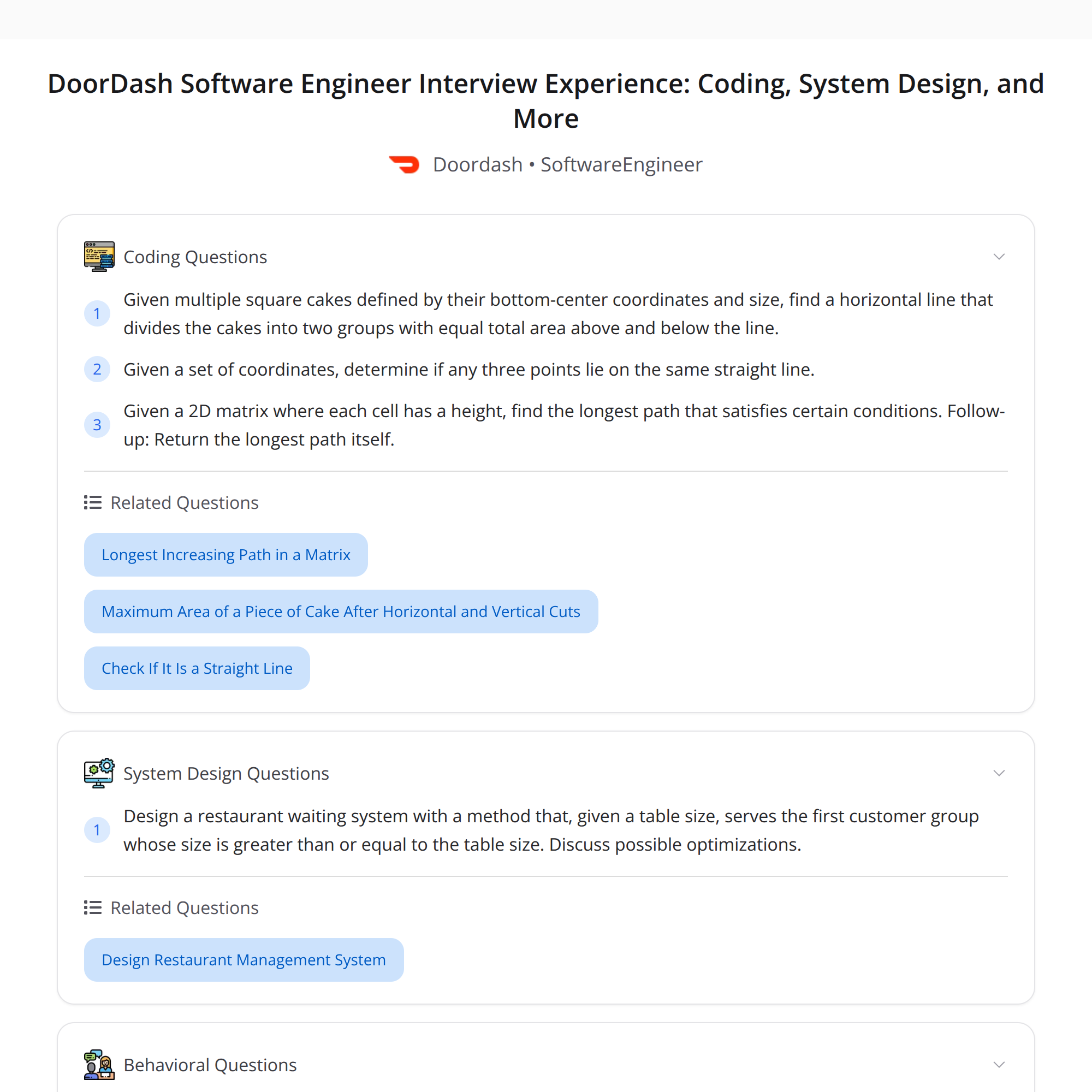
1) Geometry / area split — "Find a horizontal line that balances cake area above vs below"
Problem summary
- Given a 2D shape (e.g., polygonal "cake"), find a horizontal line y = Y such that the area above that line equals the area below it (or is as balanced as possible).
Approach
- Observe that the area below a horizontal line is a monotonically increasing function of Y. Use binary search on Y to find the cut that gives the required split to desired precision.
- For a polygonal shape, compute the area below y=Y by clipping each polygon edge against the horizontal line and summing trapezoids/triangles that lie below Y.
- Implementation details:
- For each edge (x1,y1)-(x2,y2), find its contribution to the area below Y by computing intersections if the edge crosses Y.
- Accumulate signed area slice-by-slice (or use shoelace formula on the clipped polygon) and compare with half the total area.
Complexity and precision
- Cost per area-evaluation: O(n) for n polygon edges.
- Binary search iterations: O(log(precision_range / epsilon)). Total: O(n log(1/eps)).
Practical tips
- Handle horizontal edges carefully and use robust intersection logic to avoid numerical instability.
- Precompute total area once.
2) Restaurant waitlist design — "Serve the first group with size >= table capacity"
Problem summary
- You maintain a waitlist of arriving groups (arrival order preserved), and when a table of size s becomes available, you should serve the earliest-arriving group whose size is <= table capacity (or >= depending on exact statement). The interview discussed tradeoffs between a sorted list and balanced BST.
Approach options
- Naive approach: linear scan of a linked list/queue — O(n) per table.
- Sorted structure approach: maintain groups sorted by size, but you must also respect arrival order among same sizes.
- Balanced BST + queue per size (recommended): use a balanced BST keyed by group size. Each BST node stores a FIFO queue of groups with that size (to preserve arrival order). When a table arrives with capacity T, query the BST for the largest key <= T (or smallest >= T depending on requirement) in O(log k) where k is number of distinct sizes, then pop from that queue. If queue becomes empty, delete the key from the BST.
- Hash buckets if sizes are bounded: maintain an array or hashmap from size → queue, plus a separate order-preserving structure (e.g., a min-heap or ordered set of available sizes) for fast search.
Complexity
- BST approach: O(log k) per insertion/search + O(1) to pop from a queue.
- Bucket approach: O(1) insert, O(S) or O(log S) to find next valid size depending on how you index sizes (S = max size range).
Practical notes
- Clarify constraints in interview: are group sizes bounded? Are tables exact fits or can larger tables be used? Those details guide structure choice.
3) Collinearity check — "Detect any three points that are collinear"
Problem summary
- Given n 2D points, return true if any three points lie on the same straight line.
Approach
- For each point p as the anchor, compute slopes (or normalized direction vectors) to all other points and count duplicates using a hashmap.
- If any slope appears at least twice relative to p, then p and two others are collinear.
- To avoid floating-point issues, store slopes as reduced integer pairs (dx/g, dy/g) with a consistent sign convention, or use cross products.
Complexity
- Time: O(n^2) in the worst case (computing slopes from each anchor to all others).
- Space: O(n) temporary hashmap for each anchor.
Edge cases
- Duplicated points — count duplicates properly.
- Vertical lines: represent slope as (1,0) or a sentinel.
4) Matrix longest path — "Return the longest path in a matrix (DFS + backtracking)"
Problem summary
- Find the longest path in a grid/matrix given some move constraints (e.g., increasing values, or not revisiting cells). Return the actual path, not just its length.
Approach
- Classic technique: DFS with memoization (DP) to record the longest path starting from each cell. To reconstruct the path, keep a "next" pointer for each cell pointing to the next best cell.
- If cycles are impossible (e.g., strictly increasing constraint), memoized DFS works in O(m*n). If cycles are possible and revisits aren’t allowed, you must track visited nodes in the recursion (backtracking) to avoid invalid cycles.
- Implementation sketch:
- For each cell (i,j): if dp[i][j] not computed, run dfs(i,j).
- dfs(i,j): mark visited (if necessary), explore valid neighbors, choose neighbor with max dfs length, set next[i][j] to that neighbor, set dp[i][j] = 1 + bestNeighborLength.
- Reconstruct path by following next pointers from the start cell that yields the maximum dp value.
Complexity
- With memoization and no cycles: O(mn) time, O(mn) space for dp/next.
- Without memoization but with pruning/backtracking the worst-case may be exponential; always prefer memoization where constraints allow.
Behavioral and extra technical round notes
- Behavioral: prepare structured stories (STAR) for leadership, conflict, tradeoffs and a high-impact project. Be concise and tie to product impact.
- Extra technical: expect deeper questions on a recently discussed system-design or design/optimization of your code. Be ready to analyze complexity, edge cases, and to improve/scalability-tune your solution.
General interview tips (DoorDash-specific takeaways)
- Clarify assumptions early (input ranges, edge definitions, expected return types).
- Communicate your plan before coding—interviewers are looking for thought process and tradeoffs.
- Write clean, testable code: handle corner cases, and run small examples aloud.
- Use memoization where appropriate and discuss time-space tradeoffs.
- For system design parts (e.g., the waitlist problem): discuss data structures, scaling, fault tolerance, and operational metrics (latency, throughput).
Closing
This condensed playbook highlights the most important problems and approaches that surfaced in a high-scoring DoorDash SWE interview session. Practice the patterns (binary search over continuous monotonic functions, BST + queue for ordered-first selection, slope hashing for collinearity, and memoized DFS for path reconstruction) and you’ll gain repeatable strategies for similar interview prompts.
#SoftwareEngineering #SystemDesign #CodingInterview
About the author
bugfree.ai is an advanced AI-powered platform designed to help software engineers master system design and behavioral interviews. Whether you’re preparing for your first interview or aiming to elevate your skills, bugfree.ai provides a robust toolkit tailored to your needs. Key Features:
150+ system design questions: Master challenges across all difficulty levels and problem types, including 30+ object-oriented design and 20+ machine learning design problems. Targeted practice: Sharpen your skills with focused exercises tailored to real-world interview scenarios. In-depth feedback: Get instant, detailed evaluations to refine your approach and level up your solutions. Expert guidance: Dive deep into walkthroughs of all system design solutions like design Twitter, TinyURL, and task schedulers. Learning materials: Access comprehensive guides, cheat sheets, and tutorials to deepen your understanding of system design concepts, from beginner to advanced. AI-powered mock interview: Practice in a realistic interview setting with AI-driven feedback to identify your strengths and areas for improvement.
bugfree.ai goes beyond traditional interview prep tools by combining a vast question library, detailed feedback, and interactive AI simulations. It’s the perfect platform to build confidence, hone your skills, and stand out in today’s competitive job market. Suitable for:
New graduates looking to crack their first system design interview. Experienced engineers seeking advanced practice and fine-tuning of skills. Career changers transitioning into technical roles with a need for structured learning and preparation.
Comments
Join the discussionNo comments yet. Be the first to comment.