High-Score (Bugfree Users) DoorDash SWE Interview Experience: 4 Rounds You Can Prep For
This is a concise, high-signal recap of a DoorDash SWE loop shared by Bugfree users. The loop had four distinct rounds—each with a clear focus. Tough, but fair. Below you'll find what was asked, how to prepare, and quick tips to maximize your odds.
At-a-glance: The 4 rounds
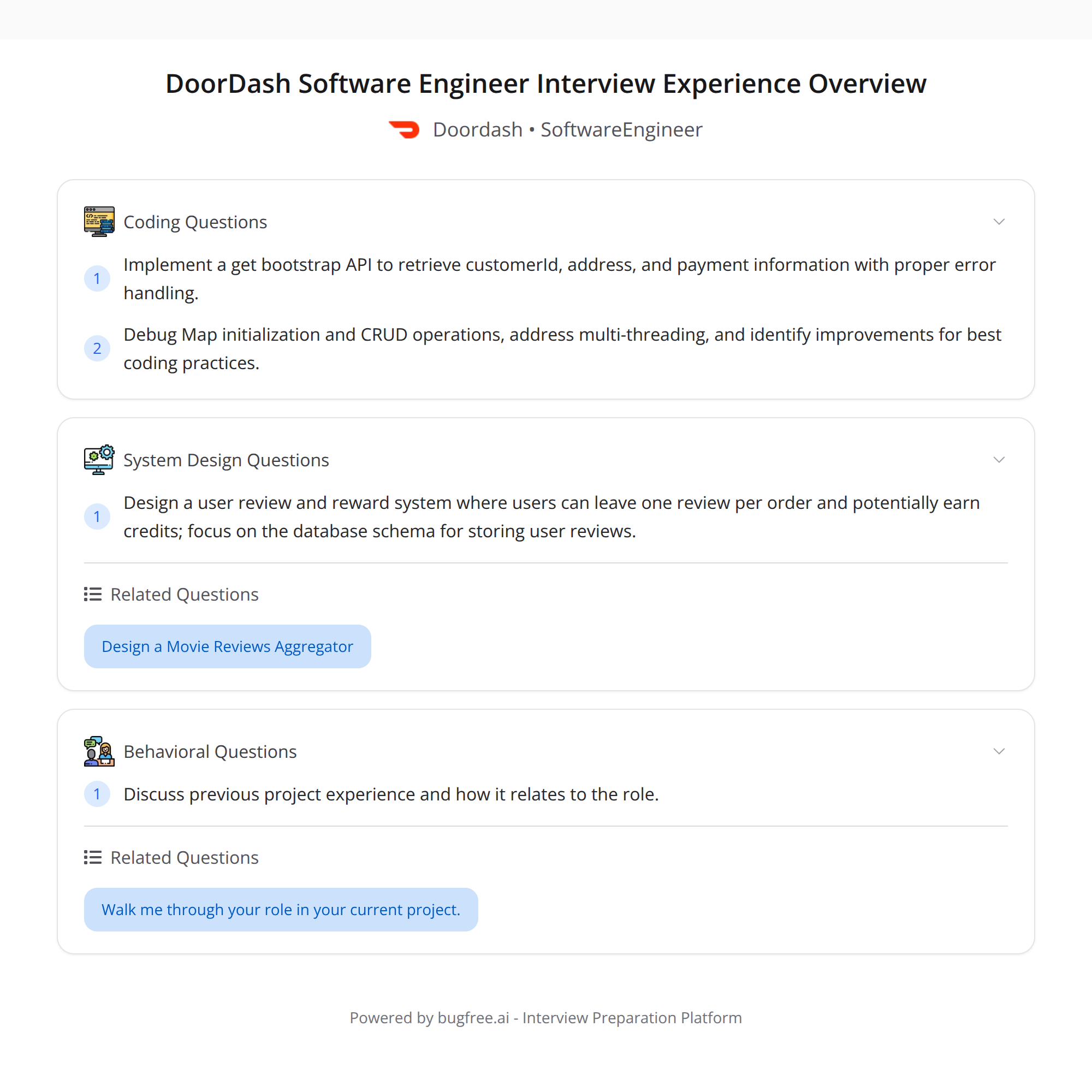
- Code Craft (coding + API implementation)
- System Design (user review system)
- HM Call (behavioral + impact)
- Debugging (map initialization, CRUD, threading, code quality)
1) Code Craft — Implement a “get bootstrap” API
What they asked
- Build a
getBootstrapAPI that returns a minimal session payload:customerId,address,paymentinformation. - Emphasis on reading and understanding existing code, composing data from multiple services, and adding resilient error handling for downstream failures.
What to prepare
- Practice implementing small service endpoints that aggregate data from multiple sources.
- Focus on defensive programming: timeouts, retries, fallback values, and meaningful error responses.
- Brush up on parsing/serializing JSON, interface contracts, and tests for edge cases.
Example checklist
- Validate inputs and return early on obvious errors.
- Merge results from multiple calls; handle partial failures gracefully (e.g., if payment fails, return fallback and an explicit status flag).
- Add unit tests and basic integration test stubs.
Tips
- Read the existing code first; make minimal, well-scoped changes.
- Describe your failure modes and your chosen policies (retry limits, circuit breakers, default values).
- Clearly state assumptions (e.g., data freshness, idempotency).
2) System Design — User Review System (1 review per order)
What they asked
- Design a user review system where each order can have one review.
- Deep dive on DB schema, constraints, indexing, and consistency. Reward/monetization aspects were optional.
What to prepare
- Schema modeling for orders, reviews, users, and constraints enforcing one-review-per-order.
- Discuss read/write patterns, scale considerations, and how to enforce uniqueness at the DB level and in the application layer.
- Think about auditability, soft deletes, and denormalized counters for quick reads.
Design talking points
- DB schema: Orders(order_id PK, user_id, ...), Reviews(review_id PK, order_id FK UNIQUE, user_id, rating, text, created_at).
- Enforcing 1 review/order: use a UNIQUE constraint on
order_idin Reviews; use transactions or conditional inserts to avoid race conditions. - Indexing: index on
user_idandorder_id, composite indexes for common queries (e.g., user reviews sorted by created_at). - Read-heavy vs write-heavy: consider caching popular reads, eventual consistency for aggregated stats (e.g., avg rating).
- Scaling: shards by user_id or order_id, partition large tables by time if needed.
Optional features to mention
- Moderation pipeline, spam detection, and reporting.
- Reward mechanics: limit gaming, track reward states separately, and design idempotent reward application.
Tips
- Draw a clear data model and justify constraints.
- Discuss edge cases: duplicate submissions, retries, partial failures, and how to rollback.
3) Hiring Manager (HM) Call — Behavioral + Project Impact
What they asked
- Behavioral questions focused on past projects, ownership, trade-offs, and impact.
- Align your work with company goals; show measurable outcomes.
What to prepare
- 2–3 concise stories using STAR (Situation, Task, Action, Result) format: highlight impact, metrics, and your specific role.
- Be ready to discuss trade-offs, technical debt you managed, and how you influenced outcomes.
Tips
- Quantify impact: e.g., reduced latency by X%, decreased error rate by Y, or shipped feature used by Z users.
- Be honest about mistakes and what you learned—HM calls value growth and ownership.
4) Debugging — Map init + CRUD, Indexing, Multithreading
What they asked
- Debug code that initialized a map and performed CRUD operations; discuss indexing decisions and multithreading risks.
- Propose code-quality improvements.
What to prepare
- Practice reading unfamiliar code and tracing execution paths quickly.
- Know common concurrency issues: data races, deadlocks, improper synchronization, and per-thread state.
- Review best practices for indexing and query performance in relational and NoSQL stores.
Debugging checklist
- Reproduce bug scenarios, add logging, and write small unit tests to lock behavior.
- Fix map initialization problems (e.g., nil maps, wrong capacity assumptions).
- Discuss safe concurrency patterns (locks, atomic ops, thread-safe collections), and explain trade-offs.
- Propose refactors: clearer abstractions, stricter invariants, and improved test coverage.
Tips
- Talk through debugging steps aloud: how you form hypotheses, validate them, and iterate.
- Prioritize fixes that reduce blast radius and make future bugs easier to find.
Final notes & preparation checklist
Overall impression: challenging but fair—interviewers expect solid engineering judgment, clear reasoning, and practical trade-offs.
Quick prep checklist
- Code Craft: practice composing APIs and resilient error handling. Write tests.
- System Design: prepare schemas, constraints, and scaling strategies for common features.
- HM Call: craft 2–3 impact stories with metrics.
- Debugging: practice reading code, fixing concurrency issues, and explaining your approach.
Good luck—focus on clarity, trade-offs, and demonstrating ownership. You’ll do best if you can both reason at a system level and implement reliably at the code level.
#SoftwareEngineering #SystemDesign #InterviewPrep
About the author
bugfree.ai is an advanced AI-powered platform designed to help software engineers master system design and behavioral interviews. Whether you’re preparing for your first interview or aiming to elevate your skills, bugfree.ai provides a robust toolkit tailored to your needs. Key Features:
150+ system design questions: Master challenges across all difficulty levels and problem types, including 30+ object-oriented design and 20+ machine learning design problems. Targeted practice: Sharpen your skills with focused exercises tailored to real-world interview scenarios. In-depth feedback: Get instant, detailed evaluations to refine your approach and level up your solutions. Expert guidance: Dive deep into walkthroughs of all system design solutions like design Twitter, TinyURL, and task schedulers. Learning materials: Access comprehensive guides, cheat sheets, and tutorials to deepen your understanding of system design concepts, from beginner to advanced. AI-powered mock interview: Practice in a realistic interview setting with AI-driven feedback to identify your strengths and areas for improvement.
bugfree.ai goes beyond traditional interview prep tools by combining a vast question library, detailed feedback, and interactive AI simulations. It’s the perfect platform to build confidence, hone your skills, and stand out in today’s competitive job market. Suitable for:
New graduates looking to crack their first system design interview. Experienced engineers seeking advanced practice and fine-tuning of skills. Career changers transitioning into technical roles with a need for structured learning and preparation.
Comments
Join the discussionNo comments yet. Be the first to comment.