High-Score (Bugfree Users) DoorDash SWE Interview Experience: 4 Rounds You Can Prep For
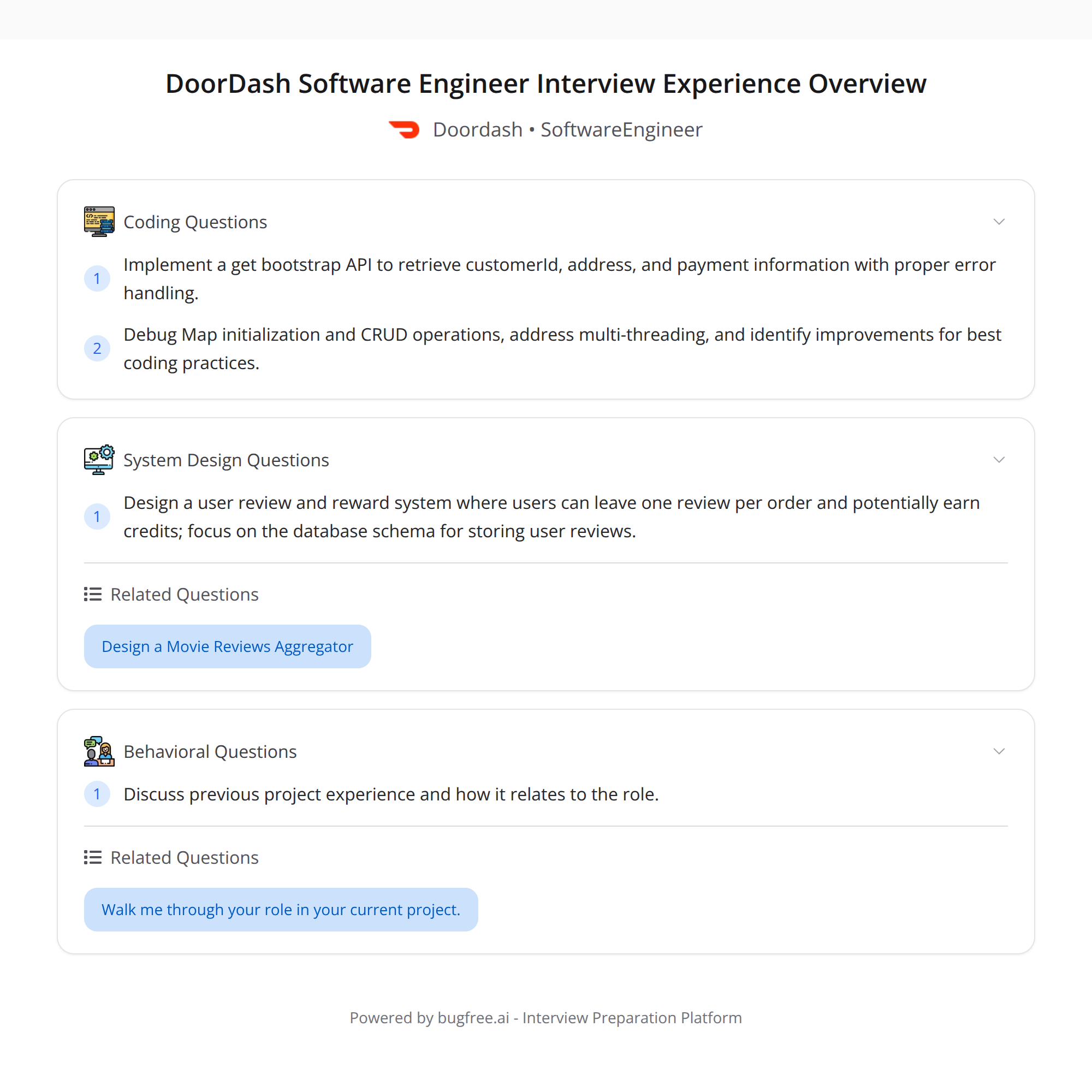
A concise breakdown of a high-scoring DoorDash Software Engineer (SWE) interview loop reported by Bugfree community users. The loop had four distinct rounds—each with clear expectations. Below you'll find what each round focused on, what interviewers look for, example prompts, and practical preparation tips.
Quick overview
- Rounds: 4
- Code Craft (coding + API implementation + reading existing code)
- System Design (user review system; DB schema & constraints)
- Hiring Manager (behavioral + impact alignment)
- Debugging (map init, CRUD, indexing, multithreading risks)
- Tone: Tough but fair. Strong positive signals help, but you’ll still need solid problem-solving and production-minded engineering.
1) Code Craft — "Get Bootstrap" API
What they asked
- Implement a "get bootstrap" API that returns customerId, address, payment info.
- You’ll read existing code, integrate with downstream services, and add resilient error handling for partial failures.
What interviewers evaluate
- Ability to understand and modify existing code quickly.
- API design and input/output contract clarity.
- Defensive programming: graceful degradation when downstream services fail or time out.
- Edge-case handling and testability.
Prep tips
- Practice reading unfamiliar codebases and explaining the data flow aloud.
- Study patterns for fault tolerance (circuit breakers, retries, fallbacks, timeouts).
- Be ready to discuss trade-offs for sync vs async aggregation and when to return partial data.
- Write small unit tests and show how you’d mock downstream dependencies.
Sample prompts to practice
- "Design an endpoint that aggregates user profile, default address, and last-used payment method. If payment service is down, indicate a partial response but still return profile/address."
- "Given a code snippet that calls three services sequentially, refactor for better error handling and explain latency implications."
Resources
- Patterns of Enterprise Application Architecture (for resilience patterns)
- Articles on idempotency, retries, and circuit breaker libraries (Hystrix, Resilience4j)
2) System Design — User Review System (1 review per order)
What they asked
- Design a user review system where each order can have one review.
- Deep dive into DB schema, integrity constraints, and optional reward mechanism.
What interviewers evaluate
- Schema design and how it enforces the 1-review-per-order constraint.
- Indexing strategy for common queries (e.g., reviews by orderId, reviews by userId, average rating per merchant).
- Consistency and transactional guarantees (how to avoid duplicate reviews in concurrent flows).
- Considerations for scale, read/write patterns, and eventual consistency if used.
Prep tips
- Design and walk through normalized schemas plus denormalized options for read-heavy paths.
- Be prepared to propose SQL constraints (unique indexes) and application-level guards (idempotency tokens).
- Discuss locking strategies, optimistic concurrency control, and how to handle retries.
- Cover analytics: storing aggregated ratings or computing on the fly, trade-offs.
Sample points to bring up
- Use a unique constraint on (order_id) in the reviews table to enforce the one-review rule.
- Add write path transaction sketch: create review + update order state + update merchant aggregates in a single transactional unit or via asynchronous worker.
- Index choices: (order_id), (user_id, created_at), (merchant_id) with pre-aggregated rating table.
Resources
- Database design fundamentals and indexing best practices
- Posts on event sourcing vs. relational transactional models for writable user data
3) Hiring Manager (HM) Call — Behavioral & Impact Alignment
What they asked
- Behavioral questions and alignment of your past projects with the company/team goals.
What interviewers evaluate
- Clear communication of past impact: problem, approach, metrics, outcomes.
- Culture fit: collaboration, ownership, trade-off decisions, and learning from mistakes.
- Career goals and how they map to the role.
Prep tips
- Use STAR (Situation, Task, Action, Result) for concise stories.
- Prepare 3–5 concrete examples emphasizing measurable impact (latency reduction, cost savings, user metrics).
- Be ready to discuss trade-offs and decisions you regret and what you learned.
- Ask informed questions about team priorities and how success is measured.
Sample prompts
- "Tell me about a system you built end-to-end and the hardest engineering trade-off you faced."
- "Describe a time you improved production reliability. What metrics improved and how did you measure them?"
4) Debugging — Map Init, CRUD, Indexing & Multithreading Risks
What they asked
- Debug a map initialization and CRUD flow; discuss indexing and multithreading hazards.
What interviewers evaluate
- Ability to reason about concurrency issues (race conditions, deadlocks).
- Awareness of safe initialization patterns and correct use of concurrent data structures.
- Code-quality improvements: clear abstractions, testability, and correctness.
Prep tips
- Practice spotting and fixing common concurrency bugs (double-checked locking pitfalls, non-atomic read-modify-write).
- Review thread-safe collections in your language of choice and explain when to use locks vs lock-free structures.
- Discuss indexing for performance and why certain index choices matter for CRUD operations.
- Show small refactors that improve readability and reduce error-proneness.
Sample prompts
- "Given a shared map used by multiple threads for caching, find the race condition and propose fixes."
- "Explain how you’d index a table to optimize both writes and the most common read queries."
Final notes — How to prepare overall
- Practice coding on timed platforms and include exercises that require integrating multiple files or reading given code.
- Do system design sketches focused on constraints, data model, and how you’d enforce invariants.
- Prepare impact-focused stories for behavioral interviews.
- Brush up on concurrency and debugging exercises—know when to prioritize correctness over micro-optimizations.
This loop is rigorous but fair: strong signals help, but the interview expects production-minded engineering, clear communication, and disciplined problem solving.
Good luck — prepare deliberately and focus on the intersection of correctness, clarity, and systems thinking.
#SoftwareEngineering #SystemDesign #InterviewPrep
About the author
bugfree.ai is an advanced AI-powered platform designed to help software engineers master system design and behavioral interviews. Whether you’re preparing for your first interview or aiming to elevate your skills, bugfree.ai provides a robust toolkit tailored to your needs. Key Features:
150+ system design questions: Master challenges across all difficulty levels and problem types, including 30+ object-oriented design and 20+ machine learning design problems. Targeted practice: Sharpen your skills with focused exercises tailored to real-world interview scenarios. In-depth feedback: Get instant, detailed evaluations to refine your approach and level up your solutions. Expert guidance: Dive deep into walkthroughs of all system design solutions like design Twitter, TinyURL, and task schedulers. Learning materials: Access comprehensive guides, cheat sheets, and tutorials to deepen your understanding of system design concepts, from beginner to advanced. AI-powered mock interview: Practice in a realistic interview setting with AI-driven feedback to identify your strengths and areas for improvement.
bugfree.ai goes beyond traditional interview prep tools by combining a vast question library, detailed feedback, and interactive AI simulations. It’s the perfect platform to build confidence, hone your skills, and stand out in today’s competitive job market. Suitable for:
New graduates looking to crack their first system design interview. Experienced engineers seeking advanced practice and fine-tuning of skills. Career changers transitioning into technical roles with a need for structured learning and preparation.
Comments
Join the discussionNo comments yet. Be the first to comment.