Interview OOD Drill: Design Uber in 5 Classes (and Explain It Clearly)
If you can model Uber with a small set of clean object-oriented classes and defend the design, you'll handle many system-design and OOD interview questions. Here is a compact, interview-friendly approach using five core classes and the reasoning you'd use to explain and extend it.
The five core classes
User
- Represents a generic user of the system (rider or driver account).
- Key fields: id, name, phone, rating
- Key methods: updateProfile(), addPaymentMethod()
Driver (extends User)
- Driver is a User plus driving-specific data: vehicle, currentLocation, availabilityStatus
- Key fields: vehicleInfo, currentLocation, status (available / busy / offline)
- Key methods: updateLocation(), acceptRide(), goOffline()
Ride
- Represents a trip with pickup/dropoff and lifecycle state
- Key fields: id, rider (User), driver (Driver|null), pickupLocation, dropoffLocation, fare, status
- Status (example): PENDING -> ACCEPTED -> IN_PROGRESS -> COMPLETED -> BILLED
- Also handle CANCELLED and FAILED states
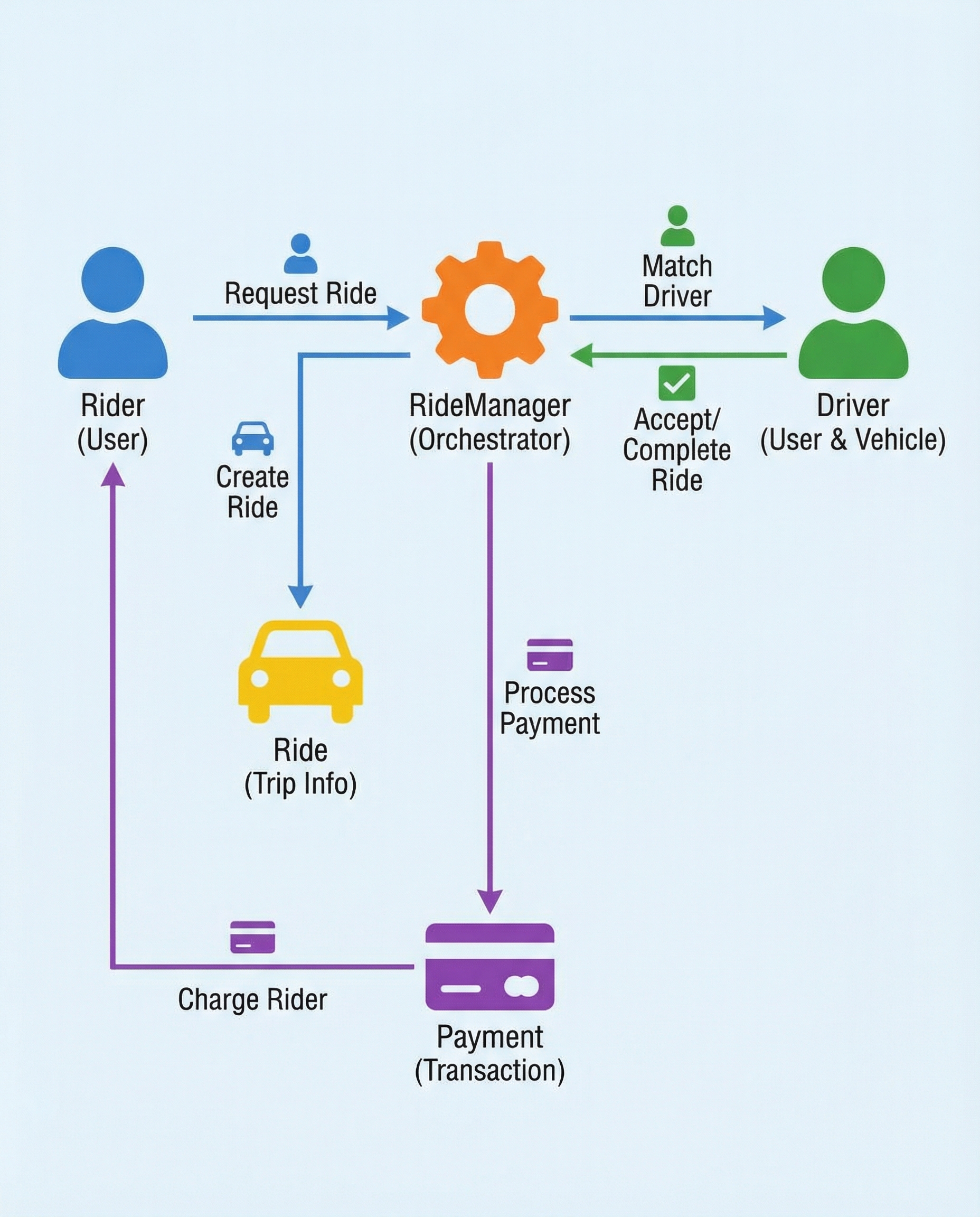
RideManager
- Coordinates matching riders to drivers and transitions ride states
- Responsibilities: findAvailableDrivers(), dispatchDriver(), startRide(), completeRide(), cancelRide()
- Keeps business logic out of domain objects (Ride/Driver) and centralizes matching & state transitions
Payment
- Handles charging, refunds, and integrating with payment providers
- Responsibilities: calculateFare(ride), charge(ride), refund(ride)
Compact class sketch (pseudo-code)
class User { id, name, phone, rating }
class Driver extends User { vehicleInfo, currentLocation, status }
class Ride { id, rider, driver, pickup, dropoff, fare, status }
class RideManager {
  findAvailableDrivers(pickup)
  matchRiderToDriver(ride)
  startRide(ride)
  completeRide(ride)
  cancelRide(ride)
}
class Payment { calculateFare(ride), charge(ride), refund(ride) }
Ride state transitions
A simple state machine you can draw and explain:
- PENDING —(driver accepts)→ ACCEPTED —(rider picked up)→ IN_PROGRESS —(trip ends)→ COMPLETED —(charge)→ BILLED
- PENDING/ACCEPTED —(cancel)→ CANCELLED
- Any failure —> FAILED
When answering, explain who triggers and enforces transitions (RideManager handles transitions; persistent store records states; Payment invoked on COMPLETED).
Why this separation? (defend responsibilities)
- Single Responsibility: each class has one reason to change — domain objects (User/Driver/Ride) store state, RideManager encapsulates orchestration, Payment isolates billing.
- Low coupling & high cohesion: RideManager coordinates but doesn’t implement charging logic; Payment can be swapped for another provider.
- Clear extension points: adding surge, cancellations, ratings, or new matching strategies doesn’t force major changes to core classes.
Extensibility & real-world considerations
- Pricing: add a PricingService (or extend Payment) that supports base fare, distance/time, surge multipliers, promotions.
- Surge & dispatch strategy: keep matching algorithm in RideManager or extract to a MatchingService to try different strategies (nearest, ETA, pooled rides).
- Cancellations & refunds: RideManager signals CANCELLED and Payment handles partial/conditional refunds.
- Ratings & history: User and Driver keep rating summaries; a separate Audit/History store keeps ride events for analytics.
- Concurrency: driver availability and matching require locking or optimistic updates (e.g., compare-and-swap) and fast caches for location queries.
- Scaling: split services — Authentication, RideService, MatchingService, PaymentService — and use event-driven flows (messages) for state changes and billing.
How to explain this in an interview
- Start with assumptions (single city vs global, real-time constraints, offline drivers, cancellation policy).
- Present the 5-class model and walk through a ride lifecycle: request → match → accept → start → complete → bill.
- Explain responsibilities (who changes what and why), state transitions, and where to add features like surge or pooled rides.
- Discuss operational concerns: scaling, consistency, failure handling, and how you'd split into services.
Quick summary
Model Uber with these core classes: User, Driver (extends User), Ride, RideManager, and Payment. This keeps domain state, orchestration, and billing separated and makes it easy to defend responsibilities, add features, and reason about state transitions during an interview.
About the author
bugfree.ai is an advanced AI-powered platform designed to help software engineers master system design and behavioral interviews. Whether you’re preparing for your first interview or aiming to elevate your skills, bugfree.ai provides a robust toolkit tailored to your needs. Key Features:
150+ system design questions: Master challenges across all difficulty levels and problem types, including 30+ object-oriented design and 20+ machine learning design problems. Targeted practice: Sharpen your skills with focused exercises tailored to real-world interview scenarios. In-depth feedback: Get instant, detailed evaluations to refine your approach and level up your solutions. Expert guidance: Dive deep into walkthroughs of all system design solutions like design Twitter, TinyURL, and task schedulers. Learning materials: Access comprehensive guides, cheat sheets, and tutorials to deepen your understanding of system design concepts, from beginner to advanced. AI-powered mock interview: Practice in a realistic interview setting with AI-driven feedback to identify your strengths and areas for improvement.
bugfree.ai goes beyond traditional interview prep tools by combining a vast question library, detailed feedback, and interactive AI simulations. It’s the perfect platform to build confidence, hone your skills, and stand out in today’s competitive job market. Suitable for:
New graduates looking to crack their first system design interview. Experienced engineers seeking advanced practice and fine-tuning of skills. Career changers transitioning into technical roles with a need for structured learning and preparation.
Comments
Join the discussionNo comments yet. Be the first to comment.