Circuit Breaker Pattern: The Interview Answer That Shows You Build Resilient Systems
Circuit Breaker is a resilience pattern that prevents repeated calls to a failing dependency so your system can stay responsive and avoid cascading failures. In interviews, explaining this pattern well shows you think about availability, fault isolation, and observability — all key for building resilient systems.
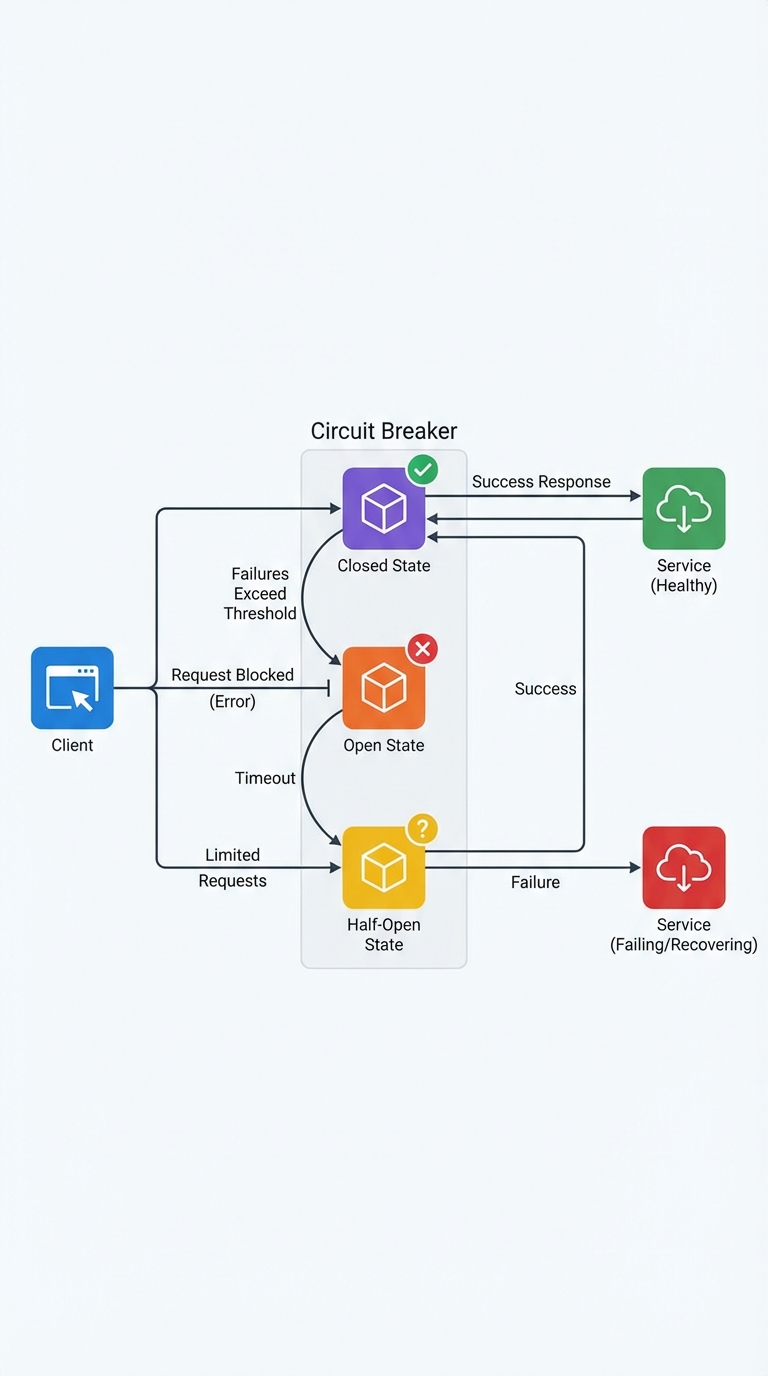
The three states (and what they mean)
Closed
- Normal operation: traffic flows to the dependency.
- Failures are tracked (counts, rates, windows).
- When failures cross configured thresholds, the breaker trips to Open.
Open
- Fail-fast mode: calls to the failing dependency are rejected immediately (or handled by a fallback).
- Prevents resource exhaustion and reduces load on the broken service.
- After a configured delay, the breaker transitions to Half-Open to test recovery.
Half-Open
- A few probe requests are allowed through to verify the dependency’s health.
- If probes succeed (within thresholds), the breaker closes and normal traffic resumes.
- If probes fail, the breaker re-opens and the cycle repeats.
Why interviewers care
- Prevents cascading failures across services.
- Improves system recovery and reduces mean time to recovery (MTTR).
- Provides predictable behavior under partial outages (fail-fast + fallbacks).
- Shows you design with fault isolation, graceful degradation, and observability in mind.
Practical tuning guidance (what to mention in an interview)
- Thresholds
- Consecutive failures: trip after N failures in a row (N = 3–10 is common).
- Failure rate: trip if error rate > X% over a time window (e.g., 50% over 10s).
- Timeouts
- Set a sensible request timeout before counting a failure (prevents slow calls from piling up).
- Sleep window (open duration)
- How long the circuit stays Open before allowing probes (e.g., 10–60s). Shorter windows allow faster recovery but may cause flapping.
- Half-Open probes
- Limit concurrent probes (e.g., 1–5). Gradually increase on success.
- Backoff strategies
- Exponential backoff for retrying the dependency or enlarging the sleep window on repeated failures.
Example sensible defaults (starting point, not universal):
- Timeout: 2s
- Trip: 5 consecutive failures or 50% failure rate over 10s
- Sleep window: 30s
- Half-Open probe limit: 2
Monitoring & alerting
Instrument and alert on:
- Circuit state transitions (Open/Half-Open/Closed)
- Failure rate and success rate
- Latency percentiles for the dependency
- Number of requests short-circuited (rejected by the breaker)
Dashboards and alerts let you spot noisy neighbors, flapping circuits, or configuration issues quickly.
Interactions with other patterns
- Retries: Use carefully — retries + long timeouts can worsen cascading failures. Prefer fail-fast then fallback.
- Bulkhead: Isolate resource pools so one failing dependency doesn’t consume all threads/connections.
- Fallbacks: Return cached responses, default values, or degraded features while dependency is down.
Common pitfalls
- Too aggressive thresholds that open the circuit for brief spikes.
- Not instrumenting state transitions — you won’t know when breakers trip.
- Using retries without timeouts or without considering the circuit state.
- Applying one global circuit for multiple endpoints that have different failure characteristics.
How to explain it in an interview (concise script)
- State the problem: "We want to stop repeated calls to an unhealthy dependency to avoid cascading failures."
- Describe the pattern: "A Circuit Breaker tracks failures and cycles through Closed, Open, and Half-Open states to isolate faults."
- Mention tuning & monitoring: "I’d tune thresholds, timeouts, probe behavior, and instrument state transitions and error/latency metrics."
- Give trade-offs and related patterns: "Be careful with retries and add bulkheads/fallbacks for graceful degradation."
- Optional: provide a brief config example (values and why).
Minimal pseudocode (state machine)
if circuit == OPEN:
  return fallback()

response = callRemoteWithTimeout()
if response.success:
  resetFailureCount()
  if circuit == HALF_OPEN: closeCircuit()
  return response
else:
  incrementFailureCount()
  if failureCount > threshold: openCircuit()
  return fallback()

// timer: after sleepWindow -> set circuit = HALF_OPEN
Takeaway
When you describe the Circuit Breaker in an interview, cover the problem it solves, the three states, how you’d tune thresholds/timeouts, how you’d monitor it, and how it composes with retries, bulkheads, and fallbacks. That shows you design for resilience, not just functionality.
#SystemDesign #CircuitBreaker #DistributedSystems #Microservices #ReliabilityEngineering #SRE #BackendEngineering #SoftwareEngineering #InterviewPrep
About the author
bugfree.ai is an advanced AI-powered platform designed to help software engineers master system design and behavioral interviews. Whether you’re preparing for your first interview or aiming to elevate your skills, bugfree.ai provides a robust toolkit tailored to your needs. Key Features:
150+ system design questions: Master challenges across all difficulty levels and problem types, including 30+ object-oriented design and 20+ machine learning design problems. Targeted practice: Sharpen your skills with focused exercises tailored to real-world interview scenarios. In-depth feedback: Get instant, detailed evaluations to refine your approach and level up your solutions. Expert guidance: Dive deep into walkthroughs of all system design solutions like design Twitter, TinyURL, and task schedulers. Learning materials: Access comprehensive guides, cheat sheets, and tutorials to deepen your understanding of system design concepts, from beginner to advanced. AI-powered mock interview: Practice in a realistic interview setting with AI-driven feedback to identify your strengths and areas for improvement.
bugfree.ai goes beyond traditional interview prep tools by combining a vast question library, detailed feedback, and interactive AI simulations. It’s the perfect platform to build confidence, hone your skills, and stand out in today’s competitive job market. Suitable for:
New graduates looking to crack their first system design interview. Experienced engineers seeking advanced practice and fine-tuning of skills. Career changers transitioning into technical roles with a need for structured learning and preparation.
Comments
Join the discussionNo comments yet. Be the first to comment.