
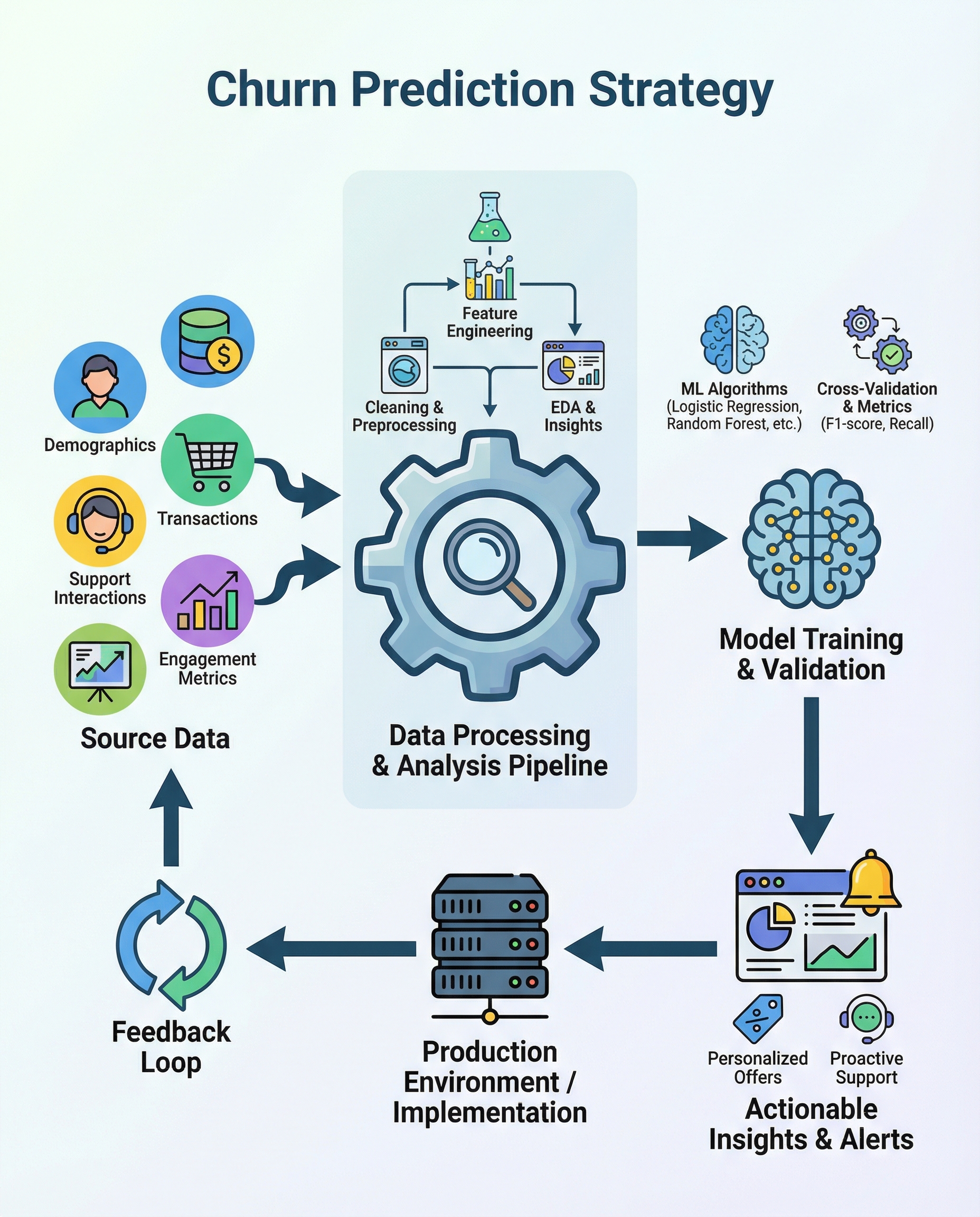
Churn Prediction in Interviews: The 7-Step Strategy You Must Explain Clearly
In interviews, churn prediction isn't just about "build a model." Interviewers want to hear a business-focused, end-to-end plan that ties data, evaluation, and actions together. Use this 7-step framework to show you can translate analytics into impact.
1) Define churn — what it is and why it happens
- Clarify the business definition: involuntary (payment failure) vs voluntary (stop using service), time-based (no activity for X days) or event-based (cancel subscription).
- Explain root causes: product gaps, poor onboarding, low engagement, pricing, competitors, service issues.
- What to say in an interview: "Churn is [definition]. I’d measure it to align with business goals — e.g., revenue churn vs. user churn — and prioritize interventions that reduce high-value customer churn."
2) Collect signals — what data matters
- Typical features: demographics, subscription plan, transaction history, product usage (frequency, depth), session logs, support tickets, NPS/surveys, marketing interactions.
- Temporal signals: tenure, trend in usage, recent downgrades, time since last login.
- Operational signals: payment failures, number of support escalations.
- Interview tip: show you’d prioritize high-signal, low-latency features first for real-time scoring.
3) Preprocess — clean and craft features
- Handle missing values (imputation strategies, encode missingness as feature when meaningful).
- Categorical encoding: one-hot, target encoding (careful with leakage), embeddings for many categories.
- Scaling as needed for distance-based models.
- Feature engineering examples: tenure, rolling averages (7/30/90 days), change metrics (delta in usage), recency-frequency-monetary (RFM) features.
- What to mention: feature importance and explainability tradeoffs.
4) Exploratory Data Analysis (EDA)
- Goals: identify churn drivers, seasonality, segments at risk, class imbalance.
- Visuals/analyses to cite: cohort analysis, survival curves, churn rate by plan/segment, correlation and feature distributions.
- Interview tip: highlight segmentation — churn drivers often differ between cohorts (new users vs. long-tenured).
5) Model selection — choose and justify algorithms
- Candidate models: logistic regression (baseline, interpretable), decision trees, random forest, GBM (XGBoost/LightGBM/CatBoost), neural networks for complex signals.
- Tradeoffs: interpretability vs. accuracy vs. latency. For example, use LR or simple tree for explainable operational decisions, GBM for higher predictive performance.
- Metrics to optimize: precision@k, recall (capture churners), F1, AUC, and business metrics like revenue saved. For targeted offers, precision matters; for broad retention campaigns, recall may matter more.
- Interview phrasing: "I’d pick a model balancing performance and actionability and justify it with expected ROI and operational constraints."
6) Validate — robust evaluation and avoid leakage
- Validation strategies: temporal split (train on past, test on future) is critical for churn; use cross-validation within time-aware folds.
- Address class imbalance: resampling, class weights, or appropriate metrics.
- Overfitting checks: learning curves, calibration plots, test on holdout/cohort.
- Additional validation: shadow mode or backtesting with past campaigns.
7) Deploy — integrate, monitor, and close the loop
- Integration: scoring pipeline (batch or real-time), API or feature store, and routing scores to CRM/marketing systems.
- Monitor: model performance (AUC, calibration), data drift, feature distributions, and business KPIs (churn rate, retention lift).
- Feedback loop: capture outcomes from interventions (did offers reduce churn?), retrain cadence, and instrument experiments (A/B tests) to measure true impact.
- Actions: targeted offers, onboarding improvements, personalized in-app messaging, proactive support outreach.
Common interview prompts and concise answers
- Q: "How would you evaluate success?" — A: "Measure retention lift and revenue saved via controlled experiments; track precision@top-k for targeting efficiency."
- Q: "How to avoid false positives?" — A: "Prioritize precision for costly interventions; use business rules and human review for top tiers."
- Q: "What features would you engineer first?" — A: "Tenure, recent activity counts, trend in engagement, payment failures, and support ticket counts."
Quick checklist to rehearse before an interview
- State the business definition of churn clearly.
- Name 3 high-value signals and 2 engineering features you’d create.
- Describe your validation strategy (temporal split) and preferred metric for a campaign.
- Explain one deployment/monitoring consideration and one example intervention.
Wrap up by emphasizing business impact: a successful churn prediction approach pairs a solid model with clear prioritization, measurable interventions, and continuous monitoring — that’s what interviewers want to hear.
About the author
bugfree.ai is an advanced AI-powered platform designed to help software engineers master system design and behavioral interviews. Whether you’re preparing for your first interview or aiming to elevate your skills, bugfree.ai provides a robust toolkit tailored to your needs. Key Features:
150+ system design questions: Master challenges across all difficulty levels and problem types, including 30+ object-oriented design and 20+ machine learning design problems. Targeted practice: Sharpen your skills with focused exercises tailored to real-world interview scenarios. In-depth feedback: Get instant, detailed evaluations to refine your approach and level up your solutions. Expert guidance: Dive deep into walkthroughs of all system design solutions like design Twitter, TinyURL, and task schedulers. Learning materials: Access comprehensive guides, cheat sheets, and tutorials to deepen your understanding of system design concepts, from beginner to advanced. AI-powered mock interview: Practice in a realistic interview setting with AI-driven feedback to identify your strengths and areas for improvement.
bugfree.ai goes beyond traditional interview prep tools by combining a vast question library, detailed feedback, and interactive AI simulations. It’s the perfect platform to build confidence, hone your skills, and stand out in today’s competitive job market. Suitable for:
New graduates looking to crack their first system design interview. Experienced engineers seeking advanced practice and fine-tuning of skills. Career changers transitioning into technical roles with a need for structured learning and preparation.
Comments
Join the discussionNo comments yet. Be the first to comment.


