The partition key that makes or breaks your chat design
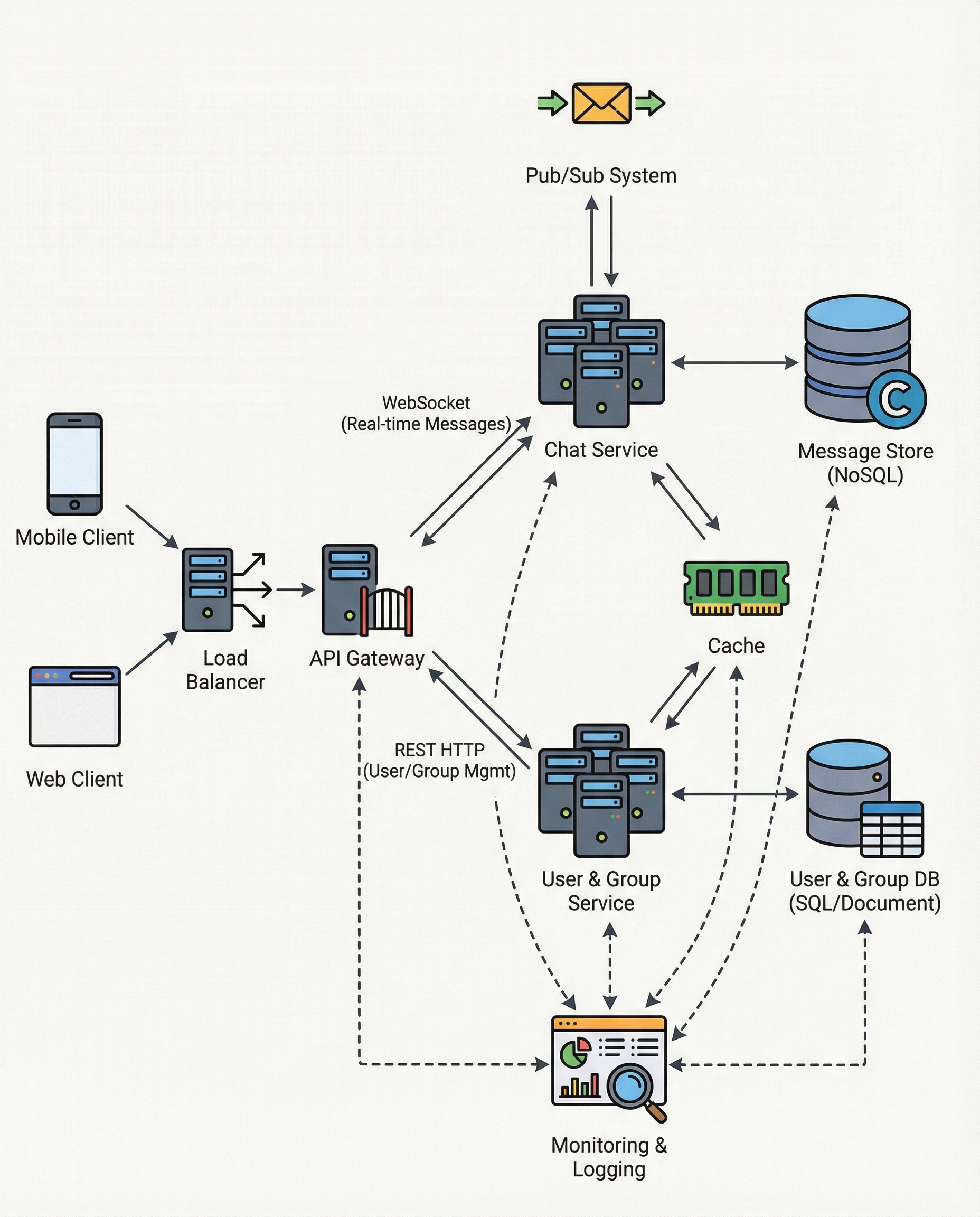
In chat systems, the way you design the message table often determines whether your service scales or collapses under load. A common and powerful pattern for NoSQL stores (e.g., Cassandra) is:
- partition key:
group_id - clustering key:
timestamp(or a time-based UUID)
This choice is simple but deliberate — it optimizes the dominant access pattern for chat: "give me the messages for this conversation, in order." Below I explain why interviewers care, show a compact schema example, and cover trade-offs and mitigation strategies you should mention in interviews.
Why interviewers care
Fast reads for the dominant query
- Chat history queries are typically: "fetch messages for this chat (group_id), ordered by time, possibly paginated." With
partition_key = group_idandclustering_key = timestamp, the DB can do a single range scan and return results quickly.
- Chat history queries are typically: "fetch messages for this chat (group_id), ordered by time, possibly paginated." With
Append-friendly writes
- Writes are essentially append-only. Because each conversation (group) is a separate partition, writes spread across many partitions and avoid single-point write bottlenecks when groups are numerous.
Natural ordering
- The clustering key provides chronological ordering out of the box, so you don't need extra sorting at read time.
Rule of thumb: optimize for your dominant access pattern rather than chasing generic flexibility.
Example (Cassandra-style) table
CREATE TABLE messages (
  group_id uuid,
  created_at timeuuid,
  message_id uuid,
  sender_id uuid,
  body text,
  PRIMARY KEY (group_id, created_at)
) WITH CLUSTERING ORDER BY (created_at ASC);
Notes:
- Use a time-based UUID (
timeuuid) forcreated_atwhen you need both uniqueness and time ordering. - Store message metadata (sender, attachments pointers, status) alongside or in another table depending on read patterns.
Important trade-offs and pitfalls (mention these in interviews)
Hot partitions
- If a single group receives a huge fraction of writes (e.g., a public channel), that partition becomes a hotspot. Solutions: bucket the partition (see below), offload high-volume chatter to sharded topics, or use separate storage for high-traffic channels.
Unbounded partitions
- Very large partitions hurt compaction and repair. Introduce time-bucketed partitions (e.g.,
PRIMARY KEY ((group_id, day), created_at)) or use TTLs/archival to bound partition size.
- Very large partitions hurt compaction and repair. Introduce time-bucketed partitions (e.g.,
Tombstones and deletes
- Frequent deletes create tombstones that harm read performance. Prefer TTLs or soft-delete strategies and batch deletions where possible.
Consistency and ordering across replicas
- NoSQL systems offer tunable consistency. In interviews, be ready to discuss required read/write consistency (e.g., QUORUM) and how eventual consistency affects perceived ordering.
Secondary queries
- If you need queries like "search my messages for a keyword" or "list all groups for a user sorted by last message", additional indexes or denormalized tables are required. Design those tables to match each access pattern.
Common mitigations (patterns to mention)
Bucketing (time or hash):
- Partition by (group_id, bucket) where bucket = day or a hash mod N. This keeps partitions bounded and reduces hotspots.
Materialized views / denormalization:
- Maintain a per-user inbox table to support fast retrieval of recent conversations and unread counts.
Archival pipeline:
- Move old messages to cold storage (S3) and only keep recent messages in the fast store.
TTLs and compaction tuning:
- Use TTL for ephemeral chats and tune compaction to reduce the impact of tombstones.
What to say in an interview
- State the dominant access pattern (read history per chat, chronological). Explain how partitioning by
group_idwith timestamp clustering satisfies that pattern efficiently. - Call out trade-offs (hot partitions, unbounded growth) and propose mitigations (bucketing, TTLs, archival).
- Mention how additional requirements (search, per-user views, message edits/deletes) change the schema — you will likely need denormalized tables or indices.
Quick checklist
- Is the dominant pattern "messages by chat, ordered by time"? Use partition =
group_id, clustering =timestamp. - Do you expect very large or very hot groups? Add bucketing or sharding.
- Need global search or per-user lists? Add supporting denormalized tables.
Optimizing for the dominant access pattern wins interviews and production systems. The partition key is small to state but huge in consequences.
#SystemDesign #DistributedSystems #SoftwareEngineering
About the author
bugfree.ai is an advanced AI-powered platform designed to help software engineers master system design and behavioral interviews. Whether you’re preparing for your first interview or aiming to elevate your skills, bugfree.ai provides a robust toolkit tailored to your needs. Key Features:
150+ system design questions: Master challenges across all difficulty levels and problem types, including 30+ object-oriented design and 20+ machine learning design problems. Targeted practice: Sharpen your skills with focused exercises tailored to real-world interview scenarios. In-depth feedback: Get instant, detailed evaluations to refine your approach and level up your solutions. Expert guidance: Dive deep into walkthroughs of all system design solutions like design Twitter, TinyURL, and task schedulers. Learning materials: Access comprehensive guides, cheat sheets, and tutorials to deepen your understanding of system design concepts, from beginner to advanced. AI-powered mock interview: Practice in a realistic interview setting with AI-driven feedback to identify your strengths and areas for improvement.
bugfree.ai goes beyond traditional interview prep tools by combining a vast question library, detailed feedback, and interactive AI simulations. It’s the perfect platform to build confidence, hone your skills, and stand out in today’s competitive job market. Suitable for:
New graduates looking to crack their first system design interview. Experienced engineers seeking advanced practice and fine-tuning of skills. Career changers transitioning into technical roles with a need for structured learning and preparation.
Comments
Join the discussionNo comments yet. Be the first to comment.