High-Score Interview Experience (Bugfree Users): ByteDance Data Scientist — What Actually Happened
Posted by Bugfree users — a high-score ByteDance Data Scientist interview experience.
Quick summary
This is a concise, practical walkthrough of a successful ByteDance Data Scientist interview. The process was structured, professional, and surprisingly conversational. Below are the key moments, what the interviewers cared about, and concrete preparation advice.
Key takeaways
- HR screen: A friendly 40-minute call that clearly set expectations for the process and timelines. Treat this as an opportunity to confirm role fit and communicate your priorities.
- Technical round: Conducted about a week later. Tone was approachable and conversational rather than a grilling technical test.
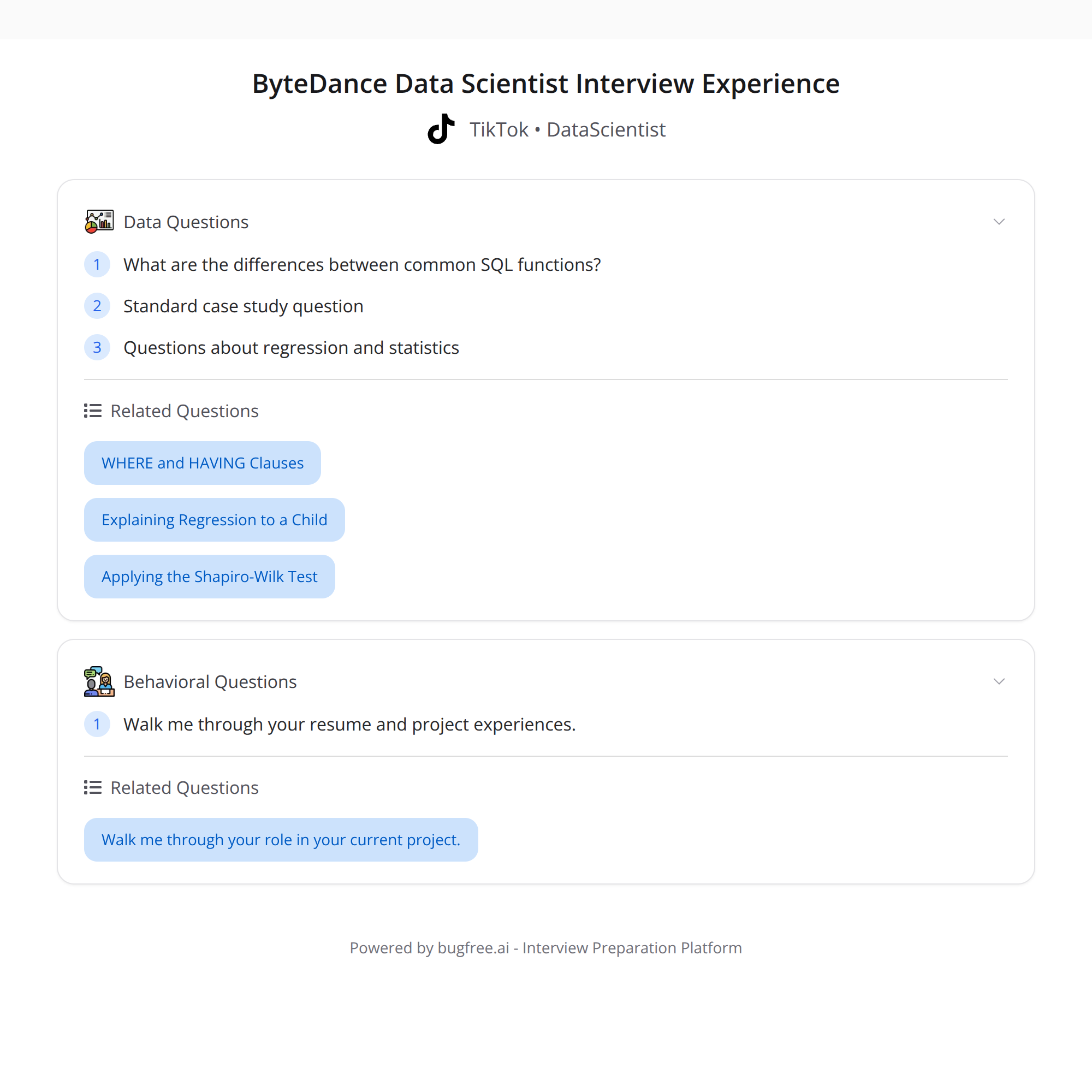
- Resume & project deep-dive (~30 minutes): The bulk of the technical conversation dove into projects. Be ready to explain impact, tradeoffs, metrics, datasets, and concrete decisions.
- SQL: Light coverage. Expect a few oral questions about function differences and intent (no live coding in this case).
- Case study + stats: Simple case-study style questions and basic regression/statistics checks—focused on reasoning and interpretation rather than heavy math.
- Follow-up & HR: Feedback took a few days. HR was professional, transparent, and willing to reroute the candidate to another role when headcount changed.
What interviewers seemed to value most
- Clear storytelling about projects: why you did it, what you measured, and how you judged success.
- Practical tradeoffs: engineering constraints, data quality issues, and time-to-impact decisions.
- Clarity on metrics: primary metrics, A/B test design, and how results influenced product decisions.
- Communication: being concise, structured, and able to translate technical results into business outcomes.
Practical prep checklist
- Project storytelling
- Prepare 2–3 projects with crisp narratives: problem, role, approach, metrics, outcome, and follow-ups.
- Quantify impact (%, absolute numbers, or velocity improvements) and be ready to defend them.
- SQL fundamentals
- Review common functions, join types, aggregation pitfalls, and when to use window functions.
- Practice explaining differences verbally (e.g., GROUP BY vs. window functions) rather than only writing queries.
- Stats & modeling
- Brush up on regression interpretation (coefficients, p-values, R²) and assumptions.
- Know basic A/B testing concepts: null hypothesis, significance, power, and common pitfalls.
- Case studies
- Practice structuring answers: clarify the problem, list assumptions, propose metrics, outline steps, and discuss validation.
- Communication
- Keep answers structured (context → action → result), call out tradeoffs, and ask clarifying questions when prompts are vague.
Example prompts you might see
- “Walk me through a project where you moved a key metric—what did you measure and how did you evaluate success?”
- “Explain the difference between LEFT JOIN and INNER JOIN, and when one is preferred.”
- “How would you set up an A/B test for a feed ranking change? What metrics and safeguards would you use?”
- “Interpret this regression output: what do you trust and what would you validate next?”
Timeline & expectations
- Initial HR screen: ~40 minutes.
- Technical round: typically scheduled a week later (can vary by team).
- Decision/follow-up: a few days; HR may offer alternate roles if headcount or priorities shift.
Final notes
This candidate’s experience shows that ByteDance’s interviews can be candidate-friendly and emphasize real product impact and communication over trick puzzles. If you’re prepping, prioritize storytelling for projects, refresh core SQL concepts, and be comfortable explaining practical stats and modeling decisions.
#DataScience #InterviewTips #CareerGrowth
If you want, I can convert the checklist into a one-week study plan or draft answers to the example prompts above.
About the author
bugfree.ai is an advanced AI-powered platform designed to help software engineers master system design and behavioral interviews. Whether you’re preparing for your first interview or aiming to elevate your skills, bugfree.ai provides a robust toolkit tailored to your needs. Key Features:
150+ system design questions: Master challenges across all difficulty levels and problem types, including 30+ object-oriented design and 20+ machine learning design problems. Targeted practice: Sharpen your skills with focused exercises tailored to real-world interview scenarios. In-depth feedback: Get instant, detailed evaluations to refine your approach and level up your solutions. Expert guidance: Dive deep into walkthroughs of all system design solutions like design Twitter, TinyURL, and task schedulers. Learning materials: Access comprehensive guides, cheat sheets, and tutorials to deepen your understanding of system design concepts, from beginner to advanced. AI-powered mock interview: Practice in a realistic interview setting with AI-driven feedback to identify your strengths and areas for improvement.
bugfree.ai goes beyond traditional interview prep tools by combining a vast question library, detailed feedback, and interactive AI simulations. It’s the perfect platform to build confidence, hone your skills, and stand out in today’s competitive job market. Suitable for:
New graduates looking to crack their first system design interview. Experienced engineers seeking advanced practice and fine-tuning of skills. Career changers transitioning into technical roles with a need for structured learning and preparation.
Comments
Join the discussionNo comments yet. Be the first to comment.