High-Score Interview Experience (Bugfree Users): ByteDance Data Scientist — What Actually Happened
A Bugfree user shared a high-scoring, candid account of their ByteDance Data Scientist interview. The process was efficient, conversational, and focused more on product impact than whiteboard puzzles. Below is a cleaned-up summary plus practical prep tips you can use.
Interview at a glance
- Friendly 40-minute HR screen that clearly set expectations and next steps.
- Technical interview (scheduled a week later) felt surprisingly approachable and conversational rather than purely algorithmic.
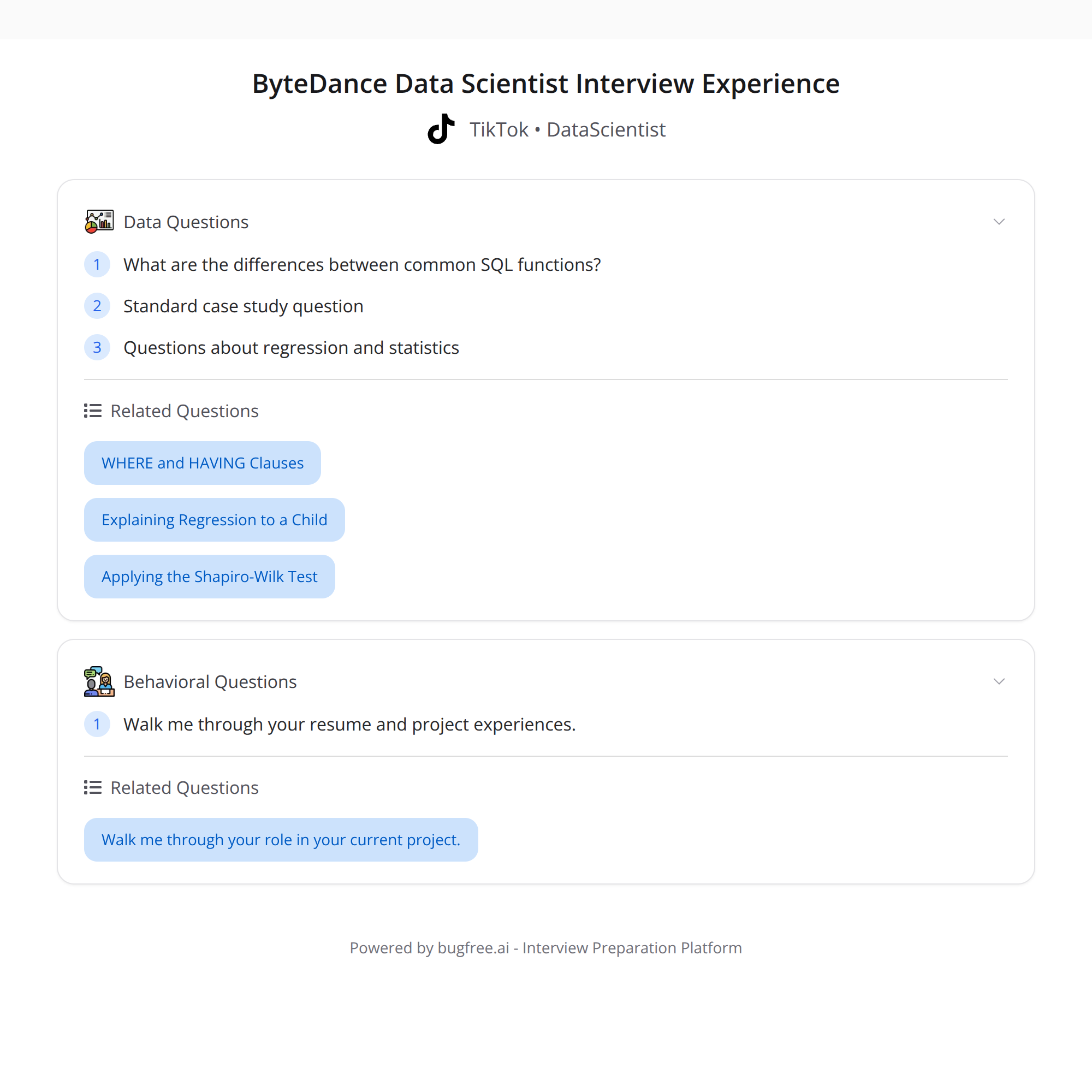
- Heavy emphasis on resume and project deep-dive (~30 minutes). Be prepared to explain impact, tradeoffs, and measurement choices.
- SQL was light — mostly oral questions about differences between functions and concepts; no live coding required.
- Case study and basic regression/statistics questions were straightforward and practical.
- Follow-up communication took a few days. HR was professional and rerouted the candidate to another role when headcount shifted.
What actually happened (expanded)
HR screen: The recruiter ran a clear 40-minute call to align expectations. They explained role scope, interview rounds, timeline, and what to prepare. This set a calm, organized tone for the process.
Technical round: Took place about a week after the screen. The interviewer favored a conversational approach:
- Large portion devoted to a deep dive into the candidate's resume and projects.
- Focus on impact: how the project influenced product metrics, what tradeoffs were considered, and how you validated results.
- Light SQL check: oral conceptual questions (e.g., differences between functions, when to use window functions vs aggregation) — no hands-on coding.
- Case study: practical, product-oriented problem solving rather than abstract puzzles.
- Basic statistics/regression: fundamental questions to validate understanding of modeling and evaluation.
Offer process & HR handling: Feedback returned in a few days. When headcount changed, HR proactively suggested and moved the candidate to an alternative role rather than leaving things hanging.
Key takeaways — what to prioritize in prep
- Storytelling for projects: You should rehearse concise narratives that cover the problem, your role, the approach, the outcome (with metrics), and tradeoffs. Use numbers wherever possible.
- Impact and metrics: Be ready to quantify impact (e.g., lift in conversion, CTR changes, revenue impact) and explain how you measured it.
- Tradeoffs & design decisions: Discuss alternatives you considered, why you chose one approach over another, and implications for production (latency, maintainability, data drift).
- SQL fundamentals: Review conceptual differences (JOIN types, window functions vs GROUP BY, aggregations, subqueries) and when to use each. Expect oral, not necessarily live-coding, questions.
- Practical stats & regression: Know basic regression interpretation (coefficients, R-squared, bias-variance), hypothesis testing, and evaluation metrics relevant to product/data science work.
- Case-style thinking: Practice structuring product-analytics problems—clarify goals, propose metrics, sketch experiments or modeling pipelines, and discuss tradeoffs.
Quick preparation checklist
- Prepare 2–3 project narratives with clear metrics and tradeoffs.
- Brush up on SQL concepts (window functions, joins, aggregations) and be able to explain differences succinctly.
- Review basic statistics and regression interpretation (p-values, confidence intervals, overfitting vs underfitting).
- Practice a short case: define the problem, propose metrics, outline an approach, and identify risks.
- Be ready to discuss production considerations: monitoring, model retraining, and data quality checks.
Final thoughts
This ByteDance interview example shows that many data science interviews value clear project storytelling and practical judgment over pure algorithmic prowess. If you emphasize impact, clear reasoning, and foundational SQL/stats concepts, you'll be well-positioned for a conversational, high-quality interview experience.
#DataScience #InterviewTips #CareerGrowth
About the author
bugfree.ai is an advanced AI-powered platform designed to help software engineers master system design and behavioral interviews. Whether you’re preparing for your first interview or aiming to elevate your skills, bugfree.ai provides a robust toolkit tailored to your needs. Key Features:
150+ system design questions: Master challenges across all difficulty levels and problem types, including 30+ object-oriented design and 20+ machine learning design problems. Targeted practice: Sharpen your skills with focused exercises tailored to real-world interview scenarios. In-depth feedback: Get instant, detailed evaluations to refine your approach and level up your solutions. Expert guidance: Dive deep into walkthroughs of all system design solutions like design Twitter, TinyURL, and task schedulers. Learning materials: Access comprehensive guides, cheat sheets, and tutorials to deepen your understanding of system design concepts, from beginner to advanced. AI-powered mock interview: Practice in a realistic interview setting with AI-driven feedback to identify your strengths and areas for improvement.
bugfree.ai goes beyond traditional interview prep tools by combining a vast question library, detailed feedback, and interactive AI simulations. It’s the perfect platform to build confidence, hone your skills, and stand out in today’s competitive job market. Suitable for:
New graduates looking to crack their first system design interview. Experienced engineers seeking advanced practice and fine-tuning of skills. Career changers transitioning into technical roles with a need for structured learning and preparation.
Comments
Join the discussionNo comments yet. Be the first to comment.