Stop Confusing Retention with “Months Stayed”: The Break‑Even Trick Interviewers Want
When you switch a customer from a one‑time purchase to a subscription, the core interview question is: how long does the subscriber need to stay to break even? The clean way to answer is to convert the one‑time profit into "months of profit," then translate months into a monthly retention rate — and avoid the common inversion mistake.
The step‑by‑step method (with numbers)
Compute the one‑time sale profit (the contribution you'd lose by moving the customer to a subscription).
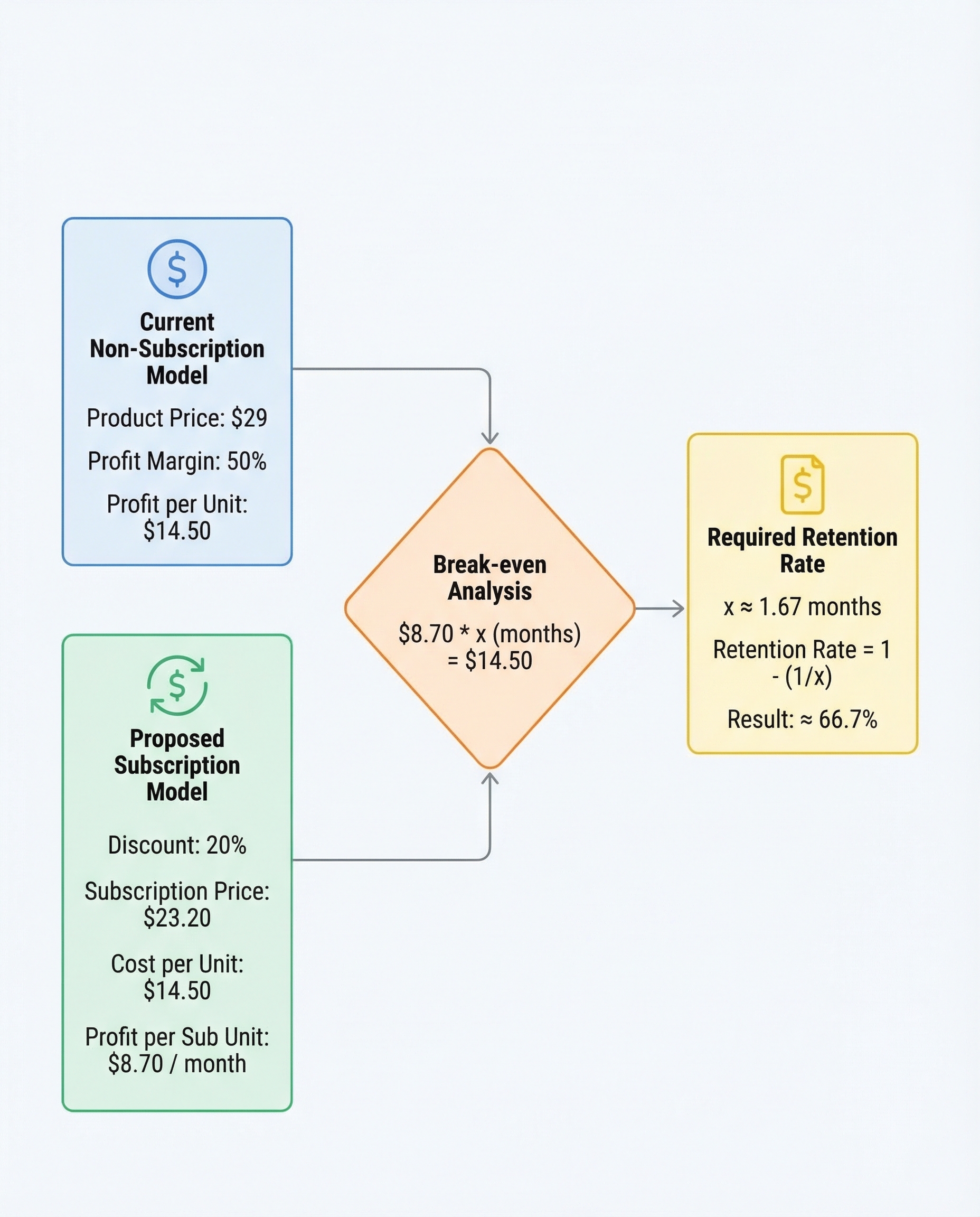
- Example: one‑time price = $29, margin = 50% → one‑time profit = 29 × 0.50 = $14.50.
Compute the subscription monthly contribution (revenue — the same cost basis as before, if you assume cost per customer is unchanged).
- Example: subscription price is 20% off → 29 × 0.80 = $23.20 monthly revenue.
- If you assume the per‑month cost basis equals the original one‑time profit's cost structure, monthly contribution = 23.20 − 14.50 = $8.70.
Find break‑even months (how many months of that monthly contribution equal the one‑time profit):
- break_even_months = one_time_profit / monthly_contribution
- Example: 14.50 / 8.70 ≈ 1.67 months.
Convert months to a monthly retention rate using the geometric retention model.
- With constant monthly retention r, expected tenure (in months) = 1 / (1 − r).
- Solve for r: r = 1 − 1 / expected_months.
- Example: 1 / (1 − r) = 1.67 → 1 − r = 1 / 1.67 ≈ 0.5988 → r ≈ 0.4012 → ~40% monthly retention.
Important: do NOT compute retention by inverting break_even_months (i.e., don't do r = 1 / months). That inversion is wrong — the correct algebra gives r = 1 − 1 / months. For the example above, the correct monthly retention is ~40% (not 60% or 66.7%).
Quick formulas cheat‑sheet
- monthly_contribution = subscription_price − assumed_cost_base
- break_even_months = one_time_profit / monthly_contribution
- monthly_retention r = 1 − 1 / break_even_months (assuming geometric retention)
Or, in terms of churn c = 1 − r: expected_months = 1 / c.
Assumptions and caveats
- We used a geometric model (constant monthly retention). Real cohorts may not follow constant retention.
- The "cost basis" used to compute monthly contribution must be consistent with how you computed the one‑time profit (same margin/cost assumptions).
- Small differences in rounding or initial assumptions can change practical recommendations; call out assumptions in an interview.
TL;DR (what to say in an interview)
"Compute one‑time profit and monthly contribution, divide to get break‑even months, then convert months to retention using r = 1 − 1 / months. In this example break‑even ≈ 1.67 months → required monthly retention ≈ 40%."
One‑sentence tip
Don't confuse "months stayed" with "monthly retention" — months is the expected tenure (1/(1−r)), and retention is 1 − 1/tenure, not 1/tenure.
About the author
bugfree.ai is an advanced AI-powered platform designed to help software engineers master system design and behavioral interviews. Whether you’re preparing for your first interview or aiming to elevate your skills, bugfree.ai provides a robust toolkit tailored to your needs. Key Features:
150+ system design questions: Master challenges across all difficulty levels and problem types, including 30+ object-oriented design and 20+ machine learning design problems. Targeted practice: Sharpen your skills with focused exercises tailored to real-world interview scenarios. In-depth feedback: Get instant, detailed evaluations to refine your approach and level up your solutions. Expert guidance: Dive deep into walkthroughs of all system design solutions like design Twitter, TinyURL, and task schedulers. Learning materials: Access comprehensive guides, cheat sheets, and tutorials to deepen your understanding of system design concepts, from beginner to advanced. AI-powered mock interview: Practice in a realistic interview setting with AI-driven feedback to identify your strengths and areas for improvement.
bugfree.ai goes beyond traditional interview prep tools by combining a vast question library, detailed feedback, and interactive AI simulations. It’s the perfect platform to build confidence, hone your skills, and stand out in today’s competitive job market. Suitable for:
New graduates looking to crack their first system design interview. Experienced engineers seeking advanced practice and fine-tuning of skills. Career changers transitioning into technical roles with a need for structured learning and preparation.
Comments
Join the discussionNo comments yet. Be the first to comment.