High-Score (Bugfree Users) Interview Experience: Bloomberg SWE — 4 Rounds That Test Coding + Real System Design
A concise write-up of a Bloomberg software engineering loop shared by a high-scoring Bugfree user. The loop balanced data structures & algorithms problems with practical, production-oriented system design and behavioral questions. Outcome: rejection two hours after the loop — still a very useful blueprint for focused prep.
Quick highlights
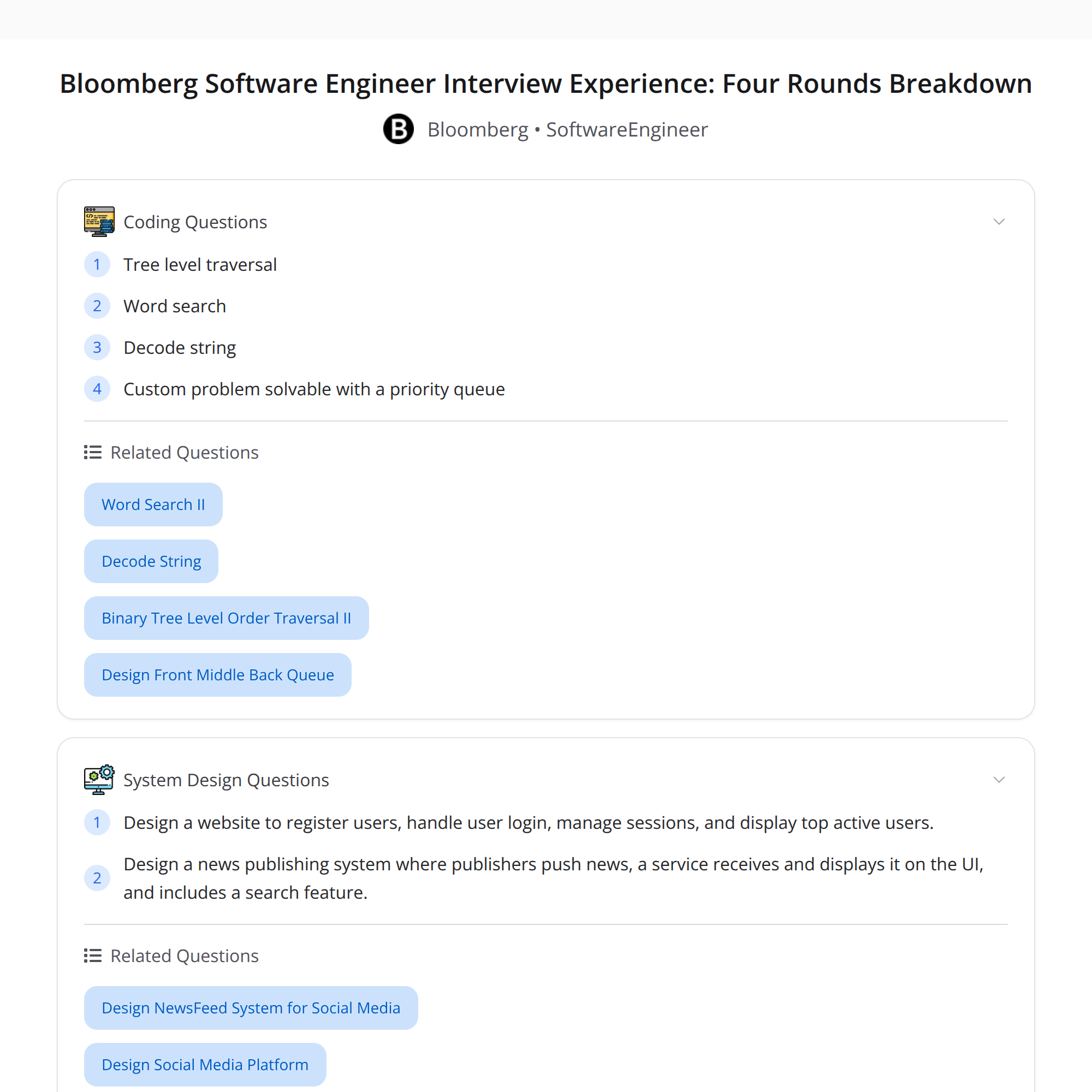
- Phone screen: tree-level traversal + word search (DS&A)
- Onsite coding: "decode string"-style problem + a custom priority-queue-based problem
- System design (Hiring Manager): user registration/login, session management, and tracking "top active users"
- System design (Tech Lead): publisher → UI news pipeline, search, and scaling considerations
- Behavioral (Sr. Manager): project pride, "Why Bloomberg?", conflict/feedback examples
Round-by-round breakdown and what to prepare
1) Phone screen — DS&A (screening)
What happened
- Two algorithm questions: one tree-level traversal and one word-search style problem.
What they evaluated
- Correct traversal strategy (BFS vs DFS), recursion vs iterative, handling edge cases, complexity analysis.
Prep tips
- Practice tree traversals (pre/in/post-order, level-order) and grid/word-search problems.
- Always state time/space complexity, walk through an example, and mention edge cases.
2) Onsite coding — algorithmic problems
What happened
- Problem A: "Decode string" (similar to LeetCode 394) — handle nested counts and bracketed substrings.
- Problem B: Custom problem that required a priority queue (heap) — probably about selecting top-k items over sliding constraints.
What they evaluated
- Clear problem decomposition, correctness, and clean code. Emphasis on test cases and performance bounds.
Prep tips
- For decode-type problems: outline stack-based solution and iterative parsing; demonstrate both correctness and complexity.
- For PQ problems: explain why a heap suits the constraints, how to maintain invariants, and discuss alternatives.
- Write concise pseudo-code, run through small examples, and handle boundary conditions.
3) System design (Hiring Manager) — auth + "top active users"
What happened
- Design user registration & login flows, session management, and a feature to track and surface "top active users."
Key design considerations
- Authentication: stateless JWT vs stateful sessions; password hashing and account verification.
- Session management: token storage, expiration, refresh flows, and logout.
- Top active users: tracking activity in real time vs near real time; windowed counts; deduplication; fairness.
Concrete options to propose
- Use a relational DB for user metadata, store sessions in a cache (Redis) if you need quick invalidation.
- Track activity counters in Redis (sorted sets) for quick top-k queries; maintain TTLs or sliding-window buckets to compute recent activity.
- For very large scale, use streaming (Kafka) → aggregator microservice → time-series DB or approximation algorithms (count-min sketch / HyperLogLog) depending on accuracy needs.
Prep tips
- Draw components, data models, and call flows. Discuss trade-offs: consistency, latency, cost, and operational complexity.
- Mention security (rate-limiting, brute-force protection, secure cookie flags/CORS).
4) System design (Tech Lead) — news pipeline, search, scalability
What happened
- End-to-end pipeline: publisher pushes news → processing/transform → storage/index → UI. Also covered search and how the system scales.
Key components and responsibilities
- Ingestion: API gateway + auth → message queue (Kafka) for decoupling.
- Processing: stream processors or workers to enrich, transform, and validate content.
- Storage & indexing: object store for content, Elasticsearch (or OpenSearch) for search and real-time queries.
- Delivery: CDN for static content, API layer for UI queries, fanout strategies for notifications.
Scalability & availability topics to discuss
- Partitioning: topic partitions in Kafka, sharding for DBs and search clusters.
- Backpressure: bounded queues, retry & DLQ strategy.
- Real-time vs eventual consistency trade-offs: how quickly should news appear in search/UI?
- Monitoring, alerting, and capacity planning.
Prep tips
- Be explicit about data flow and failure modes. Sketch how you would handle spikes and ensure low-latency reads for the UI.
- Discuss indexing strategy (what fields to shard/replicate), query patterns, and caching.
5) Behavioral (Senior Manager)
What happened
- Questions focused on: a project you’re proud of, why Bloomberg, and examples of conflict or receiving/giving feedback.
What they evaluated
- Fit with team culture, communication, ownership, and leadership potential.
Prep tips
- Use STAR (Situation, Task, Action, Result) for stories. Quantify impact when possible.
- For conflict/feedback, emphasize how you listened, iterated, and improved outcomes.
Takeaways & practical preparation plan
- Practice 3–5 targeted algorithm problems a day: trees, stacks, heaps, and graphs.
- Do timed mock interviews and practice explaining trade-offs aloud.
- For system design: prepare 3–4 end-to-end designs (auth, news pipeline, messaging, search). Be able to adapt them to scale and constraints.
- Know your resume stories cold for behavioral and leadership questions.
- Focus on communication: ask clarifying questions, outline your approach, and iterate with the interviewer.
A sample weekly plan
- Mon–Wed: DS&A practice (1–2 medium/hard problems per day).
- Thu: System design sketch and mock interview.
- Fri: Behavioral stories + one full mock loop.
- Weekend: Review weak spots, read design patterns and system trade-offs.
Resources
- LeetCode (medium/hard problems)
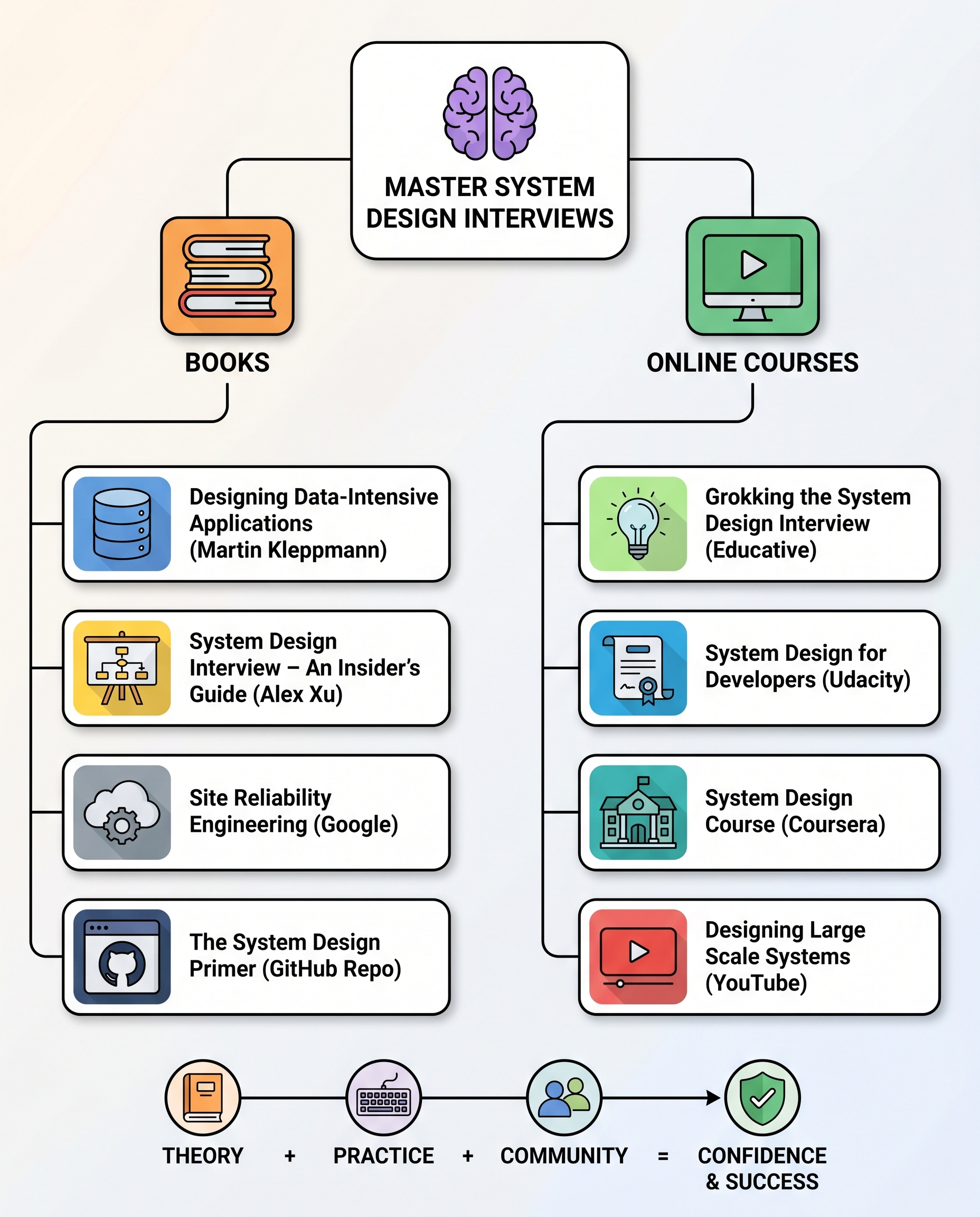
- "Grokking the System Design Interview" and real architecture case studies
- "Designing Data-Intensive Applications" for deeper systems concepts
- Cracking the Coding Interview for algorithm patterns
Final note
Getting rejected quickly doesn’t mean the interview wasn’t valuable. This loop provides a strong, realistic template for what major finance/tech SDE interviews test: clean algorithms, production-aware system design, and clear communication. Use the breakdown above to structure practice and iterate.
If you'd like, I can: provide example solutions (decode string + PQ problem), sketch the auth system architecture in a diagram-friendly layout, or create a 4-week study plan tailored to your current level.
About the author
bugfree.ai is an advanced AI-powered platform designed to help software engineers master system design and behavioral interviews. Whether you’re preparing for your first interview or aiming to elevate your skills, bugfree.ai provides a robust toolkit tailored to your needs. Key Features:
150+ system design questions: Master challenges across all difficulty levels and problem types, including 30+ object-oriented design and 20+ machine learning design problems. Targeted practice: Sharpen your skills with focused exercises tailored to real-world interview scenarios. In-depth feedback: Get instant, detailed evaluations to refine your approach and level up your solutions. Expert guidance: Dive deep into walkthroughs of all system design solutions like design Twitter, TinyURL, and task schedulers. Learning materials: Access comprehensive guides, cheat sheets, and tutorials to deepen your understanding of system design concepts, from beginner to advanced. AI-powered mock interview: Practice in a realistic interview setting with AI-driven feedback to identify your strengths and areas for improvement.
bugfree.ai goes beyond traditional interview prep tools by combining a vast question library, detailed feedback, and interactive AI simulations. It’s the perfect platform to build confidence, hone your skills, and stand out in today’s competitive job market. Suitable for:
New graduates looking to crack their first system design interview. Experienced engineers seeking advanced practice and fine-tuning of skills. Career changers transitioning into technical roles with a need for structured learning and preparation.
Comments
Join the discussionNo comments yet. Be the first to comment.