Overview
A Bugfree user shared a high-score interview experience for Bloomberg's Software Engineer (SWE) loop. The loop was a balanced mix of data structures & algorithms (DS&A) problems and practical system design sessions. This write-up summarizes each round, highlights what the interviewers were testing, and offers focused tips for preparation.
Outcome: Rejected two hours after the onsite — still a useful blueprint for prepping similar interviews.
Quick highlights
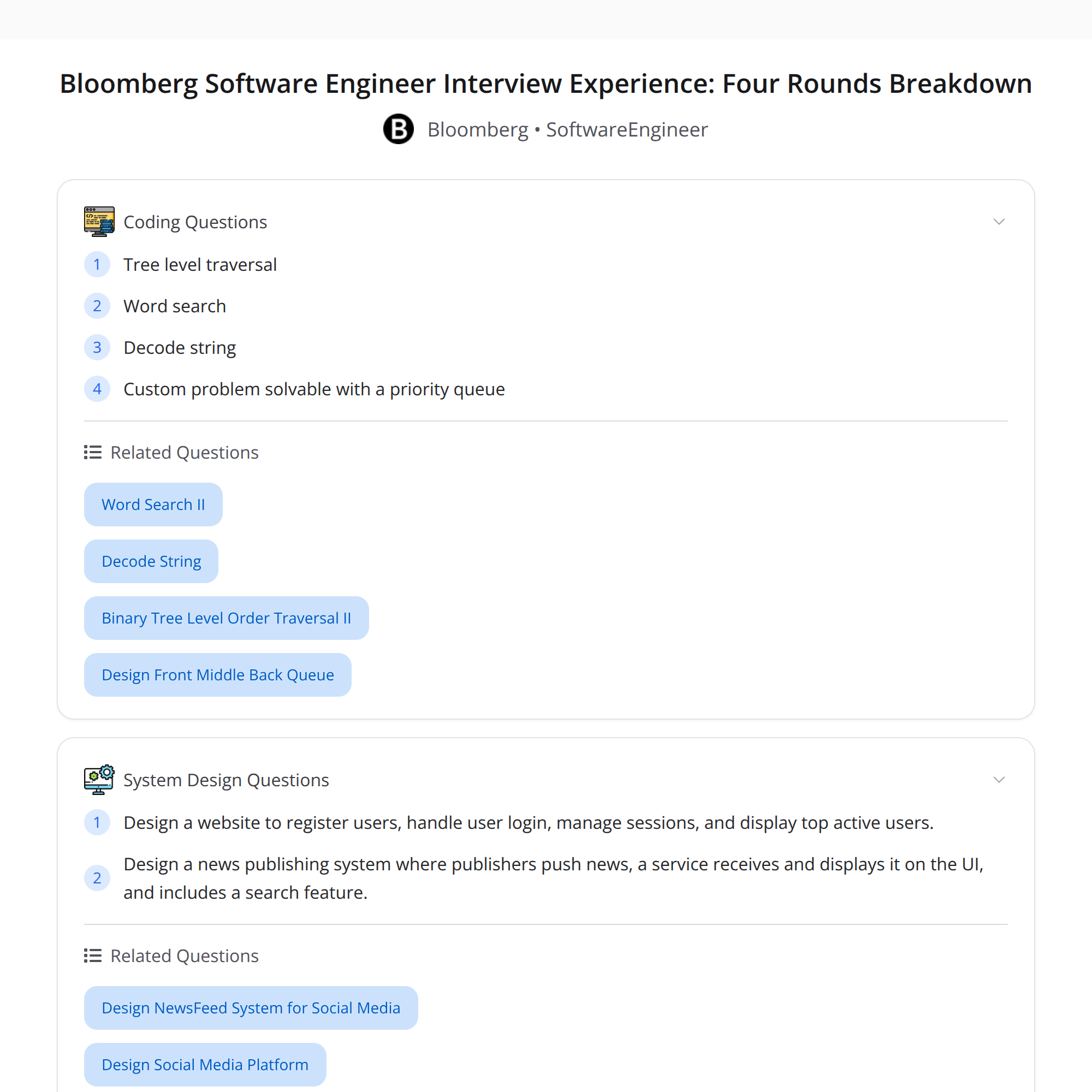
- Phone screen: tree-level traversal + word search
- Onsite coding:
decode stringstyle problem + a custom priority-queue problem - System design (HM): user registration/login, session management, and tracking "top active users"
- System design (TL): publisher-to-UI news pipeline, search, and scalability
- Behavioral (Sr Mgr): project pride, "Why Bloomberg?", conflict/feedback
Round-by-round breakdown
1) Phone screen — Tree traversal + word search
What they asked
- A traversal problem on a tree (likely tests recursion/iteration and complexity reasoning)
- A word-search-like problem (string/DFS backtracking — think LeetCode 79)
What interviewers assess
- Clarity in choosing DFS vs BFS
- Handling edge cases and input shape (empty tree, large depth)
- Time/space complexity analysis
Prep tips
- Practice recursive and iterative tree traversals; articulate stack usage and base cases
- For word search, explain visited-marking strategies and pruning to avoid TLE
2) Onsite coding — Decode string + priority-queue custom problem
Problem 1: Decode string
- Typical pattern: use stack(s) or recursion to expand encoded patterns like
3[a2[c]] - Explain approach, run through an example, and state complexity O(n * k) behavior where k is repeat factor
Problem 2: Custom priority-queue problem
- They gave a problem requiring a custom comparator or an augmented heap (e.g., maintain top-K or order by multiple fields)
What interviewers assess
- Ability to derive and implement heap-based solutions
- Handling tie-breakers and updating elements in a priority queue
- Writing clean, bug-free code under time pressure
Prep tips
- Refresh stack and heap implementations and common patterns (top-K, sliding window with heap)
- Practice writing comparator functions and in-place heap operations
- Verbally walk through invariants (what the heap stores and why)
3) System design (Hiring Manager) — Auth + session management + "top active users"
Scope
- User registration/login, session/token management, and a feature to track/display the top active users in near real-time
Key design considerations
- Auth: stateless JWT vs stateful sessions — tradeoffs for revocation and scale
- Session management: cookie/session store, Redis for session storage, TTL, refresh tokens
- "Top active users": counters, rolling windows (e.g., last 24 hours), approximate counting (HyperLogLog, Count-Min Sketch) vs exact counters
- Caching and freshness: how often to update the ranking, caching layer for UI
- Consistency and scaling: sharding counters, using a distributed datastore vs analytics pipeline
Architecture sketch
- Ingest auth requests via API gateway → auth service → store credentials in DB (hashed) and sessions in Redis
- Activity events emitted to a message queue (Kafka) → real-time aggregator service maintains per-user activity counts → leaderboard service exposes top-N
Prep tips
- Know basic auth flows, session invalidation strategies, and secure storage best practices
- Be ready to justify eventual consistency and explain how to keep leaderboard reasonably fresh
4) System design (Tech Lead) — Publisher → UI news pipeline + search + scalability
Scope
- End-to-end news publishing pipeline: publisher services, message bus, indexing for search, and delivering to user-facing UI
Key design considerations
- Ingestion: buffer publishers via a message queue (Kafka) to decouple producers and consumers
- Processing: stream processors for enrichment, deduplication, and extracting metadata
- Storage & Search: index news articles into a search engine (Elasticsearch/Opensearch), design schemas and analyzers
- Delivery: CDN and caching for read-heavy endpoints, personalization layer for relevance
- Scalability & reliability: partitioning topics, consumer groups, backpressure handling, batching, monitoring
Prep tips
- Understand how indexing latency affects freshness and how to architect for near real-time search
- Know tradeoffs between monolithic indexing vs micro-batching and eventual consistency models
5) Behavioral (Senior Manager)
Topics covered
- Describe a project you’re proud of — focus on impact and ownership
- Why Bloomberg? — be specific about product, data, or culture fit
- Handling conflict or feedback — use STAR: Situation, Task, Action, Result
Prep tips
- Prepare 3 concise STAR stories (ownership, conflict, impact)
- Tie your answers to Bloomberg’s domain (finance, low-latency systems, data quality) if possible
Key takeaways & tactical prep checklist
- Practice both classic DS&A problems and non-trivial heap/stack problems under timed conditions
- Rehearse common system-design patterns: auth/session, leaderboards, message queues, real-time pipelines
- For design rounds, sketch architecture first, list bottlenecks, then iterate on scaling and consistency
- For coding rounds, always run through examples and edge cases before coding; explain complexity clearly
- Prepare STAR stories for behavioral rounds and connect them to the company’s mission
Common pitfalls to avoid
- Skipping clarification questions (assumptions matter)
- Not discussing trade-offs when designing for scale
- Writing code without dry-running corner cases
- Over-optimizing prematurely — get a correct solution first, then improve
Final note
Rejection came quickly, but this loop provides an excellent template for what Bloomberg (and similar companies) evaluate: solid algorithmic thinking, clean heap/stack implementations, and practical system design that balances correctness, latency, and scalability.
#SoftwareEngineering #SystemDesign #InterviewPrep
About the author
bugfree.ai is an advanced AI-powered platform designed to help software engineers master system design and behavioral interviews. Whether you’re preparing for your first interview or aiming to elevate your skills, bugfree.ai provides a robust toolkit tailored to your needs. Key Features:
150+ system design questions: Master challenges across all difficulty levels and problem types, including 30+ object-oriented design and 20+ machine learning design problems. Targeted practice: Sharpen your skills with focused exercises tailored to real-world interview scenarios. In-depth feedback: Get instant, detailed evaluations to refine your approach and level up your solutions. Expert guidance: Dive deep into walkthroughs of all system design solutions like design Twitter, TinyURL, and task schedulers. Learning materials: Access comprehensive guides, cheat sheets, and tutorials to deepen your understanding of system design concepts, from beginner to advanced. AI-powered mock interview: Practice in a realistic interview setting with AI-driven feedback to identify your strengths and areas for improvement.
bugfree.ai goes beyond traditional interview prep tools by combining a vast question library, detailed feedback, and interactive AI simulations. It’s the perfect platform to build confidence, hone your skills, and stand out in today’s competitive job market. Suitable for:
New graduates looking to crack their first system design interview. Experienced engineers seeking advanced practice and fine-tuning of skills. Career changers transitioning into technical roles with a need for structured learning and preparation.
Comments
Join the discussionNo comments yet. Be the first to comment.