
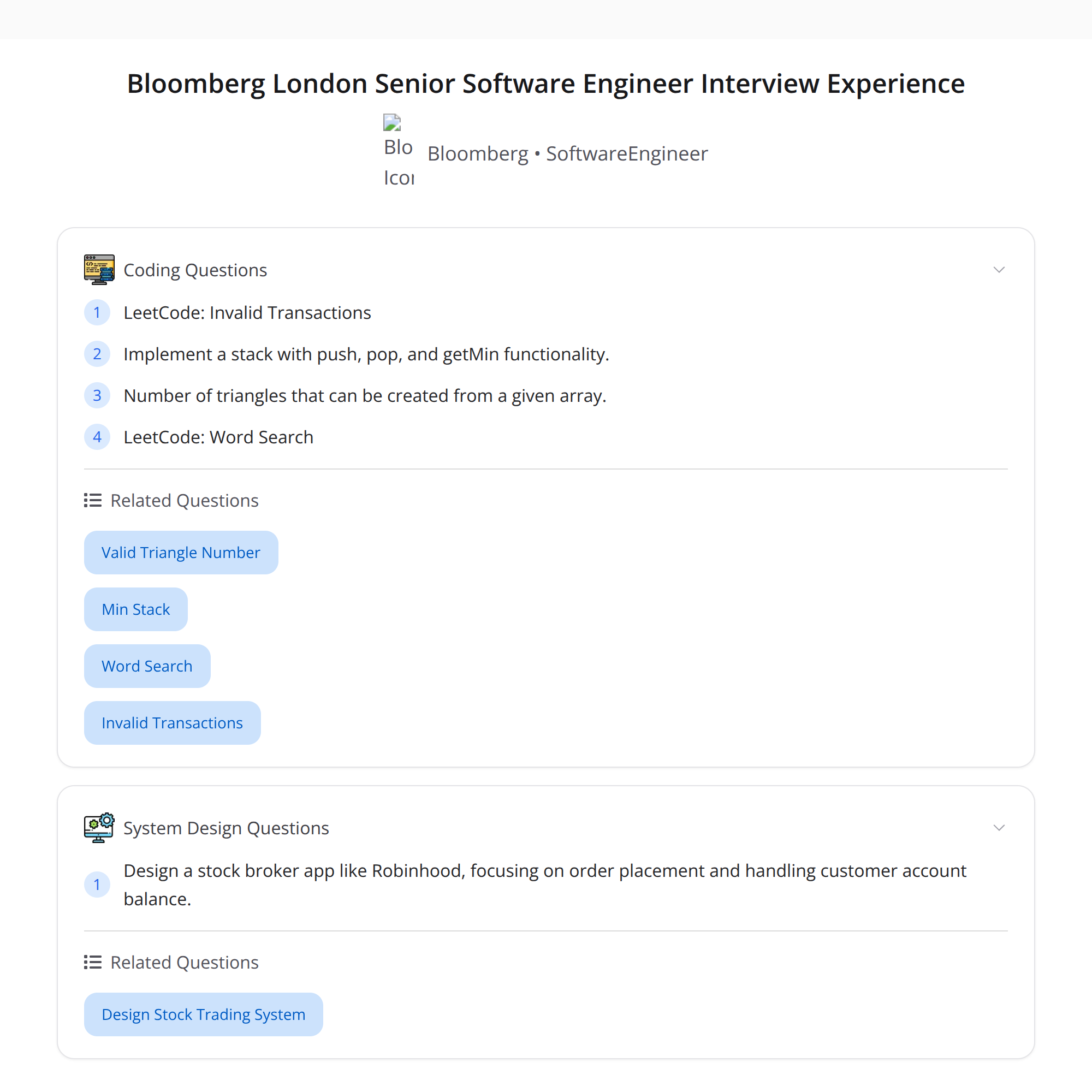
Bloomberg London Senior SWE Interview — Coding & System Design Highlights
Posted by Bugfree Users — High-Score Interview Experience.
I interviewed for a Senior Software Engineer role at Bloomberg (London). The process sharpened both my algorithmic skills and system-design instincts. I didn’t get the offer, but the experience highlighted useful patterns and concrete problems to practice.
Quick overview
- Phone screen: focused on core DS/Algo questions.
- Onsite round 1: algorithm-heavy — array and backtracking problems.
- Onsite round 2: system design — a Robinhood-like trading app with immediate trade-offs around order placement and account balance.
Below I summarize the concrete problems I faced, how I approached them, and practical tips to prepare for similar interviews.
Phone screen — problems & tips
Invalid Transactions (edge cases + efficiency)
- Problem pattern: string parsing, grouping by person, date/time windows and cross-checking.
- Key tips: handle parsing robustly, consider sorting or bucketing by name/time, and watch for off-by-one and timezone/format edge cases.
- Efficiency: aim for O(n log n) with sorting or O(n) with appropriate hashing/bucketing.
MinStack (push/pop/getMin)
- Common solutions:
- Pair each stack element with the current min (store tuples).
- Use two stacks: one regular stack and one min-stack that stores current minima.
- For constant-space trick: store encoded values to recover previous min (more error-prone — use only if asked).
- Tip: state complexity guarantees (O(1) for push/pop/getMin) and discuss space trade-offs.
- Common solutions:
Onsite Round 1 — algorithm highlights
Count valid triangles from an array (optimize to O(n^2))
- Approach: sort the array, then for each i use two pointers (left, right) to count pairs where arr[i] + arr[left] > arr[right].
- Complexity: sorting O(n log n) + two-pointer loops O(n^2).
- Pitfalls: watch integer overflow in other languages; clearly explain why sorting enables the two-pointer method.
Word Search (backtracking / recursion)
- Approach: DFS from each cell that matches the first letter, maintain a visited matrix, backtrack on dead ends.
- Tips: prune early (mismatch or out-of-bounds), mark visited in-place if allowed (and restore), and bound recursion depth.
- Complexity: worst-case expensive, so explain pruning and average-case expectations.
Onsite Round 2 — system design: Robinhood-like broker app
Prompt: design a stock broker app similar to Robinhood. The interviewer pushed on a core trade-off quickly: how do you handle order placement vs. account balance checks? That drove the architecture discussion.
Key design concerns and recommended components:
Requirements & Constraints (first questions to ask)
- Functional: place orders (market/limit), view portfolio, deposit/withdraw, order history, cancellations.
- Non-functional: latency (ms for order placement), throughput, consistency of balances, durability, regulatory/audit logging.
Core components
- Client API / Gateway: auth, rate-limiting, request validation.
- Order Service: validates order, reserves funds (or collateral), and forwards to Matching Engine.
- Matching Engine / Order Book: matches buy/sell orders, supports market and limit orders, keeps best-price book per symbol.
- Balance & Ledger Service: authoritative account balances, reservations/holds, transaction history and reconciliation.
- Clearing & Settlement / External Exchanges: connectivity to market venues and handling settlement flows.
- Persistence & Audit: durable logs (append-only ledger), event sourcing or write-ahead logs for traceability.
The immediate trade-off: optimistic vs. pessimistic balance handling
- Pessimistic (reserve funds on order placement): prevents overspending, stronger invariants, simpler reasoning for compliance, but requires low-latency locking or an atomic reservation system.
- Optimistic (allow order placement then reconcile): improves throughput and UX but risks oversubscription; needs strong reconciliation and compensating actions.
- For a retail broker with regulatory constraints, prefer reserving funds (pessimistic) or at least a hybrid model where high-value or margin orders require reservations.
Consistency & Concurrency
- Use transactional/atomic operations for balance changes and reservations (optimistic concurrency control or database transactions).
- Idempotency for order submissions and robust retry strategies for network failures.
Scalability & Availability
- Partition order books by symbol/ shard by ticker to scale matching.
- Use async pipelines for non-latency-critical tasks (reporting, analytics), but keep order placement and matching on the fast path.
Observability & Testing
- Metrics (latency, throughput, failed orders), tracing, and durable audit logs for compliance.
- Chaos testing and load tests that simulate flash volumes.
What I learned & advice for prepping
For coding rounds:
- Practice edge-case-heavy parsing problems and data-structure invariants.
- Master two-pointer patterns for array pair counting and backtracking templates for grid/DFS problems.
- When explaining, state complexity clearly and justify why your approach is correct.
For system design:
- Start by clarifying requirements and constraints aloud.
- Explicitly state the trade-offs (e.g., latency vs. safety) and choose one defensibly.
- Sketch components and data flows; call out scaling, consistency, and failure modes.
After any interview, reflect and extract 3–4 action items to practice (I implemented a tighter two-pointer template, reworked ledger consistency examples, and practiced fast requirement-clarifying questions).
Final note
I didn’t receive an offer, but the process was a great checkpoint. If you’re preparing for senior SWE interviews at finance/tech companies, focus both on polished algorithm patterns and clear, defensible system-design trade-offs.
#SoftwareEngineering #SystemDesign #InterviewPrep
About the author
bugfree.ai is an advanced AI-powered platform designed to help software engineers master system design and behavioral interviews. Whether you’re preparing for your first interview or aiming to elevate your skills, bugfree.ai provides a robust toolkit tailored to your needs. Key Features:
150+ system design questions: Master challenges across all difficulty levels and problem types, including 30+ object-oriented design and 20+ machine learning design problems. Targeted practice: Sharpen your skills with focused exercises tailored to real-world interview scenarios. In-depth feedback: Get instant, detailed evaluations to refine your approach and level up your solutions. Expert guidance: Dive deep into walkthroughs of all system design solutions like design Twitter, TinyURL, and task schedulers. Learning materials: Access comprehensive guides, cheat sheets, and tutorials to deepen your understanding of system design concepts, from beginner to advanced. AI-powered mock interview: Practice in a realistic interview setting with AI-driven feedback to identify your strengths and areas for improvement.
bugfree.ai goes beyond traditional interview prep tools by combining a vast question library, detailed feedback, and interactive AI simulations. It’s the perfect platform to build confidence, hone your skills, and stand out in today’s competitive job market. Suitable for:
New graduates looking to crack their first system design interview. Experienced engineers seeking advanced practice and fine-tuning of skills. Career changers transitioning into technical roles with a need for structured learning and preparation.
Comments
Join the discussionNo comments yet. Be the first to comment.


