
Behavioral rounds aren’t "soft." They’re evidence-based. Top candidates win because they prepare with intent and tell credible, focused stories—never ramble. Use the STAR framework, map stories to the role and company values, and show measurable impact.
What top candidates do (and how you can too)
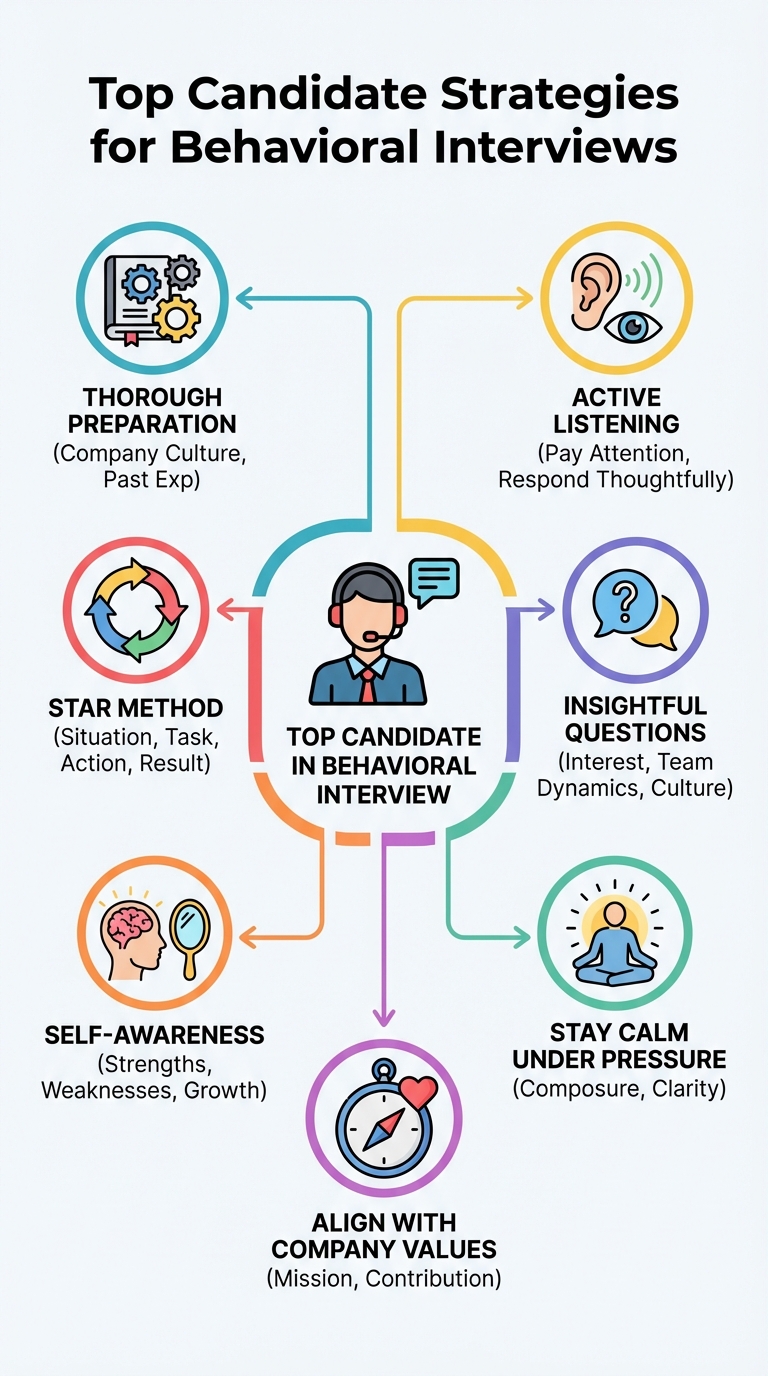
1) Research values and role signals; map your stories to them
- Read the job description for repeated phrases (e.g., "customer-centric", "ownership").
- Scan the company's mission page, team bios, and recent blog posts or PR to surface values and priorities.
- Map 6–8 of your best stories to those signals so you can quickly pick the one that fits the question.
- Tip: annotate each story with 2–3 keywords (e.g., "cross-functional", "latency reduced", "mentored") so it's easy to recall.
2) Answer with STAR: Situation, Task, Action, Result—no rambling
- Situation: 1–2 sentences of context.
- Task: What was your responsibility or goal?
- Action: The steps you took (focus on your contributions).
- Result: Quantified outcome or learning; include metrics when possible.
Quick example:
- Situation: Our API latency was increasing during peak traffic.
- Task: I led a small task force to reduce tail latency.
- Action: We profiled services, added timeouts, and implemented retry/backoff logic.
- Result: 95th-percentile latency dropped 40% and error rates fell by 60%.
3) Show self-awareness: strengths, weaknesses, and what you changed
- Be specific about a real weakness and the concrete steps you took to improve.
- Pair the weakness with a measurable improvement or a distinct behavioral change.
- Example: "I used to overcommit; now I set clearer scope with stakeholders and block time for focused work, which reduced missed deadlines by X%."
4) Listen actively; answer the exact question asked
- Pause after the interviewer finishes; 1–3 seconds of silence is fine.
- If the question is ambiguous, ask a clarifying question before answering.
- If you get off-track, gently steer back: "To focus on the core ask..."
5) Bring sharp questions (team dynamics, success metrics, growth)
Good examples to ask near the end:
- "How do you measure success for this role in the first 3–6 months?"
- "What's the current team's biggest technical or product challenge?"
- "How do decisions get made here and how do teams collaborate cross-functionally?"
These questions show you care about impact, context, and collaboration—not just perks.
6) Stay calm: breathe, pause, think
- Use a short breathing technique before answering (inhale 4, hold 3, exhale 6) to slow your mind.
- If you need a moment to organize thoughts, say: "Good question—I'd like 15 seconds to structure my answer." Interviewers expect it.
Common mistakes to avoid
- Rambling without a clear result.
- Treating behavioral interviews like hypothetical debates instead of evidence-sharing.
- Repeating generic strengths without examples.
- Only praising past teammates or companies without describing your personal contribution.
Quick prep checklist (30–60 minutes)
- Identify 6–8 meaningful stories and label them with role/value keywords.
- For each story, write a one-sentence Situation and Result, then flesh out Action.
- Prepare 4–6 sharp questions to ask the interviewer.
- Practice one STAR story aloud and time it to ~60–90 seconds.
Your job: tell a credible story, not a perfect one. Interviewers want evidence of impact, learning, and consistent judgment—not flawless heroes. Make every answer a compact, honest narrative that demonstrates how you’ll contribute.
About the author
bugfree.ai is an advanced AI-powered platform designed to help software engineers master system design and behavioral interviews. Whether you’re preparing for your first interview or aiming to elevate your skills, bugfree.ai provides a robust toolkit tailored to your needs. Key Features:
150+ system design questions: Master challenges across all difficulty levels and problem types, including 30+ object-oriented design and 20+ machine learning design problems. Targeted practice: Sharpen your skills with focused exercises tailored to real-world interview scenarios. In-depth feedback: Get instant, detailed evaluations to refine your approach and level up your solutions. Expert guidance: Dive deep into walkthroughs of all system design solutions like design Twitter, TinyURL, and task schedulers. Learning materials: Access comprehensive guides, cheat sheets, and tutorials to deepen your understanding of system design concepts, from beginner to advanced. AI-powered mock interview: Practice in a realistic interview setting with AI-driven feedback to identify your strengths and areas for improvement.
bugfree.ai goes beyond traditional interview prep tools by combining a vast question library, detailed feedback, and interactive AI simulations. It’s the perfect platform to build confidence, hone your skills, and stand out in today’s competitive job market. Suitable for:
New graduates looking to crack their first system design interview. Experienced engineers seeking advanced practice and fine-tuning of skills. Career changers transitioning into technical roles with a need for structured learning and preparation.
Comments
Join the discussionNo comments yet. Be the first to comment.