Technical interviews test more than technical correctness — they test trust. Recruiters want to know who you are under pressure, how you learn from mistakes, and whether you’ll fit the team. That means your behavioral answers must be memorable, human, and credible.
Make STAR stories feel real: add emotion and empathy
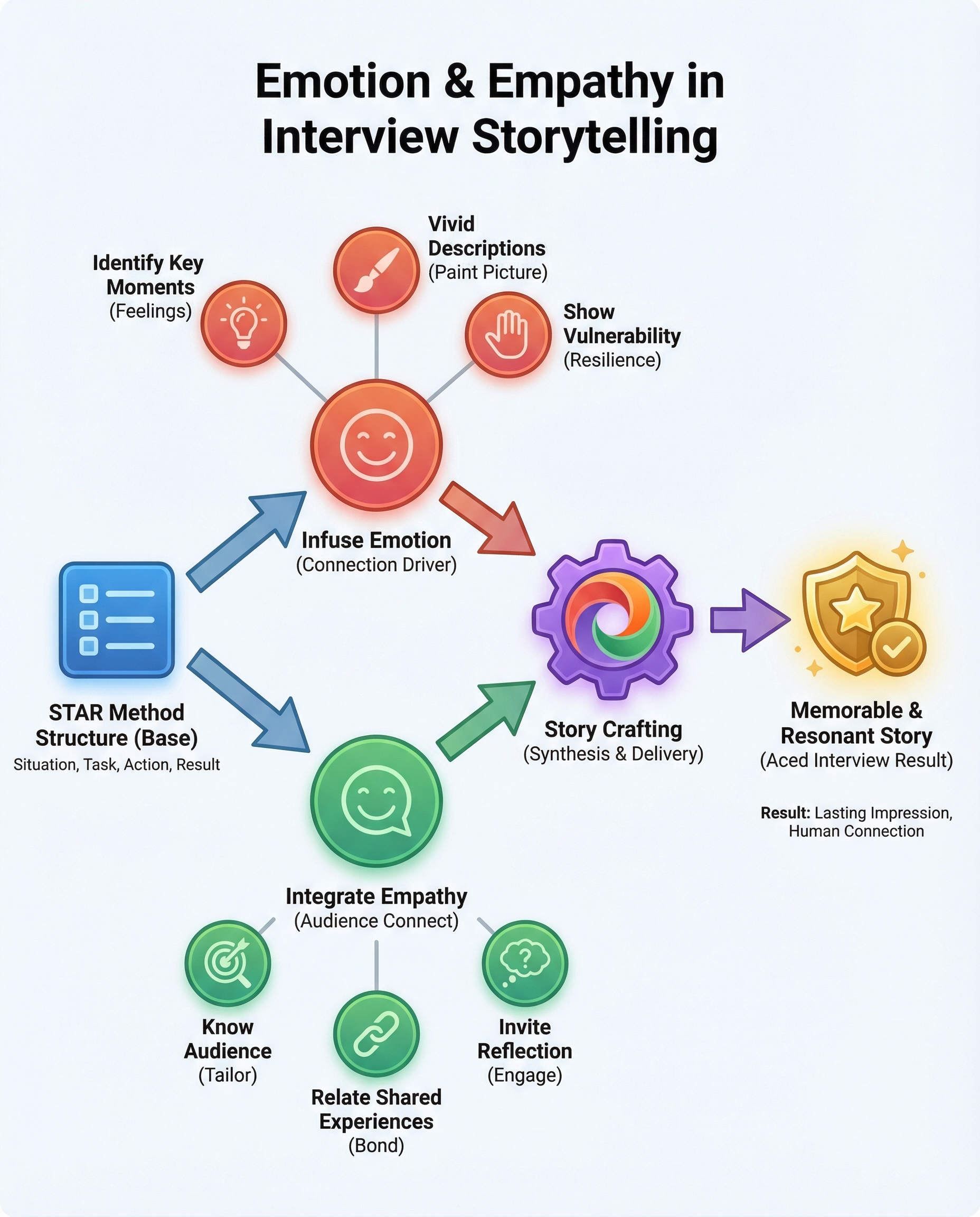
Keep the STAR framework (Situation, Task, Action, Result) for clarity. Then layer two human elements on top:
- Use emotion: pick moments with real stakes. Say what you felt — pressure, doubt, responsibility — and show vulnerability. Describe failures and the lessons you took away.
- Use empathy: connect your story to the company’s values or shared engineering challenges. Invite reflection with a brief question to the interviewer (e.g., “Have you seen this at your team?”).
These additions turn a factual recap into a story that interviewers remember and care about.
How to weave emotion into STAR
- Situation: set the scene and the stakes. Don’t just list facts — share the personal cost or risk.
- Task: explain what responsibility landed on you and why it mattered to you.
- Action: describe the steps, including emotional decisions (e.g., choosing transparency over sheltering the truth).
- Result: give numbers or outcomes, then close with what it taught you and how it changed your approach.
Example — before vs. after:
Before (flat): “I found a bug in the pipeline and fixed it.”
After (human): “Two days before launch, our data pipeline failed. I was worried we’d miss the deadline and let the team down. I stayed late, isolated the issue to a schema mismatch, and coordinated a hotfix. We launched on time. That night I realized we needed better checks; I drove a new CI test that reduced similar incidents by 70%.”
Notice the emotional cues: worry, responsibility, late-night effort — and the clear lesson.
How to add empathy
- Research the company’s mission, values, or published engineering challenges.
- Tie your story to a shared problem (scalability, data quality, cross-team communication).
- Ask a short, open question to engage the interviewer: “Have you seen this at your team?” or “Does your team prioritize transparency in incidents?”
This signals you’re not just solving problems — you’re aligned with their priorities.
Quick STAR + Emotion + Empathy template
- Situation: "At Company X, we faced [problem]. I felt [emotion] because [why it mattered]."
- Task: "I was responsible for [goal/task], and it mattered because [impact]."
- Action: "I did [steps]. Midway, I realized [vulnerability/uncertainty]. I addressed that by [what you changed]."
- Result: "We achieved [metric/outcome]. I learned [insight]. Has your team handled similar trade-offs between speed and reliability?"
Practice prompts
- Describe a time you missed a shipping target. What did you feel and what did you change?
- Tell me about a time you disagreed with a peer on design. How did you handle it emotionally and practically?
- Share a failure that still bothers you. What would you do differently now?
- Describe an incident where you had to communicate bad news. How did you balance honesty and confidence?
- Give an example of improving a process after a near-miss. What convinced you it was worth the effort?
Practice aloud, keep answers to ~2–3 minutes, and be specific. Authenticity beats a perfect-sounding script.
Final tip
Interviewers hire people they trust to act well under pressure. Use STAR to stay structured — then add emotion, vulnerability, and empathy to make your story stick.
#BehavioralInterview #SoftwareEngineering #DataScience
About the author
bugfree.ai is an advanced AI-powered platform designed to help software engineers master system design and behavioral interviews. Whether you’re preparing for your first interview or aiming to elevate your skills, bugfree.ai provides a robust toolkit tailored to your needs. Key Features:
150+ system design questions: Master challenges across all difficulty levels and problem types, including 30+ object-oriented design and 20+ machine learning design problems. Targeted practice: Sharpen your skills with focused exercises tailored to real-world interview scenarios. In-depth feedback: Get instant, detailed evaluations to refine your approach and level up your solutions. Expert guidance: Dive deep into walkthroughs of all system design solutions like design Twitter, TinyURL, and task schedulers. Learning materials: Access comprehensive guides, cheat sheets, and tutorials to deepen your understanding of system design concepts, from beginner to advanced. AI-powered mock interview: Practice in a realistic interview setting with AI-driven feedback to identify your strengths and areas for improvement.
bugfree.ai goes beyond traditional interview prep tools by combining a vast question library, detailed feedback, and interactive AI simulations. It’s the perfect platform to build confidence, hone your skills, and stand out in today’s competitive job market. Suitable for:
New graduates looking to crack their first system design interview. Experienced engineers seeking advanced practice and fine-tuning of skills. Career changers transitioning into technical roles with a need for structured learning and preparation.
Comments
Join the discussionNo comments yet. Be the first to comment.