Behavioral Interviews: Make Your STAR Stories Unforgettable with Emotion + Empathy
Technical interviews aren’t only about correctness—they’re about trust. Hiring teams hire people they trust to make decisions, collaborate under pressure, and learn from failure. That’s why your behavioral answers must be remembered.
Below is a compact playbook to turn a competent STAR answer into a human, memorable story using emotion and empathy.
Why this matters
- Technical skill proves you can do the job; behavioral answers prove you’ll do it well with others.
- Interviewers remember stories that feel real: high stakes, emotions, vulnerability, and values alignment.
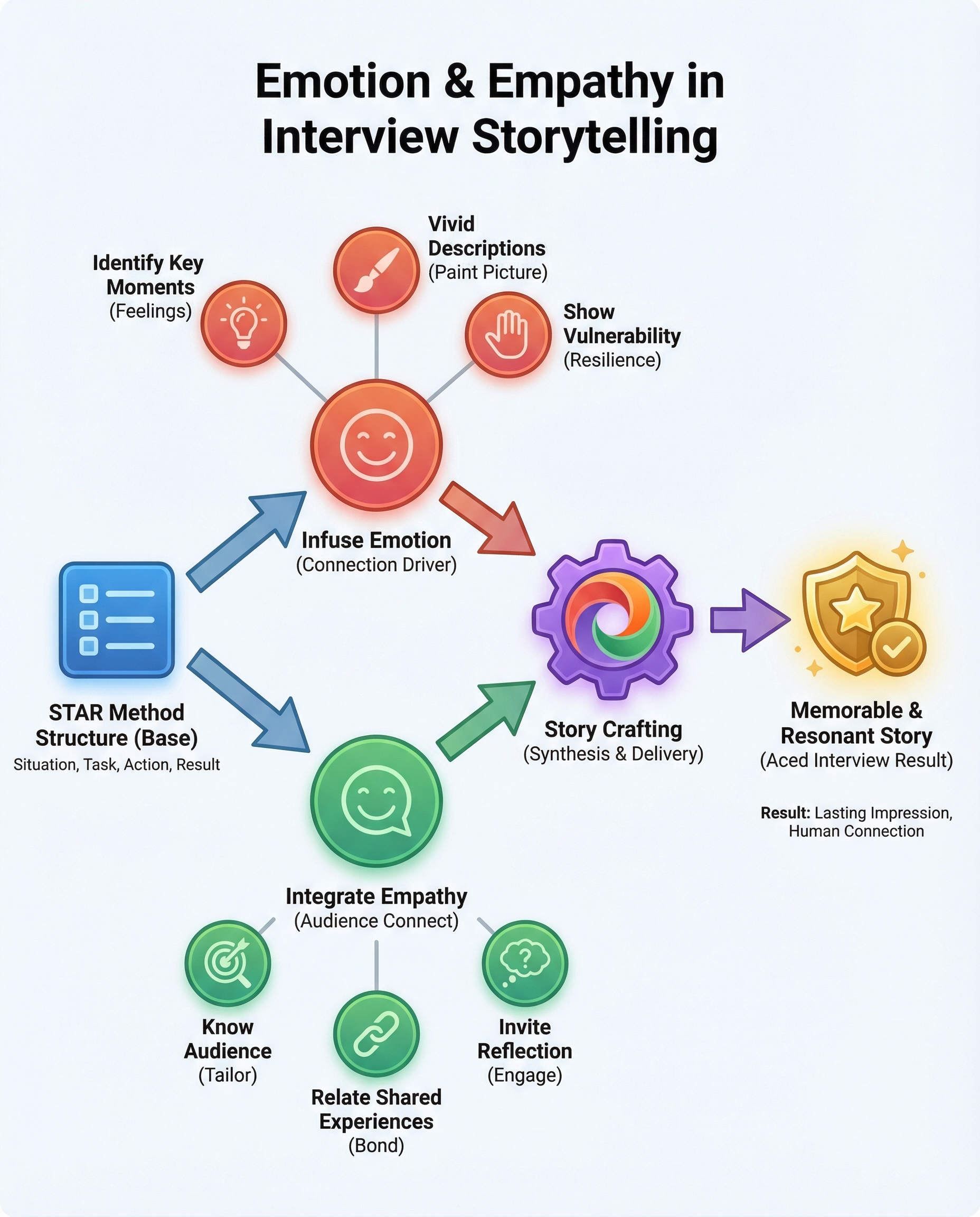
Use emotion: pick the stakes and show human truth
- Choose a high-stakes moment: outages, tight deadlines, customer impact, or team conflict.
- Name your feelings succinctly: pressure, doubt, responsibility, pride—don’t hide them.
- Show vulnerability: say what went wrong, what you doubted, and what you learned.
Short example lines to weave in:
- “I felt the pressure when…"
- “I was worried that we’d lose customer trust…"
- “At first I got it wrong—here’s what that taught me…"
Use empathy: connect to the interviewer and the company
- Research the company’s values (e.g., reliability, customer obsession, collaboration) and tie your story to them.
- Connect to shared technical challenges (scale, latency, data quality) to show domain empathy.
- Invite reflection: end with a question like, “Have you seen this at your team?” or “How does your team prioritize trade-offs like this?”
This signals you’re not just telling a tale—you’re engaging in a conversation.
Keep structure with STAR, then add human depth
Use the classic STAR (Situation, Task, Action, Result) as the scaffold, then layer emotion and empathy into each part.
- Situation: set the stakes and your emotional state briefly. (“We had a three-hour outage before launch; I was terrified the users’ trust would evaporate.”)
- Task: define the goal and personal responsibility. (“My job was to restore service and keep stakeholders informed.”)
- Action: describe concrete steps—and your thought process, doubts, and how you involved others. (“I prioritized customer-facing fixes, admitted uncertainty to the PM, and rallied two engineers to test a rollback.”)
- Result: quantify outcomes and state the lesson and connection to company values. (“We restored service in 3 hours, reduced recurrence by 80% with automated checks, and I learned the value of transparent communication.”)
Example: Enhanced STAR with emotion + empathy
Situation: "We discovered a production database migration would overload reads right before a major product launch. I felt immediate pressure—this could break customer experience and the launch timeline."
Task: "As the release owner, I had to decide whether to pause the migration, roll back, or accept increased risk."
Action: "I quickly convened the core team, admitted uncertainty about the migration plan, and we ran a focused risk test on a replica. I prioritized steps that minimized customer impact, communicated trade-offs to the PM and support leads, and prepared a rollback play. I also asked the team, ‘Have you seen this pattern before and what would you do?’ to get ideas fast."
Result: "We paused the migration, implemented a lightweight throttling change, and went live without customer impact. The rollout window slipped by one day, but complaints stayed below our threshold. Post-mortem actions cut related incidents by ~70%. The lesson: transparency and quick, focused experiments beat silent optimism—aligned with your company value of customer-first reliability."
Quick checklist to practice before interviews
- Pick 3-4 strong, high-stakes stories from your experience.
- Write each in STAR form, then add 1–2 sentences for feeling + 1 for empathy/company tie-in.
- Practice aloud until your emotions sound genuine but concise (not theatrical).
- Prepare 1 reflective question per story to invite interviewer input.
Closing tips
- Be honest: vulnerability builds trust faster than polished perfection.
- Be concise: emotion should amplify the story, not distract from facts.
- Be curious: empathy turns a monologue into a conversation.
Make them feel the impact, not just hear the facts.
#BehavioralInterview #SoftwareEngineering #DataScience
About the author
bugfree.ai is an advanced AI-powered platform designed to help software engineers master system design and behavioral interviews. Whether you’re preparing for your first interview or aiming to elevate your skills, bugfree.ai provides a robust toolkit tailored to your needs. Key Features:
150+ system design questions: Master challenges across all difficulty levels and problem types, including 30+ object-oriented design and 20+ machine learning design problems. Targeted practice: Sharpen your skills with focused exercises tailored to real-world interview scenarios. In-depth feedback: Get instant, detailed evaluations to refine your approach and level up your solutions. Expert guidance: Dive deep into walkthroughs of all system design solutions like design Twitter, TinyURL, and task schedulers. Learning materials: Access comprehensive guides, cheat sheets, and tutorials to deepen your understanding of system design concepts, from beginner to advanced. AI-powered mock interview: Practice in a realistic interview setting with AI-driven feedback to identify your strengths and areas for improvement.
bugfree.ai goes beyond traditional interview prep tools by combining a vast question library, detailed feedback, and interactive AI simulations. It’s the perfect platform to build confidence, hone your skills, and stand out in today’s competitive job market. Suitable for:
New graduates looking to crack their first system design interview. Experienced engineers seeking advanced practice and fine-tuning of skills. Career changers transitioning into technical roles with a need for structured learning and preparation.
Comments
Join the discussionNo comments yet. Be the first to comment.