Behavioral Interviews: Mock Practice Isn’t Optional—It’s the Edge
Behavioral interviews rarely reward mere intelligence. They reward clear, specific evidence that you can handle challenges, collaborate, take ownership, and learn. That means interviewers aren’t asking if you’re smart — they’re asking how you behaved in real situations.
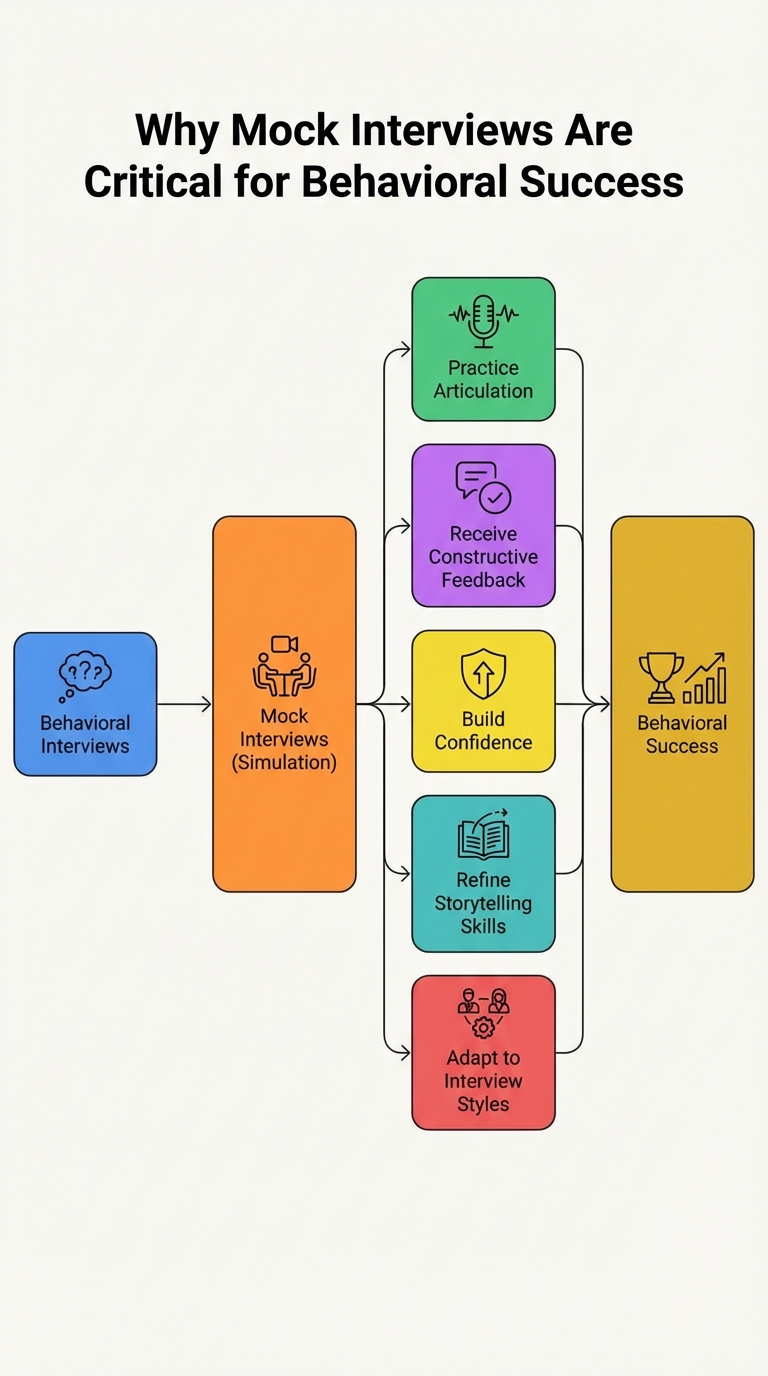
Mock interviews are the fastest, most reliable way to turn your experience into persuasive evidence. They help you practice concise articulation, expose weak structure or awkward delivery, and build calm under pressure. Done deliberately, mocks sharpen your storytelling, strengthen your body language and tone, and train you to adapt to different interviewer styles.
Why mock practice matters
- Focused evidence over cleverness: Interviewers want examples, not theories. Practice forces you to extract concrete outcomes, metrics, and ownership from your experience.
- Real pressure, real feedback: Role-playing simulates the time limits and stress of a live interview so you can learn to be clear under pressure.
- Structure and brevity: Mocks help you refine a compact narrative that answers the question directly while highlighting impact.
- Adaptability: Different interviewers expect different emphases (technical depth, leadership, collaboration). Practicing with variety teaches you to pivot your story quickly.
Key skills to practice
- STAR storytelling — with impact
- Situation: one-liner context
- Task: your responsibility
- Action: what you did (most of your time)
- Result: metrics, outcomes, learnings
Make the Result the payoff: quantify impact (reduced latency by 30%, onboarded 5 customers) and name what you learned.
- Concise articulation
- Lead with the answer, then provide the story. Start with a one-sentence takeaway: “Yes — I led a cross-functional launch that increased retention by 12%.”
Timebox details: use a 60–90 second summary before a 2–3 minute expansion.
Tone, pace, and body language
- Maintain eye contact (or camera focus). Use an open posture and avoid fidgeting.
Vary tone to show engagement; pause before key points.
Handling follow-ups
- If you don’t know an exact detail, say what you remember and what you’d check.
- Use bridging phrases: “The key part was…”, “What I’d do differently now is…”
How to run effective mock interviews
- Schedule them like reps: at least weekly in the month leading up to interviews; twice-weekly if you have limited time.
- Record everything: video is best — it reveals posture, eye contact, and pacing. Audio helps isolate verbal tics.
- Get blunt feedback: use peers, mentors, or paid coaches who will point out structure problems and filler words.
- Use a rubric: clarity of answer, STAR structure, impact quantification, eye contact, voice cadence, and handling of follow-ups.
- Iterate: revise your example after feedback and re-run the same prompt to see improvement.
4-week mock plan (example)
- Week 1: Collect and craft — write 10 STAR stories covering leadership, conflict, failure, ownership, and tradeoffs.
- Week 2: Practice delivery — run 3 recorded mocks, focus on concise opening lines and results.
- Week 3: Stress test — run on-the-spot prompts, add time pressure and interruptions.
- Week 4: Polishing — refine tone, remove filler words, and practice 5-minute and 30-second answers.
Common pitfalls to avoid
- Rambling: don’t narrate your whole week. Stick to relevant actions and outcomes.
- Vague results: “improved performance” → “reduced load time by 45% and cut error rate by 60%.”
- Ignoring the question: answer the question directly before you expand.
Quick checklist for every mock
- Do I start with a one-sentence answer?
- Is the Action section the longest and most specific?
- Did I quantify the Result?
- Did I summarize a learning or follow-up?
- How was my eye contact, pace, and filler-word count?
Practice prompts to use in mocks
- Tell me about a time you took ownership of a failing project.
- Describe a conflict with a teammate and how you resolved it.
- Give an example of when you had to make a tradeoff between speed and quality.
- Tell me about a time you delivered impact with limited resources.
- Describe a failure and what you changed afterwards.
- When did you influence a decision without formal authority?
- Tell me about mentoring or growing someone on your team.
- Describe a time you had to learn something new quickly.
- Give an example of collaborating across functions.
- Tell me about a high-stakes presentation or demo.
Parting advice
Treat mock interviews like gym reps: consistent, deliberate, and measured. The goal isn’t to memorize perfect answers — it’s to reliably produce clear, evidence-backed stories under pressure. Record, review, get honest feedback, and iterate. That practice is the edge.
About the author
bugfree.ai is an advanced AI-powered platform designed to help software engineers master system design and behavioral interviews. Whether you’re preparing for your first interview or aiming to elevate your skills, bugfree.ai provides a robust toolkit tailored to your needs. Key Features:
150+ system design questions: Master challenges across all difficulty levels and problem types, including 30+ object-oriented design and 20+ machine learning design problems. Targeted practice: Sharpen your skills with focused exercises tailored to real-world interview scenarios. In-depth feedback: Get instant, detailed evaluations to refine your approach and level up your solutions. Expert guidance: Dive deep into walkthroughs of all system design solutions like design Twitter, TinyURL, and task schedulers. Learning materials: Access comprehensive guides, cheat sheets, and tutorials to deepen your understanding of system design concepts, from beginner to advanced. AI-powered mock interview: Practice in a realistic interview setting with AI-driven feedback to identify your strengths and areas for improvement.
bugfree.ai goes beyond traditional interview prep tools by combining a vast question library, detailed feedback, and interactive AI simulations. It’s the perfect platform to build confidence, hone your skills, and stand out in today’s competitive job market. Suitable for:
New graduates looking to crack their first system design interview. Experienced engineers seeking advanced practice and fine-tuning of skills. Career changers transitioning into technical roles with a need for structured learning and preparation.
Comments
Join the discussionNo comments yet. Be the first to comment.