Backpropagation in 60 Seconds (Interview-Ready, No Fluff)
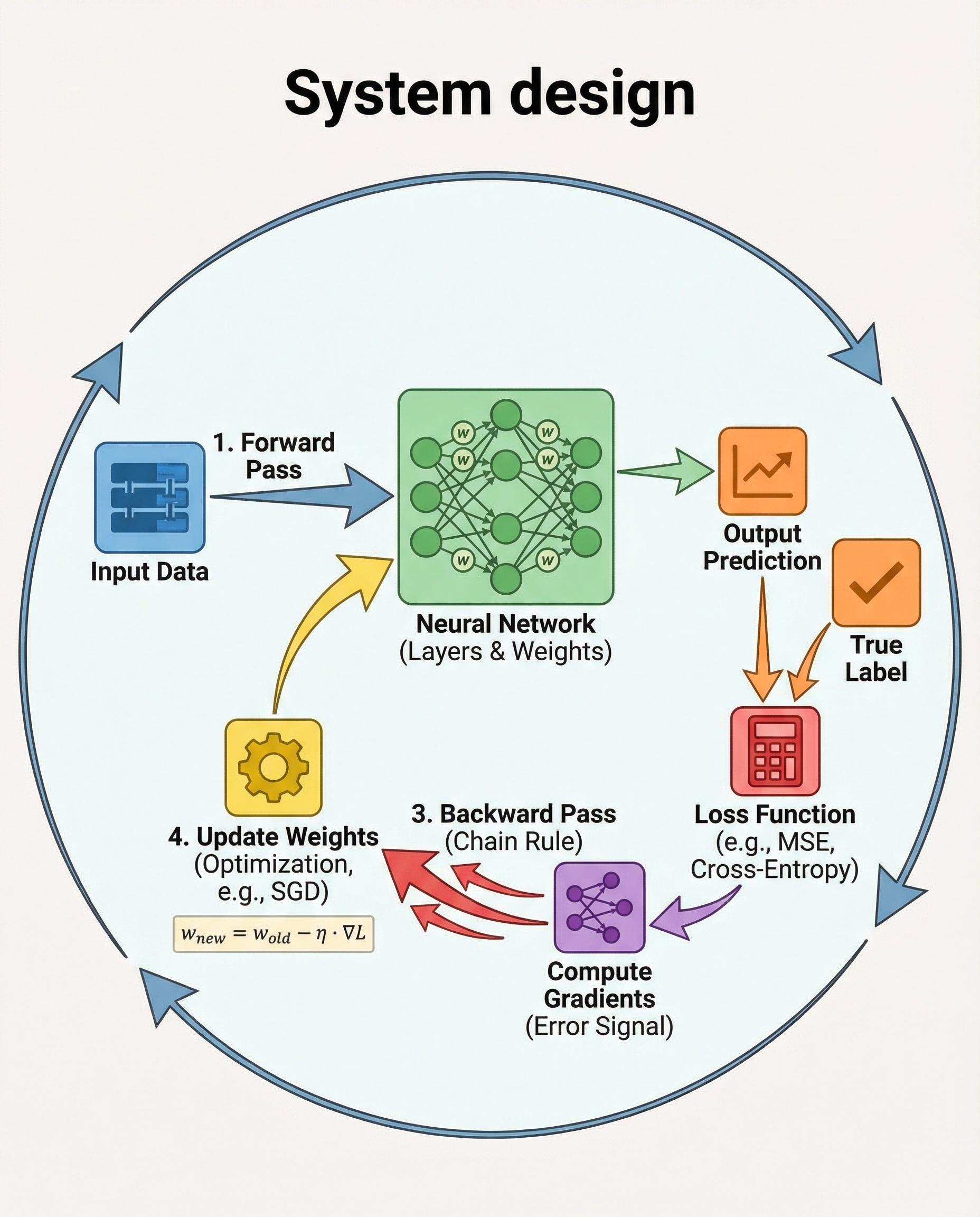
Backpropagation is how neural networks learn: it computes the gradient of the loss with respect to every weight using the chain rule. Below is a compact, interview-ready walkthrough you can state and derive on the spot.
1) Forward pass
- Run inputs through each layer to get predictions.
- Compute the scalar loss L(prediction, target).
2) Backward pass (chain rule in action)
- Start at the output and propagate error backward, layer by layer, using activation derivatives.
- For a weight w that affects output y: ∂L/∂w = ∂L/∂y * ∂y/∂w. That local multiplication of sensitivities is the chain rule.
- Common layer formula (vector form):
- δ^L = ∂L/∂a^L * σ'(z^L) (output error)
- For l = L−1..1: δ^l = (W^{l+1}^T δ^{l+1}) * σ'(z^l)
- Gradient for weights: ∂L/∂W^l = δ^l (a^{l-1})^T
3) Update
Move weights opposite the gradient (gradient descent):
w ← w − η ∇L
Quick pseudocode
# Forward
for l in 1..L:
  z[l] = W[l] @ a[l-1] + b[l]
  a[l] = σ(z[l])
loss = Loss(a[L], y)

# Backward
δ[L] = dLoss/da[L] * σ'(z[L])
for l in L-1..1:
  δ[l] = (W[l+1].T @ δ[l+1]) * σ'(z[l])
  dW[l] = δ[l] @ a[l-1].T

# Update
for l in 1..L:
  W[l] -= η * dW[l]
  b[l] -= η * db[l]
Why this matters (short intuition)
- Efficiency: backprop computes all partial derivatives in time proportional to a few times a forward pass (not one pass per weight).
- Scalability: it makes training deep networks practical by reusing intermediate computations (activations and local derivatives).
Common interview talking points
- Explain the chain rule and derive ∂L/∂w for a single neuron.
- Show how gradients flow from output to input using the δ recurrence.
- Mention practical issues: vanishing/exploding gradients (sigmoid vs ReLU), and how initialization, normalization, and skip connections help.
- Contrast with numerical gradients (finite differences) and note autodiff does this efficiently and exactly (up to floating point).
Remember: keep the derivation clear, show one example neuron, and state the update rule. That's concise, correct, and interview-ready.
#MachineLearning #DeepLearning #AI
About the author
bugfree.ai is an advanced AI-powered platform designed to help software engineers master system design and behavioral interviews. Whether you’re preparing for your first interview or aiming to elevate your skills, bugfree.ai provides a robust toolkit tailored to your needs. Key Features:
150+ system design questions: Master challenges across all difficulty levels and problem types, including 30+ object-oriented design and 20+ machine learning design problems. Targeted practice: Sharpen your skills with focused exercises tailored to real-world interview scenarios. In-depth feedback: Get instant, detailed evaluations to refine your approach and level up your solutions. Expert guidance: Dive deep into walkthroughs of all system design solutions like design Twitter, TinyURL, and task schedulers. Learning materials: Access comprehensive guides, cheat sheets, and tutorials to deepen your understanding of system design concepts, from beginner to advanced. AI-powered mock interview: Practice in a realistic interview setting with AI-driven feedback to identify your strengths and areas for improvement.
bugfree.ai goes beyond traditional interview prep tools by combining a vast question library, detailed feedback, and interactive AI simulations. It’s the perfect platform to build confidence, hone your skills, and stand out in today’s competitive job market. Suitable for:
New graduates looking to crack their first system design interview. Experienced engineers seeking advanced practice and fine-tuning of skills. Career changers transitioning into technical roles with a need for structured learning and preparation.
Comments
Join the discussionNo comments yet. Be the first to comment.