
ATM OOD Interview Question: Nail the Classes, Not the Buzzwords
Interviewers are not testing your ability to recite OOD theory — they want a clear, maintainable design for the ATM problem. Start with concrete requirements, map them to objects, and explain responsibilities and interactions. If you can do that, you’ll pass.
1. Start from requirements (be explicit)
Minimum functional requirements to state out loud:
- Authenticate (card + PIN)
- Check balance
- Withdraw
- Deposit
- Transfer (between accounts)
Non-functional / constraints you might mention briefly:
- Consistency (no double-spend)
- Audit trail for transactions
- Security (PIN retries, encryption)
- Integration with bank backend
- ATM cash dispenser limits
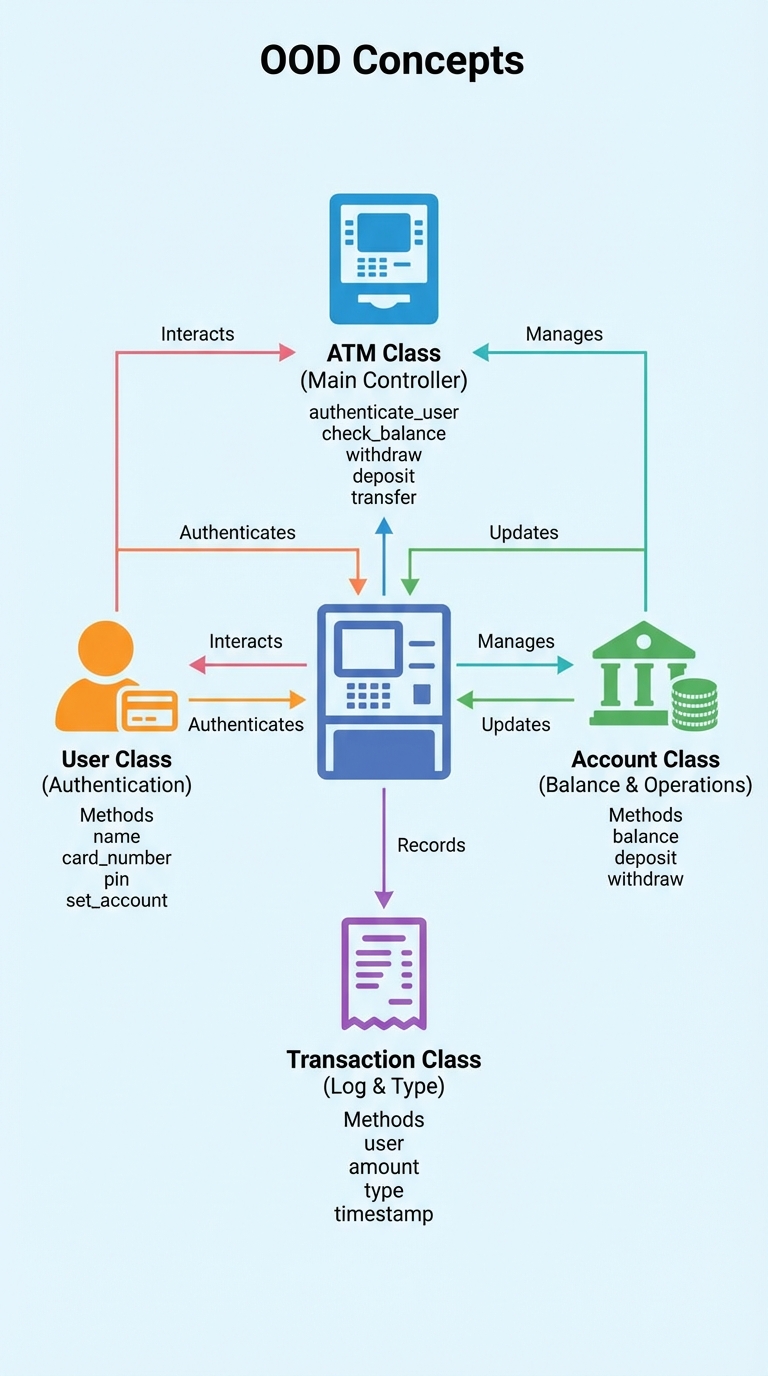
2. Map requirements to core objects
A simple, interview-friendly mapping:
- ATM
- Orchestrates a session, UI flow, and talks to hardware and bank backend.
- User (or Card / CardHolder)
- Identity, authentication (card id + PIN flow).
- Account
- Holds balance and enforces rules (overdraft, withdrawal limits).
- Transaction
- Immutable audit entry. Concrete types: Deposit, Withdraw, Transfer.
- Session (optional)
- Tracks current authenticated user and selected account.
- BankGateway / Dispenser (optional)
- External services: bank backend for account ops, hardware for cash.
3. Responsibilities and encapsulation
Keep responsibilities tight and behavior on the objects that own the data:
- Account should own balance changes. Provide methods like deposit(amount) and withdraw(amount) which validate rules and update state.
- Transaction objects are append-only audit records describing the operation and outcome.
- ATM orchestrates UI, authentication, calls into Account or BankGateway, and records Transaction objects.
Example (Python‑like skeletons):
class Account:
    def __init__(self, id, balance=0):
        self.id = id
        self._balance = balance

    def deposit(self, amount):
        if amount <= 0: raise ValueError
        self._balance += amount
        return Transaction(type='deposit', amount=amount, account_id=self.id)

    def withdraw(self, amount):
        if amount <= 0 or amount > self._balance: raise InsufficientFunds
        self._balance -= amount
        return Transaction(type='withdraw', amount=amount, account_id=self.id)

class Transaction:
    def __init__(self, type, amount, account_id, timestamp=None):
        # immutable audit record
        ...
4. Inheritance and polymorphism (keep it practical)
- Inheritance: model SavingsAccount and CheckingAccount as subclasses when they have different rules (interest calc, overdraft).
- Polymorphism: treat Deposit/Withdraw/Transfer as implementations of a common Transaction interface. That allows code that logs or processes transactions to be written against the interface, not the concrete type.
Example:
class Transaction:
    def apply(self):
        raise NotImplementedError

class Withdraw(Transaction):
    def apply(self, account):
        return account.withdraw(self.amount)

class Transfer(Transaction):
    def apply(self, from_account, to_account):
        ...
5. Typical interaction flow (withdraw)
- Card inserted -> ATM creates Session
- Prompt PIN -> authenticate with BankGateway
- User selects account and amount
- ATM requests withdraw from Account (or via BankGateway)
- Account checks balance and business rules
- Reserve or lock funds to avoid race conditions
- ATM triggers cash dispenser
- On success: commit transaction, create Transaction record, update account
- On failure: rollback reservation, show error, log audit
Explaining this sequence clearly in an interview shows you understand orchestration and invariants.
6. Concurrency, consistency, and edge cases
Bring these up briefly to show depth:
- Race conditions: lock account or use atomic operations when debiting balance.
- Idempotency: network retries between ATM and bank should not create duplicate transactions.
- Partial failures: what if dispenser jams after balance deducted? Keep a reversible state or compensating actions and a clear audit trail.
- PIN attempts, card capture, transaction limits, and offline mode.
7. What to say in the interview (strategy)
- Start by listing requirements and constraints.
- Present the object map (ATM, User/Card, Session, Account, Transaction, BankGateway/Dispenser).
- For each class, state 1–2 responsibilities and a couple of methods.
- Walk through a concrete scenario (withdraw) step-by-step.
- Mention one or two tradeoffs (local locking vs. distributed transactions, when to call the bank, offline mode).
That level of clarity beats buzzwords. Interviewers want to hear: "Here are the objects, these are their responsibilities, this is how they interact, and these are the important failure modes." If you can explain that, you're golden.
Quick checklist to mention
- Requirements: auth, balance, withdraw, deposit, transfer
- Core classes and responsibilities
- Encapsulation: Account mutates its own balance
- Inheritance: Savings/Checking extend Account when needed
- Polymorphism: Transaction types implement a common interface
- Sequence for a withdraw and failure handling
- Concurrency/consistency considerations
Good luck — focus on the classes and interactions, not on reciting patterns by name.
About the author
bugfree.ai is an advanced AI-powered platform designed to help software engineers master system design and behavioral interviews. Whether you’re preparing for your first interview or aiming to elevate your skills, bugfree.ai provides a robust toolkit tailored to your needs. Key Features:
150+ system design questions: Master challenges across all difficulty levels and problem types, including 30+ object-oriented design and 20+ machine learning design problems. Targeted practice: Sharpen your skills with focused exercises tailored to real-world interview scenarios. In-depth feedback: Get instant, detailed evaluations to refine your approach and level up your solutions. Expert guidance: Dive deep into walkthroughs of all system design solutions like design Twitter, TinyURL, and task schedulers. Learning materials: Access comprehensive guides, cheat sheets, and tutorials to deepen your understanding of system design concepts, from beginner to advanced. AI-powered mock interview: Practice in a realistic interview setting with AI-driven feedback to identify your strengths and areas for improvement.
bugfree.ai goes beyond traditional interview prep tools by combining a vast question library, detailed feedback, and interactive AI simulations. It’s the perfect platform to build confidence, hone your skills, and stand out in today’s competitive job market. Suitable for:
New graduates looking to crack their first system design interview. Experienced engineers seeking advanced practice and fine-tuning of skills. Career changers transitioning into technical roles with a need for structured learning and preparation.
Comments
Join the discussionNo comments yet. Be the first to comment.