High-Score Interview Experience: Atlassian Women in Tech SDE Internship — What Helped Me Crack It
This post condenses a high-score interview experience shared by Bugfree users for the Atlassian Women in Tech SDE internship. I’ve summarized the process, what the interviewers look for, and practical tips that helped me and others succeed.
Quick overview of the process
- Online application
- HackerRank online assessment (OA)
- Document verification
- Technical interview (~1 hour)
- Managerial / behavioral interview
Below are step-by-step tips and what to emphasize at each stage.
1) Online application — what to highlight
- Emphasize your DSA (data structures & algorithms) background and competitive programming experience if any.
- Call out direct exposure to Atlassian tooling like Jira and Confluence (projects, plugins, or workflows you used or built).
- Keep your resume concise and highlight measurable impact (e.g., reduced bug turnaround time by X%, automated Y process).
Tip: Tailor one short bullet under relevant experiences that mentions Jira/Confluence; recruiters notice domain familiarity.
2) HackerRank OA — how to approach it
- Expect 2–3 medium-to-hard DSA problems.
- Focus on writing efficient solutions: correct algorithm first, then optimize.
- Document your code: clear function names, comments for non-trivial steps, and short explanation at the top of the solution.
- Edge cases: include them and, if time permits, add brief tests in comments.
Practical strategy:
- Read all problems first and pick the one you’re most confident on.
- Outline the approach with complexity notes before coding (keeps you on track).
- If you get stuck, write a partial solution and explain the intended completion in comments.
3) Document verification
- Keep scanned copies or clear photos of required documents ready (ID, transcripts, any eligibility proofs).
- Respond quickly to verification requests—delays can slow the process.
4) Technical interview (~1 hour) — what to expect and how to excel
Typical pattern:
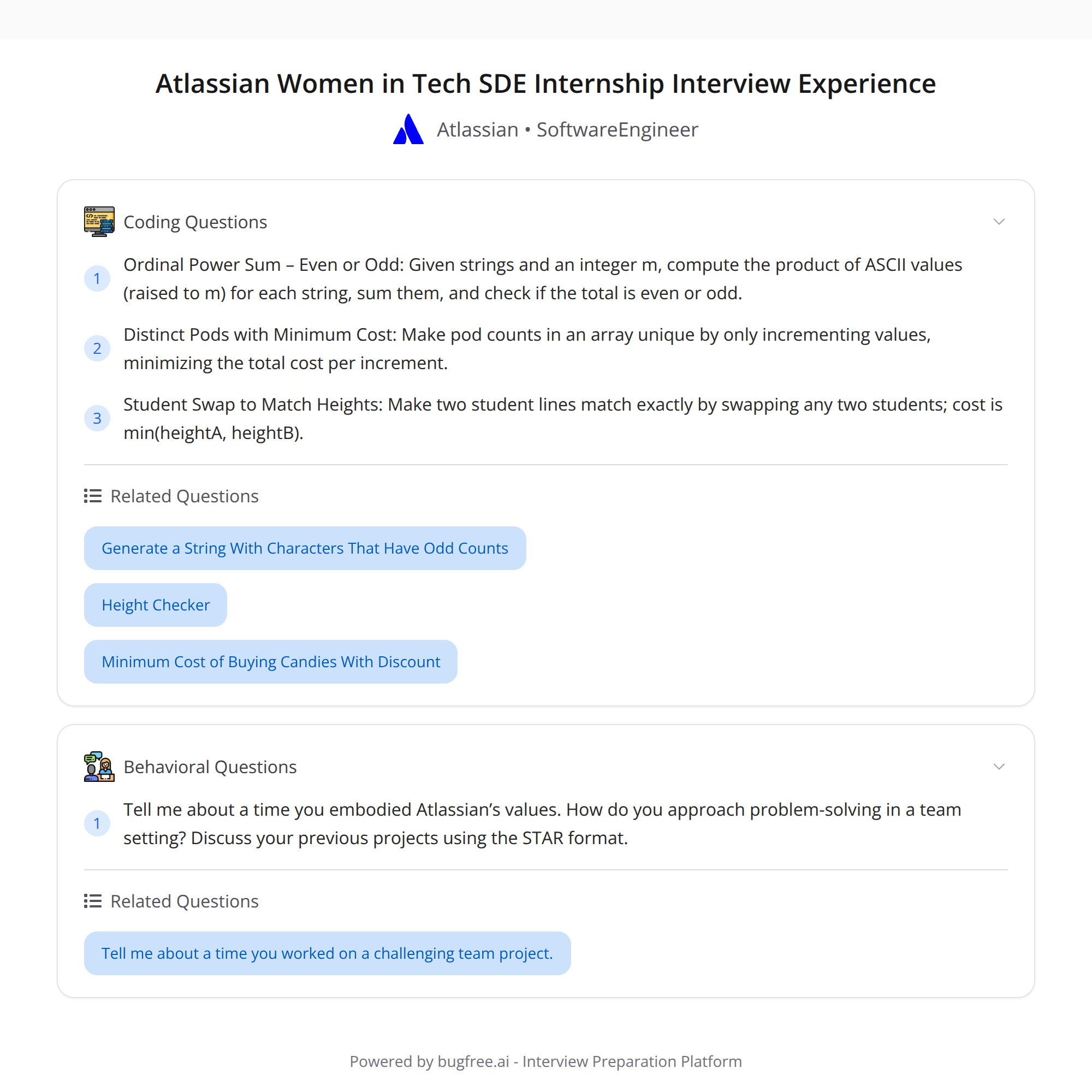
- One substantial coding problem (graphs are common in my experience).
- Expect to implement using classes or clean modular functions.
- You are expected to explain your approach, then discuss time and space complexity.
Tips to shine:
- Start by clarifying the problem and asking clarifying questions.
- Outline a high-level plan (data structures, algorithm approach, class design) before coding.
- Use classes if asked—design simple, single-responsibility classes with clear methods.
- Speak your thought process aloud: why you choose a BFS vs DFS, how you’ll store visited state, etc.
- Write clean, readable code. Comment tricky parts.
- It’s okay to look up syntax or language specifics if needed—interviewers prefer correctness and clarity over memorized syntax.
- After coding, run through example inputs and explain complexity (O-notation) and any trade-offs.
Example focus areas for a graph problem:
- Graph representation (adj list vs matrix)
- Traversal choice (BFS, DFS, Dijkstra, depending on weights)
- Handling disconnected components
- Corner cases like cycles, isolated nodes, self-loops
5) Managerial / behavioral interview — what they look for
- They assess alignment with Atlassian values, collaboration, and project ownership.
- The STAR format (Situation, Task, Action, Result) works well.
Behavioral tips:
- Prepare 4–6 stories: a technical challenge, a time you led/owned a project, how you handled conflict, and a mentorship or learning story.
- Quantify results where possible (reduced latency, improved feature adoption, etc.).
- Highlight mentorship, inclusivity, and how you collaborate across teams—these resonate in diversity-focused programs.
Short STAR example (skeleton):
- Situation: We had intermittent test flakiness blocking CI.
- Task: Identify root cause and stabilize the pipeline.
- Action: Added deterministic mocks, improved retries, and introduced logging for flaky tests.
- Result: Reduced CI failures by 70% and sped up PR merging.
Culture & communication
- Recruiters were fast with communication and provided quick feedback—respond promptly.
- Atlassian’s diversity and mentorship culture is strong; emphasize collaborative experiences and learning moments.
Final checklist before each stage
- Application: resume highlights DSA + Jira/Confluence exposure.
- OA: practice medium-to-hard problems; write commented, efficient code.
- Technical interview: clarify, design, implement, and explain complexity.
- Behavioral: prepare STAR stories aligned to company values.
- Logistics: have documents scanned and your setup ready (IDE, stable internet).
If you want, I can:
- Turn one of your project bullets into a recruiter-friendly resume line.
- Review a sample STAR story and suggest improvements.
#WomenInTech #SoftwareEngineering #InterviewPrep
About the author
bugfree.ai is an advanced AI-powered platform designed to help software engineers master system design and behavioral interviews. Whether you’re preparing for your first interview or aiming to elevate your skills, bugfree.ai provides a robust toolkit tailored to your needs. Key Features:
150+ system design questions: Master challenges across all difficulty levels and problem types, including 30+ object-oriented design and 20+ machine learning design problems. Targeted practice: Sharpen your skills with focused exercises tailored to real-world interview scenarios. In-depth feedback: Get instant, detailed evaluations to refine your approach and level up your solutions. Expert guidance: Dive deep into walkthroughs of all system design solutions like design Twitter, TinyURL, and task schedulers. Learning materials: Access comprehensive guides, cheat sheets, and tutorials to deepen your understanding of system design concepts, from beginner to advanced. AI-powered mock interview: Practice in a realistic interview setting with AI-driven feedback to identify your strengths and areas for improvement.
bugfree.ai goes beyond traditional interview prep tools by combining a vast question library, detailed feedback, and interactive AI simulations. It’s the perfect platform to build confidence, hone your skills, and stand out in today’s competitive job market. Suitable for:
New graduates looking to crack their first system design interview. Experienced engineers seeking advanced practice and fine-tuning of skills. Career changers transitioning into technical roles with a need for structured learning and preparation.
Comments
Join the discussionNo comments yet. Be the first to comment.