High-Score (Bugfree Users) Interview Experience: Atlassian Principal MLE — ML Craft + Jira Ranking Design + Tricky Rate Limiter

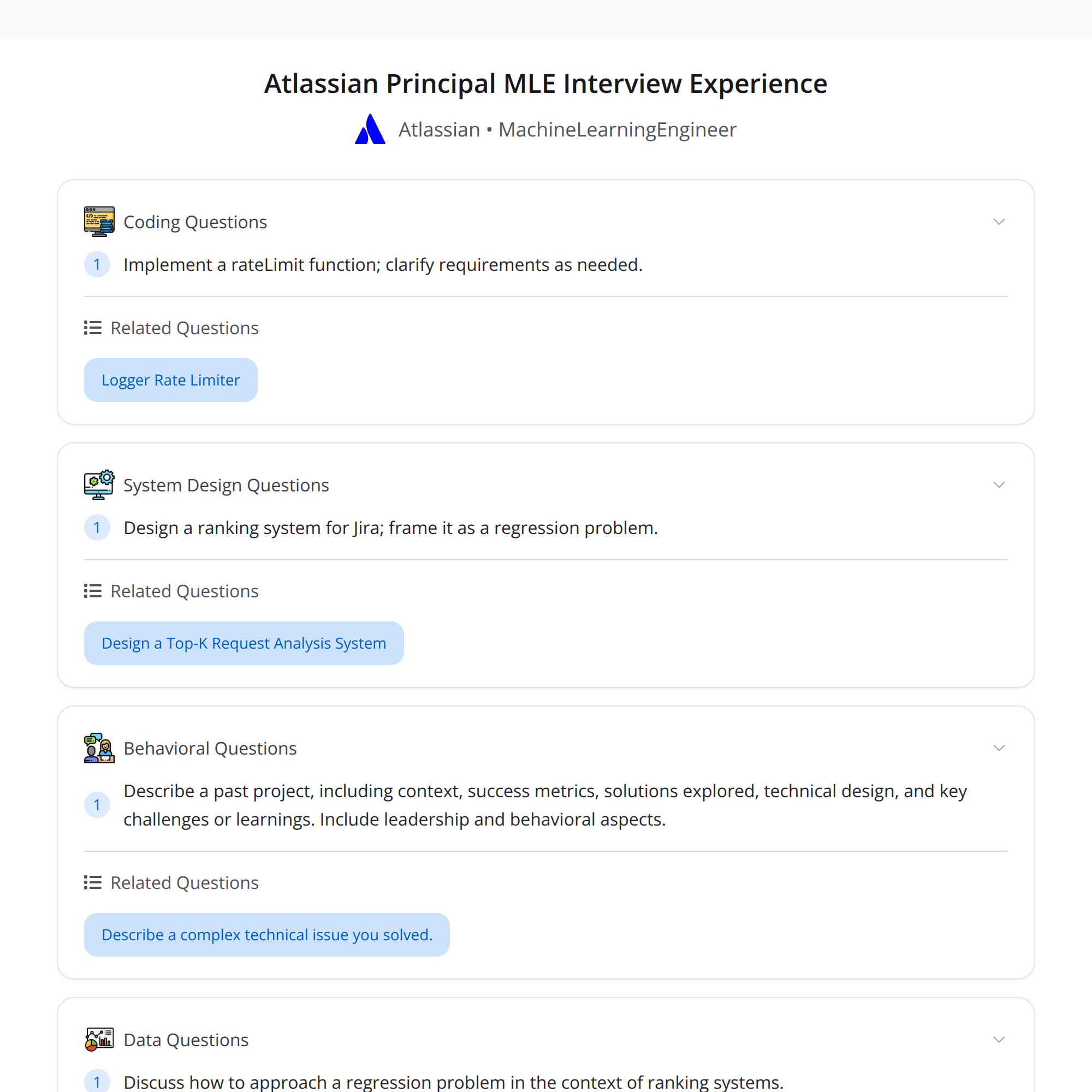
A compact, high-signal write-up from a Bugfree user who aced a Principal Machine Learning Engineer interview at Atlassian. The loop included a deep-dive project discussion (ML Craft), a system-design problem (Jira ranking), and a coding problem (implementing a tricky rate limiter). Below I summarize the structure of each stage, tips on what interviewers look for, and practical takeaways you can use to prepare.
Quick overview
- ML Craft (≈1 hour): deep-dive into a past project. Expect to explain context, metrics, architecture, trade-offs, and leadership/behavioral decisions.
- ML System Design: design a Jira ranking system. Treating the task as a regression (scoring) problem helps structure labels, features, model choices, and evaluation plans.
- Coding: build a rateLimit() function with subtle constraints. Clarifying questions and clear communication mattered as much as the code.
Takeaway: always bring a concise project narrative and explain your end-to-end thinking: from problem framing and metrics to trade-offs and rollout.
1) ML Craft — how to tell a crisp project story (what they want to hear)
Interviewers use this to assess technical depth, product sense, and leadership. Structure your answer so it’s easy to follow.
Recommended structure (use this as a checklist):
- Problem & context
- Briefly state the product and the pain point. Who are the users? What constraints exist (latency, privacy, compute)?
- Success metrics
- Define clear quantitative success criteria (business KPIs and evaluation metrics). Example: increase click-through rate (CTR) by X%, reduce average time-to-resolution by Y minutes, improve NDCG@10 by Z.
- Solution overview
- High-level architecture and model choice. Why this approach vs alternatives?
- Features & labeling
- How labels were generated (implicit vs explicit), handling of bias, feature engineering, feature stores used.
- Training & eval
- Offline metrics, validation strategy (time-split, cross-validation), and how offline metrics map to online outcomes.
- Production & scaling
- Serving architecture, latency numbers, monitoring and alerting, model retraining cadence.
- Trade-offs & failure modes
- Discuss alternatives, technical debt, data leakage, fairness, and mitigation plans.
- Leadership & impact
- Cross-functional collaboration, mentorship, rollout strategy (canary, AB tests), and how you measured impact.
Example snippet (one-liner for interview openers):
"I led a feature-ranking project for the product discovery page used by X daily users. Our goal was to increase engagement while keeping median latency < 150ms. We modeled ranking as a pointwise regression scoring problem and improved NDCG@10 by 8% in offline eval and observed a 3.2% uplift in engagement in a 2-week A/B test."
Why this works: concise context, measurable goal, approach, and outcome.
2) ML System Design — Jira ranking (how to frame it as a regression scoring problem)
Framing: cast ranking as a scoring/regression problem where the model predicts a real-valued relevance score for each issue relative to a user or context.
Key design steps and considerations:
- Problem definition & stakeholders
- Who consumes the ranking? Is it per-user personalized? Is it contextual (search vs. suggestions)?
- Labels & data collection
- Use implicit feedback (clicks, interactions, time-to-open) or explicit signals (upvotes). Consider position bias and employ techniques such as inverse propensity scoring or counterfactual learning if historical logs are biased.
- Feature design
- User features: role, activity patterns, subscription tier.
- Item features: priority, status, recent updates, assignee history.
- Context features: query text, current project, session features, time of day.
- Interaction features: user-item history, collaborative signals.
- Model choice
- Pointwise (regression) for simplicity, pairwise or listwise for optimizing ranking-specific losses. Use gradient-boosted trees or neural models depending on feature types and scale.
- Evaluation
- Offline: NDCG@k, MAP, MRR. Use time-based splits and simulate online behavior if possible.
- Online: A/B test with business metrics (task completion, time-to-resolution, retention). Monitor side effects (e.g., surfacing low-quality items).
- Iteration & experimentation
- Feature ablation, calibration (score to probability), and regular retraining to cope with concept drift.
- Production & ops
- Latency: cache top-k results, approximate nearest neighbors for embeddings, cascade models for speed.
- Monitoring: data drift detectors, quality regressions, SLIs and SLOs.
- Privacy & access: careful of sensitive fields; apply filters and governance.
Tradeoffs to call out in an interview
- Complexity vs latency: deeper models yield better relevance but cost latency. Propose cascaded architecture: cheap model to short-list, expensive model for final ranking.
- Offline-to-online gap: explain how you will validate offline signals and guard against false wins (e.g., instrument bucketed experiments, look for unintended changes).
3) Coding — implementing a tricky rateLimit() (what they were testing)
What interviewers check:
- Clarifying questions: your ability to ask about edge cases (per-user vs global, fixed window vs sliding window, concurrency, desired return behavior).
- Correctness & edge cases: off-by-one, reset behavior, memory leaks.
- Performance: time & space complexity, ability to scale (multi-instance considerations).
- Communication: explain assumptions, test cases, and tradeoffs.
Common clarifying questions to ask upfront
- Is rate limiting per user/key or global?
- Fixed window or sliding window semantics?
- How should we behave when the limit is exceeded (drop request, queue it, return a boolean)?
- Are we single-threaded/local or distributed across many instances?
- Persistence: is data lost on restart acceptable?
Simple sliding-window implementation (single-process, per-key)
Approach: keep a deque of timestamps per key, evict timestamps older than window, allow the call if queue length < limit. This gives correct sliding-window semantics and is easy to reason about.
Python-like pseudocode:
from collections import deque
import time

class RateLimiter:
    def __init__(self, max_calls, window_seconds):
        self.max_calls = max_calls
        self.window = window_seconds
        self.data = {}  # key -> deque of timestamps

    def allow(self, key: str) -> bool:
        now = time.time()
        if key not in self.data:
            self.data[key] = deque()
        q = self.data[key]

        # Evict old timestamps
        while q and now - q[0] >= self.window:
            q.popleft()

        if len(q) < self.max_calls:
            q.append(now)
            return True
        else:
            return False
Notes:
- Complexity: O(1) amortized per call for deque ops. Space: O(k) per-key where k = max_calls per window.
- Tricky parts: concurrency (use locks), cleanup for keys that stop being used (periodic sweeper), and distributed limits (use Redis, shards, or token-bucket algorithms with synchronization).
Distributed considerations
- Use a central store (Redis) with an efficient atomic script (e.g., Lua) to implement sliding windows or token buckets.
- Token bucket advantages: smoother allowance and easier to implement atomically in Redis with INCR + TTL or Lua script.
Example Redis token bucket (conceptually):
- Store last refill time and tokens. On request, compute tokens to add, cap at capacity, decrement if token available.
- Requires careful atomicity (Lua script).
Testing and edge-case examples to present in interview
- Burst behavior: allow bursts up to capacity.
- Window boundary behavior: ensure sliding-window correctly disallows calls just past capacity.
- Multi-threaded calls to same key (race conditions) — explain locking or atomic Redis ops.
Final takeaways & interview prep checklist
- For ML Craft: pick one project, rehearse a 90-second elevator pitch + detailed 8–12 minute deep dive that follows the checklist above.
- For System Design: structure answers — problem, constraints, features/labels, model, evaluation, rollout, and monitoring. Always mention offline/online evaluation plans.
- For Coding: always ask clarifying questions, surface trade-offs, and write clean, testable code. Explain edge cases and how you'd scale.
Boil it down to: crisp narrative + measurable metrics + clear trade-offs. That combination convinced interviewers in this Atlassian Principal MLE loop.
Good luck — and practice telling the same story at different levels of depth depending on the interviewer’s follow-ups.
Tags: #MachineLearning #SystemDesign #InterviewPrep
About the author
bugfree.ai is an advanced AI-powered platform designed to help software engineers master system design and behavioral interviews. Whether you’re preparing for your first interview or aiming to elevate your skills, bugfree.ai provides a robust toolkit tailored to your needs. Key Features:
150+ system design questions: Master challenges across all difficulty levels and problem types, including 30+ object-oriented design and 20+ machine learning design problems. Targeted practice: Sharpen your skills with focused exercises tailored to real-world interview scenarios. In-depth feedback: Get instant, detailed evaluations to refine your approach and level up your solutions. Expert guidance: Dive deep into walkthroughs of all system design solutions like design Twitter, TinyURL, and task schedulers. Learning materials: Access comprehensive guides, cheat sheets, and tutorials to deepen your understanding of system design concepts, from beginner to advanced. AI-powered mock interview: Practice in a realistic interview setting with AI-driven feedback to identify your strengths and areas for improvement.
bugfree.ai goes beyond traditional interview prep tools by combining a vast question library, detailed feedback, and interactive AI simulations. It’s the perfect platform to build confidence, hone your skills, and stand out in today’s competitive job market. Suitable for:
New graduates looking to crack their first system design interview. Experienced engineers seeking advanced practice and fine-tuning of skills. Career changers transitioning into technical roles with a need for structured learning and preparation.
Comments
Join the discussionNo comments yet. Be the first to comment.