

Posted by Bugfree users — a high-score interview experience from Apple’s Data Scientist process. Key twist: two phone screens were resume-focused; the real technical depth came in the final Virtual Onsite (VO).
TL;DR
- Two phone screens: mostly resume and fit checks.
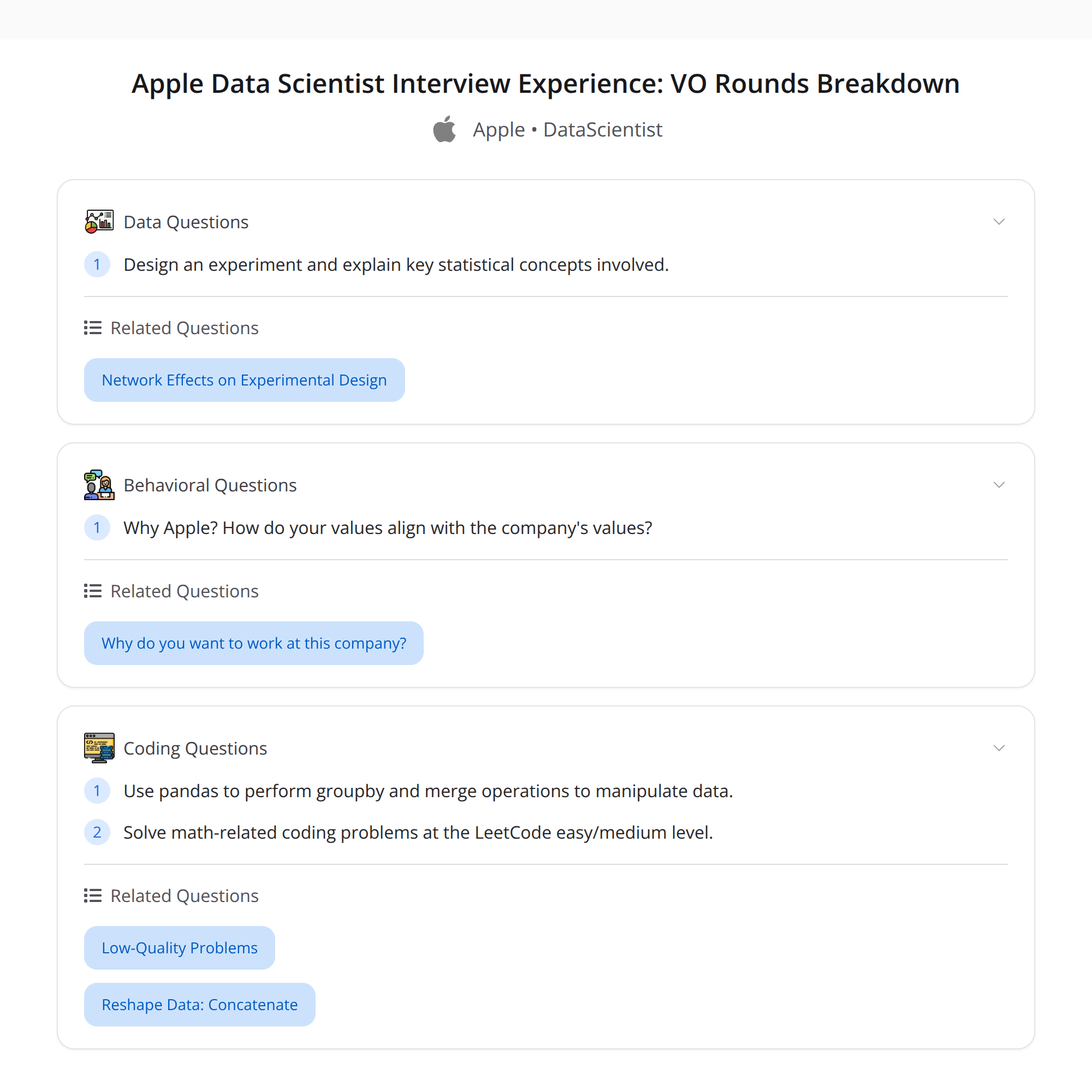
- Final Virtual Onsite (VO) tested three focused areas:
- Behavioral — "Why Apple?" and values alignment.
- Experimental design & statistics — practical experiment design and core stats concepts.
- Python coding (two parts) — pandas fluency (groupby/merge) and algorithmic problems (LeetCode easy/medium).
Use this breakdown to prioritize your prep where it actually matters.
Interview structure (what to expect)
Phone screens (x2)
- Purpose: validate resume, past projects, and basic fit.
- Depth: light technical questions sometimes, but mainly confirmation of experience.
Virtual Onsite (VO) — the main evaluation
Behavioral
- Expect direct fit questions: "Why Apple?", values alignment, teamwork, conflict resolution.
- Use STAR (Situation, Task, Action, Result). Connect answers to Apple’s values (customer focus, craftsmanship, collaboration).
- Sample prompts: “Tell me about a time you influenced a product decision with data.” “How do you prioritize ambiguous tasks?”
- Tip: prepare 4–6 stories that can be adapted to multiple questions.
Experimental Design & Statistics
- Scope: design A/B tests or experiments, choose metrics, identify biases/confounders, and reason about power and significance at a practical level.
- Core concepts to review: hypothesis testing, p-values and confidence intervals, statistical power, sample size calculations, uplift vs. absolute change, randomization, confounding and blocking, multiple comparisons, and metrics instrumentation.
- Sample prompt: “Design an experiment to evaluate feature X. What metric would you choose and why? How would you analyze the results?”
- Tip: practice walking through trade-offs (speed vs. sensitivity), metric choice (leading vs. business metrics), and post-hoc checks (sanity checks, heterogeneity analysis).
Python Coding (2 parts)
Part A — pandas fluency
- Focus: groupby/aggregate, merges/joins, reshaping (pivot/melt), handling missing data, and vectorized operations.
- Typical tasks: compute cohort metrics, join event tables to user tables, produce aggregated summaries by segments.
- Tip: explain your mental model (dataframe as table), show intermediate steps, and optimize clarity before micro-optimizations.
Part B — algorithmic problems (LeetCode easy/medium)
- Topics: math/arrays/hashmaps, two-pointers, sliding windows, simple dynamic programming, basic graph/tree traversal depending on role.
- Expect one or two problems; time and clarity matter more than clever one-liners.
- Tip: write correct, readable code; talk through edge cases and complexity; run through a quick hand simulation on sample input.
Prep checklist (targeted)
- Behavioral: prepare 4–6 STAR stories mapped to core themes (impact, ambiguity, leadership, teamwork, failure).
- Stats & experiments:
- Review A/B testing basics, power/sample size rules, and common pitfalls.
- Practice designing experiments from product prompts and arguing metric choices.
- pandas & Python:
- Master groupby/merge patterns, chaining, and common gotchas.
- Solve LeetCode easy/medium problems focused on arrays, hashmaps, and simple algorithms.
- Mock interviews: do a full VO practice (1.5–2 hours) combining behavioral + stats + coding to simulate pacing.
Recommended resources:
- pandas documentation and cookbook examples
- LeetCode (Easy/Medium) practice — prioritize array/hashmap problems
- “A/B Testing: The Most Powerful Weapon in Data Science” notes or equivalent practical guides
- Blog posts / case studies on experiment design and metric choice
2–4 week prep roadmap
2-week sprint (fast):
- Week 1: daily 1–2 hours — 3 coding problems + 30–45m pandas exercises + 1 behavioral story per day.
- Week 2: daily 1–2 hours — 2 experiment design prompts + 3 coding problems + full mock VO at end of week.
4-week plan (more thorough):
- Weeks 1–2: build pandas fluency, solve 12–15 LeetCode easy/medium.
- Weeks 3–4: focus on experiments & stats, refine behavioral stories, weekly full mock VO.
Final notes
This account from Bugfree users highlights a common pattern: early screens confirm resume fit, the real depth is in the virtual onsite. Focus your time on behavioral stories, practical experiment design, and hands-on pandas + easy/medium algorithm practice. Targeted prep beats trying to study everything at once.
#DataScience #InterviewPrep #Python
About the author
bugfree.ai is an advanced AI-powered platform designed to help software engineers master system design and behavioral interviews. Whether you’re preparing for your first interview or aiming to elevate your skills, bugfree.ai provides a robust toolkit tailored to your needs. Key Features:
150+ system design questions: Master challenges across all difficulty levels and problem types, including 30+ object-oriented design and 20+ machine learning design problems. Targeted practice: Sharpen your skills with focused exercises tailored to real-world interview scenarios. In-depth feedback: Get instant, detailed evaluations to refine your approach and level up your solutions. Expert guidance: Dive deep into walkthroughs of all system design solutions like design Twitter, TinyURL, and task schedulers. Learning materials: Access comprehensive guides, cheat sheets, and tutorials to deepen your understanding of system design concepts, from beginner to advanced. AI-powered mock interview: Practice in a realistic interview setting with AI-driven feedback to identify your strengths and areas for improvement.
bugfree.ai goes beyond traditional interview prep tools by combining a vast question library, detailed feedback, and interactive AI simulations. It’s the perfect platform to build confidence, hone your skills, and stand out in today’s competitive job market. Suitable for:
New graduates looking to crack their first system design interview. Experienced engineers seeking advanced practice and fine-tuning of skills. Career changers transitioning into technical roles with a need for structured learning and preparation.
Comments
Join the discussionNo comments yet. Be the first to comment.


