TL;DR
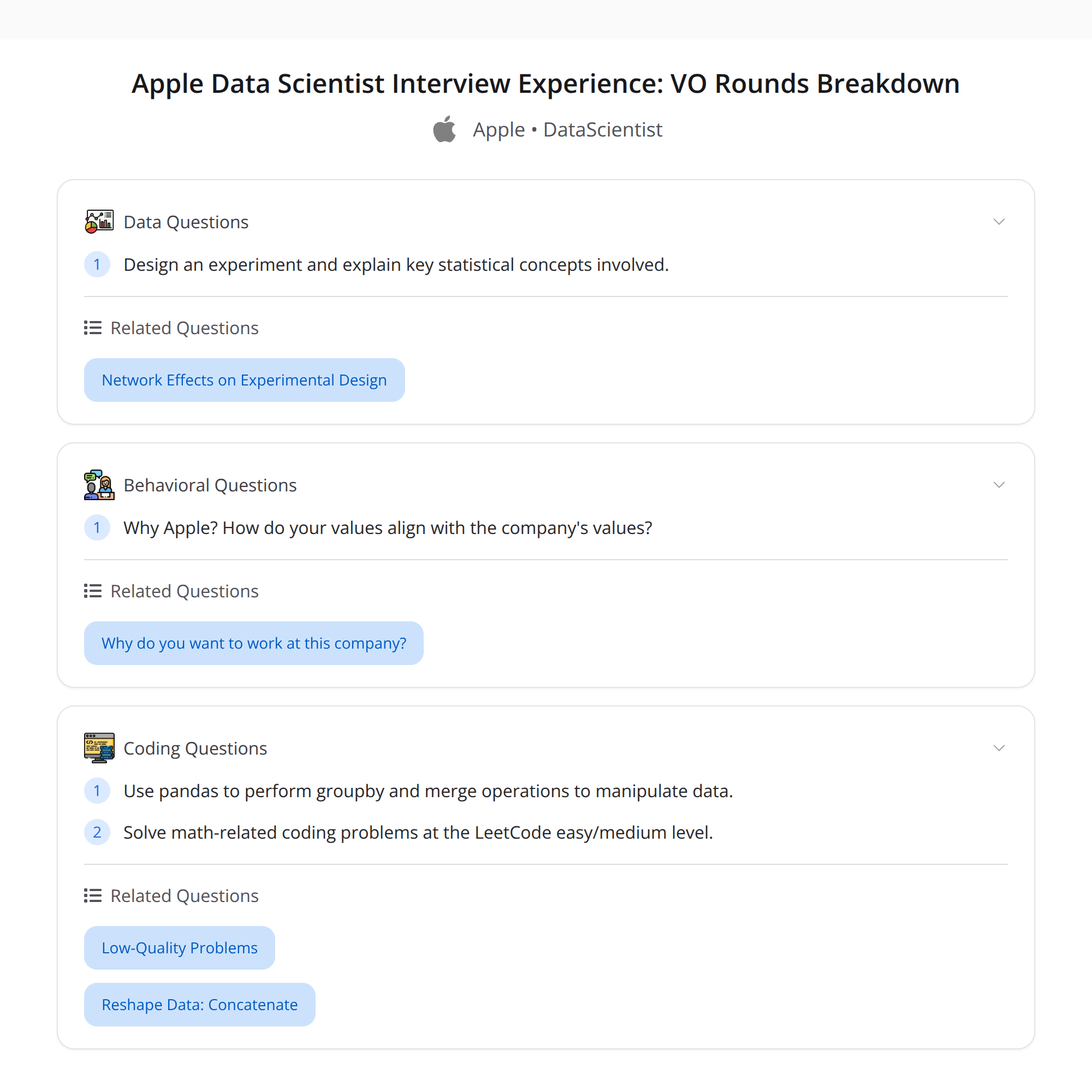
A high-scoring report from Bugfree users: the two phone screens are largely resume and fit checks. The real technical depth is in the Virtual Onsite (VO). Focus your prep on these VO areas: (1) Behavioral / values fit, (2) Experimental design & statistics, and (3) Python coding split across pandas fluency and algorithmic problems (easy/medium).
Interview overview (what actually happened)
- Two phone screens up front: primarily resume review, clarifying past projects and assessing role fit. Expect product/context questions and concise behavioral prompts.
- Virtual Onsite (VO): the decisive stage. This is where interviews dig into technical skills and judgment.
Use your limited prep time to prioritize VO topics — that’s where offers are won or lost.
Virtual Onsite breakdown (what to expect and how to prepare)
1) Behavioral — "Why Apple?" + values alignment
- What they test: cultural fit, product intuition, communication, cross-functional collaboration.
- Sample prompts: "Tell me about a time you disagreed with a stakeholder", "Why Apple?", "Describe a project with messy data and how you drove impact."
- Prep tips:
- Have 3–5 concise stories using the STAR framework (Situation, Task, Action, Result).
- Emphasize impact metrics and how your work translated to user or business outcomes.
- Know Apple’s high-level values and connect them to examples (privacy, craftsmanship, user focus).
2) Experimental Design & Statistics
- What they test: ability to design experiments, define metrics, control for bias, and interpret results.
- Common topics:
- A/B test design (randomization, sample size, power, lift vs. variance)
- Confounders, bias sources, and mitigation (selection bias, instrumentation)
- Metric design and guardrails (what metric to optimize and why)
- Basic inference and confidence intervals, p-values, multiple testing
- Prep tips:
- Practice designing experiments end-to-end: hypothesis → metrics → variants → sample size → analysis plan.
- Brush up on practical stats: confidence intervals, statistical power, Type I/II errors, and common non-parametric alternatives.
- Be ready to reason about trade-offs (speed vs. statistical significance, metric sensitivity).
3) Python Coding (2 parts)
Part A — pandas fluency (practical data manipulation):
- What they test: grouping/aggregation, joins/merges, handling missing data, time-series aggregations, multi-index operations.
- Example tasks: compute cohort retention with groupby; merge multiple tables and resolve key ambiguities.
- Prep tips: practice real data problems in pandas (use Kaggle or generated CSVs). Know when to use groupby vs. pivot_table, merge types (inner/left/right/outer), and efficient chaining.
Part B — algorithmic problems (LeetCode easy/medium; math/algorithms):
- What they test: problem-solving, coding clarity, and basic algorithms/data structures.
- Typical topics: arrays, two-pointers, sliding window, hash maps, basic tree/graph traversals, simple math/number theory.
- Prep tips: solve a set of LeetCode easy + medium problems focused on array/string manipulations and common patterns. Practice communicating your approach while coding.
How to prioritize your prep (recommended plan)
- Week 1: Behavioral + resume stories. Write and rehearse 4–6 STAR narratives with measurable outcomes.
- Week 2: Experimental design. Practice designing 5–8 experiments (hypothesis, metrics, sample-size logic, analysis decisions).
- Week 3: Pandas + coding. Do focused pandas exercises and 10–15 algorithm problems (mix of easy/medium). Time-box mock coding interviews.
- Ongoing: short mock interviews and whiteboarding practice for communication.
If you must choose what to study last-minute: prioritize pandas + experimental design — these are frequently the difference-makers.
Concrete practice resources
- Pandas docs + hands-on Kaggle notebooks for real datasets.
- LeetCode (Easy/Medium) — focus on array, string, and hash-map patterns.
- Any solid A/B testing/experimentation resource (articles or course notes) to rehearse sample-size logic and pitfalls.
- Behavioral prep: write STAR stories and practice with a peer or recorder.
Final tips
- During VO, clarify assumptions quickly and state your plan before diving into code or math.
- For experiments, always define the evaluation metric and potential failure modes first.
- For pandas problems, show intermediate outputs and edge-case handling.
- Speak to impact and trade-offs — Apple values thoughtful product judgment.
Good luck — focus where it counts: the Virtual Onsite.
#DataScience #InterviewPrep #Python
About the author
bugfree.ai is an advanced AI-powered platform designed to help software engineers master system design and behavioral interviews. Whether you’re preparing for your first interview or aiming to elevate your skills, bugfree.ai provides a robust toolkit tailored to your needs. Key Features:
150+ system design questions: Master challenges across all difficulty levels and problem types, including 30+ object-oriented design and 20+ machine learning design problems. Targeted practice: Sharpen your skills with focused exercises tailored to real-world interview scenarios. In-depth feedback: Get instant, detailed evaluations to refine your approach and level up your solutions. Expert guidance: Dive deep into walkthroughs of all system design solutions like design Twitter, TinyURL, and task schedulers. Learning materials: Access comprehensive guides, cheat sheets, and tutorials to deepen your understanding of system design concepts, from beginner to advanced. AI-powered mock interview: Practice in a realistic interview setting with AI-driven feedback to identify your strengths and areas for improvement.
bugfree.ai goes beyond traditional interview prep tools by combining a vast question library, detailed feedback, and interactive AI simulations. It’s the perfect platform to build confidence, hone your skills, and stand out in today’s competitive job market. Suitable for:
New graduates looking to crack their first system design interview. Experienced engineers seeking advanced practice and fine-tuning of skills. Career changers transitioning into technical roles with a need for structured learning and preparation.
Comments
Join the discussionNo comments yet. Be the first to comment.