High-Score (Bugfree Users) Apple App Store Interview: 5 Rounds That Test System Design + Data Engineering
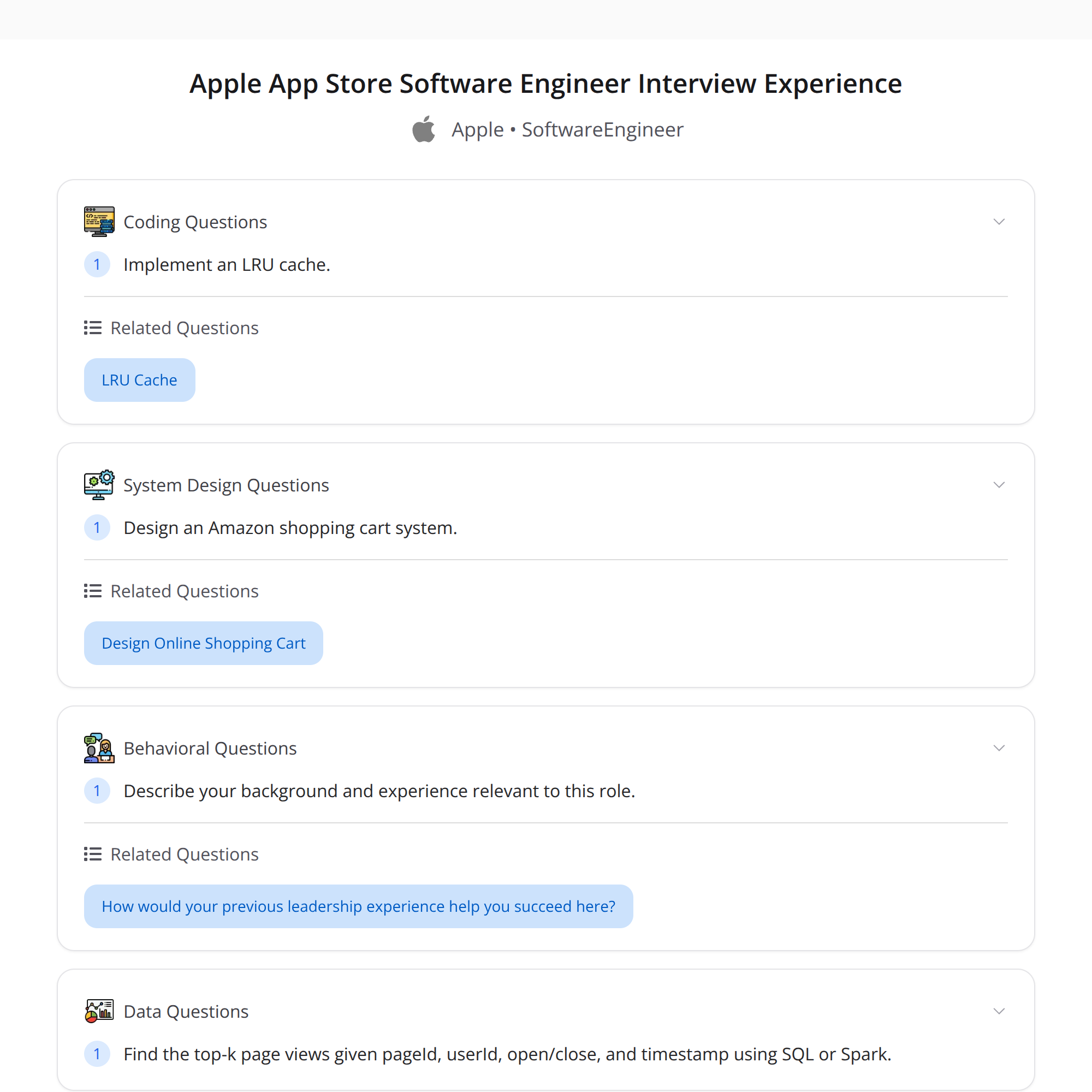
A Bugfree-users post recounts a high-score interview experience for the Apple App Store (Software Data Engineer, ICT5). The loop: five intense rounds, each beginning with a background check. Interviewers covered a broad spread — expect system design questions (LRU cache, shopping-cart systems) and data-engineering tasks (top‑K page views from pageId/userId open/close events using SQL/Spark). Interviewer focus varied across distributed systems, data engineering, and Spark — so be comfortable switching hats.
Below is a structured, expanded breakdown with concrete preparation guidance and example approaches you can use to practice.
Interview structure (what to expect)
- 5 rounds total.
- Each round started with a background-check segment or contextual questions.
- Topics spanned system design, distributed systems, and data engineering (SQL + Spark).
- Typical sample tasks: design an LRU cache, design an Amazon-style shopping cart service, compute top‑K page views from open/close events using SQL/Spark, and write Spark queries to implement aggregations.
Round-by-round themes (likely topics and what interviewers look for)
Quick background + behavioral / fit questions
- Verify experience and clarify expectations for the role.
- Tip: align your examples to distributed/data systems work.
System design — LRU cache
- Focus: API, data structures, time/space complexity, concurrency and thread-safety, eviction policies.
- Typical solution: hashmap (key -> node) + doubly linked list for O(1) get/put and eviction.
- Considerations: memory limits, TTL/expiration, persistence vs in-memory cache, distributed cache (sharding, consistent hashing), and failure modes.
System design — shopping cart (Amazon-style)
- Focus: entities and APIs, session vs persistent carts, scaling, consistency, failure recovery.
- Key components:
- API layer: create/update/get cart, checkout
- Data model: cartId, userId, items (productId, qty, priceSnapshot), timestamps
- Storage: transactional DB for strong guarantees or NoSQL for scale + event-sourcing for history
- Caching: session cache for frequent reads, write-through or write-back strategies
- Checkout flow: inventory reservation/locking, payment integration, idempotency
- Scaling: sharding by userId/cartId, CQRS for read-heavy workloads, background reconciliation jobs
Data engineering / SQL — top‑K page views from events
- Problem summary: You're given event records (pageId, userId, eventType = open/close, timestamp). Compute top‑K page views, typically within a time window.
- Clarify requirements first: Are we counting raw opens? Unique users? Sliding window or fixed window? Real-time or batch?
Example approaches:
- Batch SQL: filter for opens, group by pageId, order by count desc, limit K.
- Spark DataFrame: aggregate counts and use window functions or order/limit.
Example SQL (batch, counting open events):
SELECT pageId, COUNT(*) AS views FROM events WHERE eventType = 'open' AND timestamp BETWEEN '2024-01-01' AND '2024-01-31' GROUP BY pageId ORDER BY views DESC LIMIT 10;
Example PySpark (DataFrame API) to get top-K by views in a time range:
from pyspark.sql.functions import col
events_filtered = events_df.filter( (col('eventType') == 'open') & (col('timestamp') >= start_ts) & (col('timestamp') <= end_ts) )
topk = ( events_filtered.groupBy('pageId') .count() .orderBy(col('count').desc()) .limit(K) )
topk.show()
For unique users per page (de-duplicated counts):
topk_unique = ( events_filtered.select('pageId', 'userId').dropDuplicates() .groupBy('pageId') .count() .orderBy(col('count').desc()) .limit(K) )
For streaming or sliding windows, use Spark Structured Streaming with watermarking and window aggregations.
Spark query-writing & performance
- Be ready to write queries, optimize joins, choose partitioning keys, cache judiciously, and reason about shuffle and memory.
- Discuss trade-offs: skews, broadcast joins for small tables, partition pruning, and checkpointing for long-running jobs.
How to prepare (practical checklist)
- Brush up on core system-design patterns: caching (LRU/LFU), load balancing, sharding, CAP theorem, transactions vs eventual consistency.
- Practice designing end-to-end services (APIs, data model, scaling, failure handling).
- Be fluent with SQL and Spark (DataFrame API + SQL). Practice common aggregations, window functions, and streaming basics.
- Know how to reason about complexity, memory use, and distributed bottlenecks.
- Prepare short, crisp stories for behavioral/background checks focused on systems/data engineering impact.
- Mock interviews: alternate roles (system designer vs data engineer) so you can switch focus quickly.
Quick tips for interview time
- Clarify ambiguous requirements up front (e.g., unique users vs total page views, online vs batch).
- Start with a high-level design, then drill into components and trade-offs.
- State assumptions explicitly and iterate with the interviewer.
- When coding SQL/Spark, explain performance implications (costly shuffles, use of broadcast joins, partitioning).
- If you don’t know a detail, describe how you’d find out or what metrics you’d monitor in production.
Recommended resources
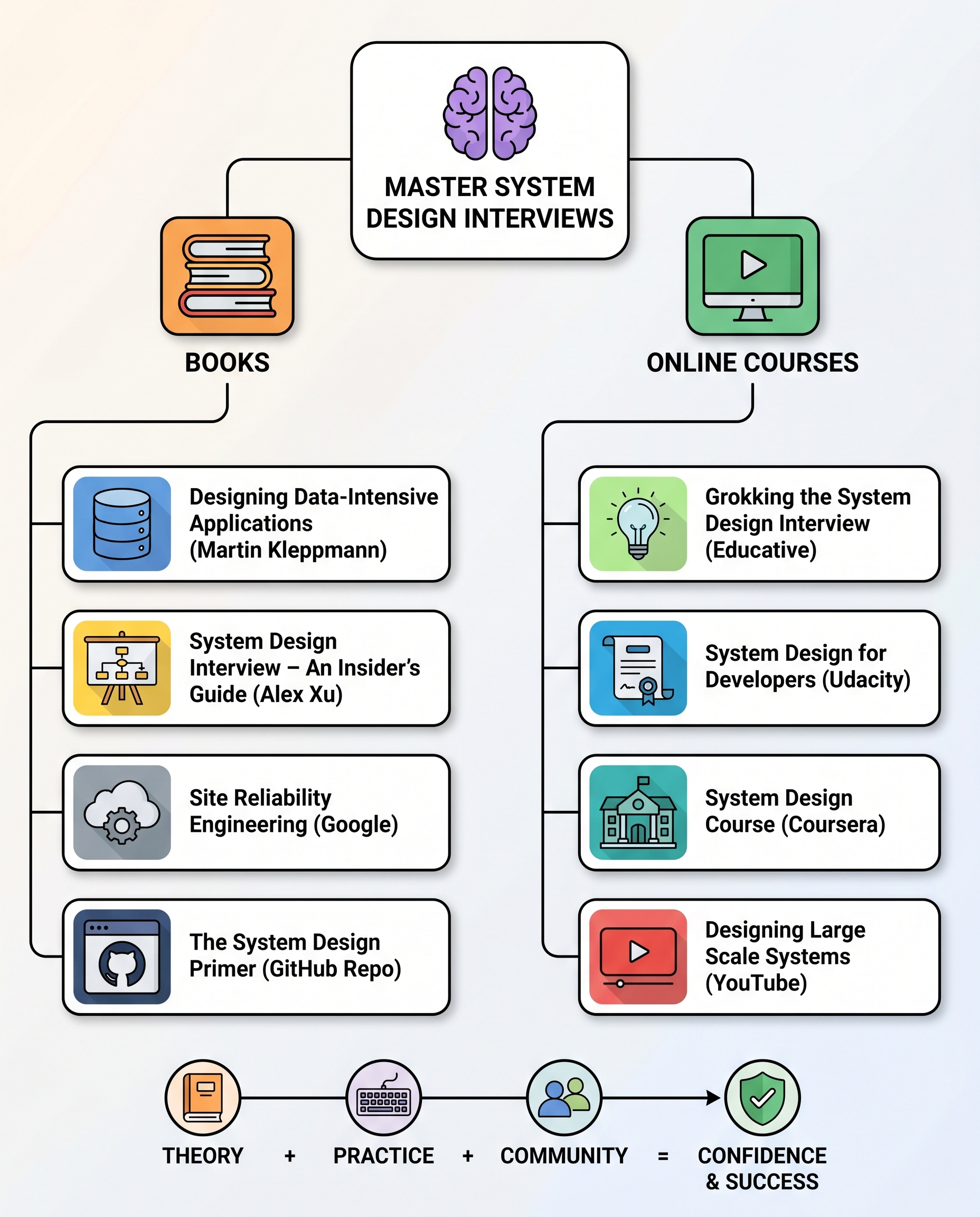
- Designing Data-Intensive Applications — Martin Kleppmann
- System Design Primer (GitHub)
- Spark official docs and Structured Streaming guide
- Practice SQL on real datasets (Kaggle, BigQuery public datasets)
Final takeaway
This Apple App Store ICT5 interview example highlights wide-ranging expectations: be prepared for distributed-system design questions, detailed data-engineering problems, and hands-on Spark/SQL work. Flexibility, clear assumptions, and an ability to switch technical lenses (systems ↔ data) will help you navigate the five rounds successfully.
Good luck — practice both the design patterns and the SQL/Spark exercises so you can pivot smoothly between roles during the interview.
About the author
bugfree.ai is an advanced AI-powered platform designed to help software engineers master system design and behavioral interviews. Whether you’re preparing for your first interview or aiming to elevate your skills, bugfree.ai provides a robust toolkit tailored to your needs. Key Features:
150+ system design questions: Master challenges across all difficulty levels and problem types, including 30+ object-oriented design and 20+ machine learning design problems. Targeted practice: Sharpen your skills with focused exercises tailored to real-world interview scenarios. In-depth feedback: Get instant, detailed evaluations to refine your approach and level up your solutions. Expert guidance: Dive deep into walkthroughs of all system design solutions like design Twitter, TinyURL, and task schedulers. Learning materials: Access comprehensive guides, cheat sheets, and tutorials to deepen your understanding of system design concepts, from beginner to advanced. AI-powered mock interview: Practice in a realistic interview setting with AI-driven feedback to identify your strengths and areas for improvement.
bugfree.ai goes beyond traditional interview prep tools by combining a vast question library, detailed feedback, and interactive AI simulations. It’s the perfect platform to build confidence, hone your skills, and stand out in today’s competitive job market. Suitable for:
New graduates looking to crack their first system design interview. Experienced engineers seeking advanced practice and fine-tuning of skills. Career changers transitioning into technical roles with a need for structured learning and preparation.
Comments
Join the discussionNo comments yet. Be the first to comment.