
High-score Anthropic SWE interview (Bugfree users) — Culture, Behavioral, and Practical Systems Thinking
I reached Anthropic’s final SWE rounds after heavy prep. What stood out across every interviewer — engineers and managers alike — was a clear, mission-driven focus and a bias toward productive engineering. The interviews tested both alignment with Anthropic’s values and practical systems thinking.
Below is a condensed, actionable breakdown of what to expect and how to prepare.
Interview structure (what to expect)
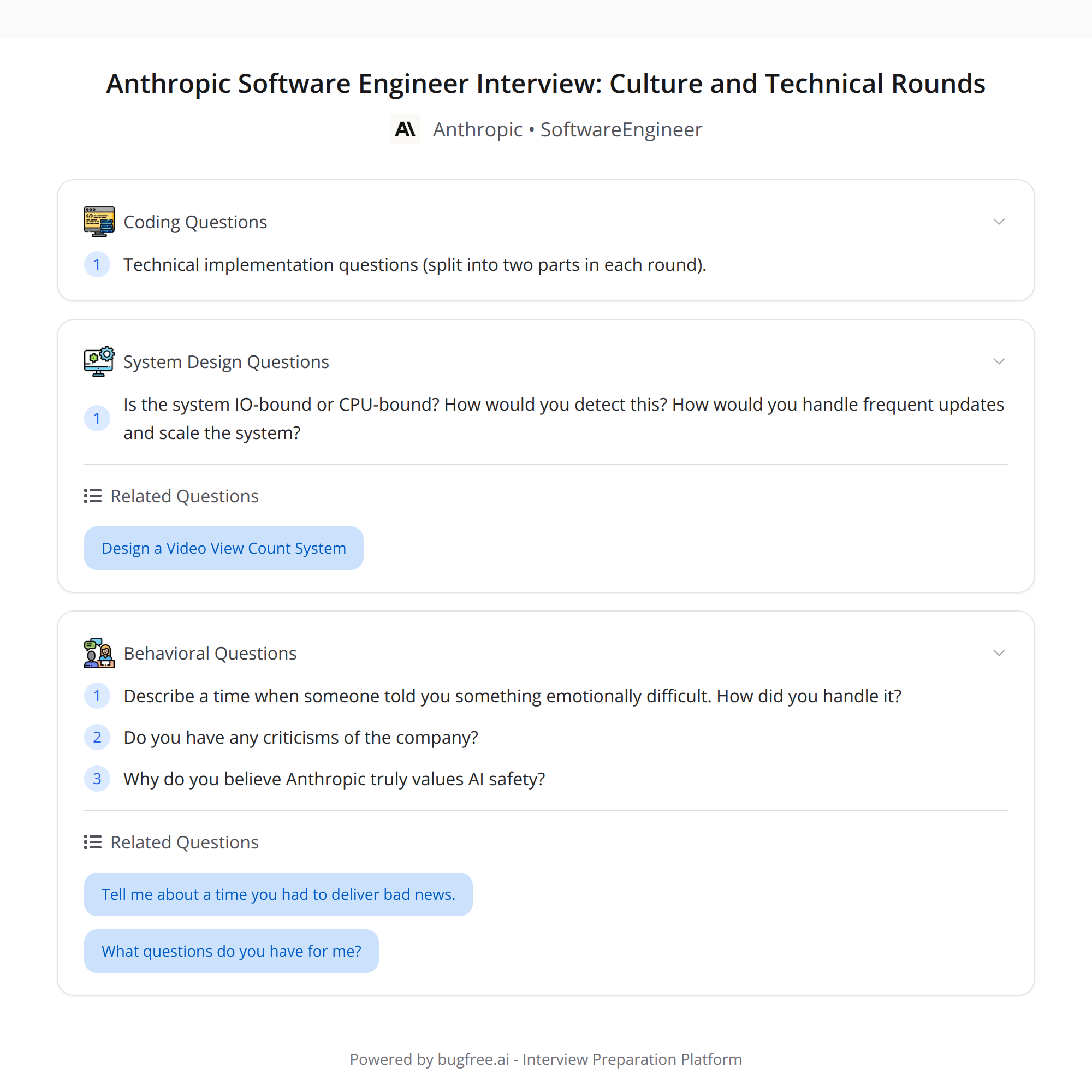
- Culture/values round: company mission, AI-safety stance, credibility questions, and critique.
- Behavioral round(s): emotionally difficult scenarios and conflict-resolution questions — look for self-awareness and the ability to iteratively resolve problems.
- Technical rounds: a 3-part coding approach that mixes implementation and practical systems design. Expect to discuss whether problems are I/O-bound or CPU-bound, how to measure performance, strategies for handling frequent updates, and scaling trade-offs.
Culture round — what to study and how to answer
Prepare these resources and lines of reasoning:
- Read the coordinator materials thoroughly and follow Anthropic’s newsroom and engineering blog posts.
- Listen to founder/podcast interviews to understand motivations, priorities, and historical trade-offs.
What interviewers want to hear:
- A clear, succinct AI-safety stance: why safety matters, and how engineering choices can reduce risk.
- Why Anthropic is credible: reference concrete signals (papers, engineering practices, hiring priorities, product focus) rather than vague praise.
- Thoughtful critiques: balance praise with constructive suggestions. Example: "I value your emphasis on red-team evaluation; I'd like to see more public benchmarks on distributional robustness so external researchers can validate claims." Give specific, feasible improvements.
Quick tips:
- Avoid ideological answers. Be pragmatic and grounded in engineering trade-offs.
- Show you can translate safety principles into concrete design decisions (e.g., monitoring, rollout strategies, adversarial testing).
Behavioral curveballs — difficult emotional scenarios
Interviewers may present conflict or emotionally charged cases to test: self-awareness, humility, ability to repair relationships, and a learning mindset.
A concise response framework (STAR + reflection):
- Situation: briefly set context.
- Task: your responsibility.
- Action: steps you took, focusing on communication and repair.
- Result: outcome and measurable impact.
- Reflection: what you learned and how you’d handle it now.
Example (short):
- Situation: A release caused user-facing regressions and teammates were upset.
- Task: Own the rollback and restore trust.
- Action: Immediately rolled back, ran root-cause triage, scheduled a postmortem, and shared a public summary with action items.
- Result: Service restored in 30 minutes; postmortem prevented recurrence.
- Reflection: I learned to add automated canaries and tighter pre-release checks.
Show empathy, accountability, and concrete follow-up actions.
Technical format — 3-part coding + practical system design
Expect a blend of coding (implement algorithms/data structures) and practical system design questions that focus on real operational trade-offs.
Key areas to prepare:
- Clarify requirements and constraints early (latency SLOs, throughput, data size, consistency needs).
- Identify whether the workload is I/O-bound or CPU-bound and justify with simple cost reasoning.
- Propose measurement strategies: metrics and tooling.
- Offer scalable, incremental solutions and explain trade-offs.
I/O-bound vs CPU-bound — how to reason
I/O-bound: bottleneck is network, disk, or other I/O. Signs: high wait time, low CPU utilization, high latency on external calls.
- Remediations: batching, caching, parallel requests, use of async IO, local caches or CDNs, reduce payload size.
CPU-bound: bottleneck is computation. Signs: high CPU utilization, slow single-threaded operations.
- Remediations: algorithmic improvements, vectorized operations, compiled implementations, horizontal scaling, offloading to accelerators.
Measure with: p50/p95/p99 latency, throughput (reqs/sec), CPU/memory profiles, I/O wait times, and end-to-end traces.
Measuring performance
- Use tracing (distributed traces), metrics (prometheus-style), and load tests.
- Focus on tail latencies (p95/p99) rather than only averages.
- If possible, instrument prototypes early to validate assumptions.
Handling frequent updates
Common scenario: models or configuration data update frequently but must be served with low latency and correctness.
Strategies:
- Blue/green or canary rollouts to reduce blast radius.
- Incremental/streaming updates (e.g., Kafka/Change Data Capture) so workers get near-real-time updates without full reloads.
- Use multi-version concurrency control or versioned keys so in-flight requests remain consistent.
- Design for eventual consistency if strict linearizability isn't required; otherwise, choose a strong consistency store and pay the latency cost.
- Cache invalidation strategies: per-key TTLs, explicit invalidation messages, or write-through caches depending on freshness needs.
Scaling strategies (practical)
- Horizontal scaling: stateless services, autoscaling groups, sharding stateful components.
- Partitioning: consistent hashing, key-range partitioning for databases.
- Batching and backpressure: reduce I/O and smooth spikes.
- Caching tiers: CDN for static content, in-memory caches for hot keys, and read replicas for read-heavy loads.
- Avoid premature optimization: prototype, measure, and iterate with real traffic patterns.
Example interview-style systems answer (concise)
Question: "We need to serve model inferences with frequent model updates and <50ms latency. How would you design this?"
Answer outline:
- Clarify: model size, request rates, acceptable staleness, SLOs.
- Approach:
- Use a separate serving fleet with model versioning. Each deployment serves a single model version.
- Stream model updates to a staging cluster and run canary traffic to validate.
- Promote to production via blue/green or canary. Use a lightweight router that can split traffic by version.
- Use aggressive batching for CPU-heavy steps where latency allows, otherwise use optimized inference engines (FP16, batching on GPU/accelerator).
- Instrument p99 latency and tail error rates; autoscale based on queue length and latency metrics.
- Consistency: allow small staleness if acceptable; otherwise, ensure atomic swap of model endpoints to avoid serving mixed versions.
Preparation checklist
- Read Anthropic coordinator materials and newsroom posts.
- Listen to founder/engineering podcasts to learn priorities.
- Prepare a succinct AI-safety stance and two or three specific critiques of Anthropic’s approach (with constructive suggestions).
- Practice STAR-style behavioral answers, including one difficult emotional/conflict example.
- Do focused systems practice: measure vs. hypothesize, and articulate trade-offs (I/O vs CPU, caching, batching, scaling).
- Build small prototypes and instrument them to be ready to discuss real measurements.
Takeaway
Interviewers evaluated both mission alignment and engineering depth. Be ready to discuss values and the concrete engineering choices that realize them. Practice clear requirement gathering, trade-off reasoning, and measurement-driven design.
#SoftwareEngineering #AI #InterviewPrep
About the author
bugfree.ai is an advanced AI-powered platform designed to help software engineers master system design and behavioral interviews. Whether you’re preparing for your first interview or aiming to elevate your skills, bugfree.ai provides a robust toolkit tailored to your needs. Key Features:
150+ system design questions: Master challenges across all difficulty levels and problem types, including 30+ object-oriented design and 20+ machine learning design problems. Targeted practice: Sharpen your skills with focused exercises tailored to real-world interview scenarios. In-depth feedback: Get instant, detailed evaluations to refine your approach and level up your solutions. Expert guidance: Dive deep into walkthroughs of all system design solutions like design Twitter, TinyURL, and task schedulers. Learning materials: Access comprehensive guides, cheat sheets, and tutorials to deepen your understanding of system design concepts, from beginner to advanced. AI-powered mock interview: Practice in a realistic interview setting with AI-driven feedback to identify your strengths and areas for improvement.
bugfree.ai goes beyond traditional interview prep tools by combining a vast question library, detailed feedback, and interactive AI simulations. It’s the perfect platform to build confidence, hone your skills, and stand out in today’s competitive job market. Suitable for:
New graduates looking to crack their first system design interview. Experienced engineers seeking advanced practice and fine-tuning of skills. Career changers transitioning into technical roles with a need for structured learning and preparation.
Comments
Join the discussionNo comments yet. Be the first to comment.