High-Score Anthropic SWE Interview Experience
I reached Anthropic’s final SWE rounds after heavy prep. What stood out across interviews was a consistent theme: every engineer and manager I met radiated mission-driven energy and a bias for productive work. If you’re preparing, expect equal focus on cultural alignment and practical systems thinking—both matter.
What to expect (high level)
- Culture / values round that’s substantive—not just small talk.
- Behavioral curveballs: emotionally charged or conflict-heavy scenarios to probe self-awareness and interpersonal judgment.
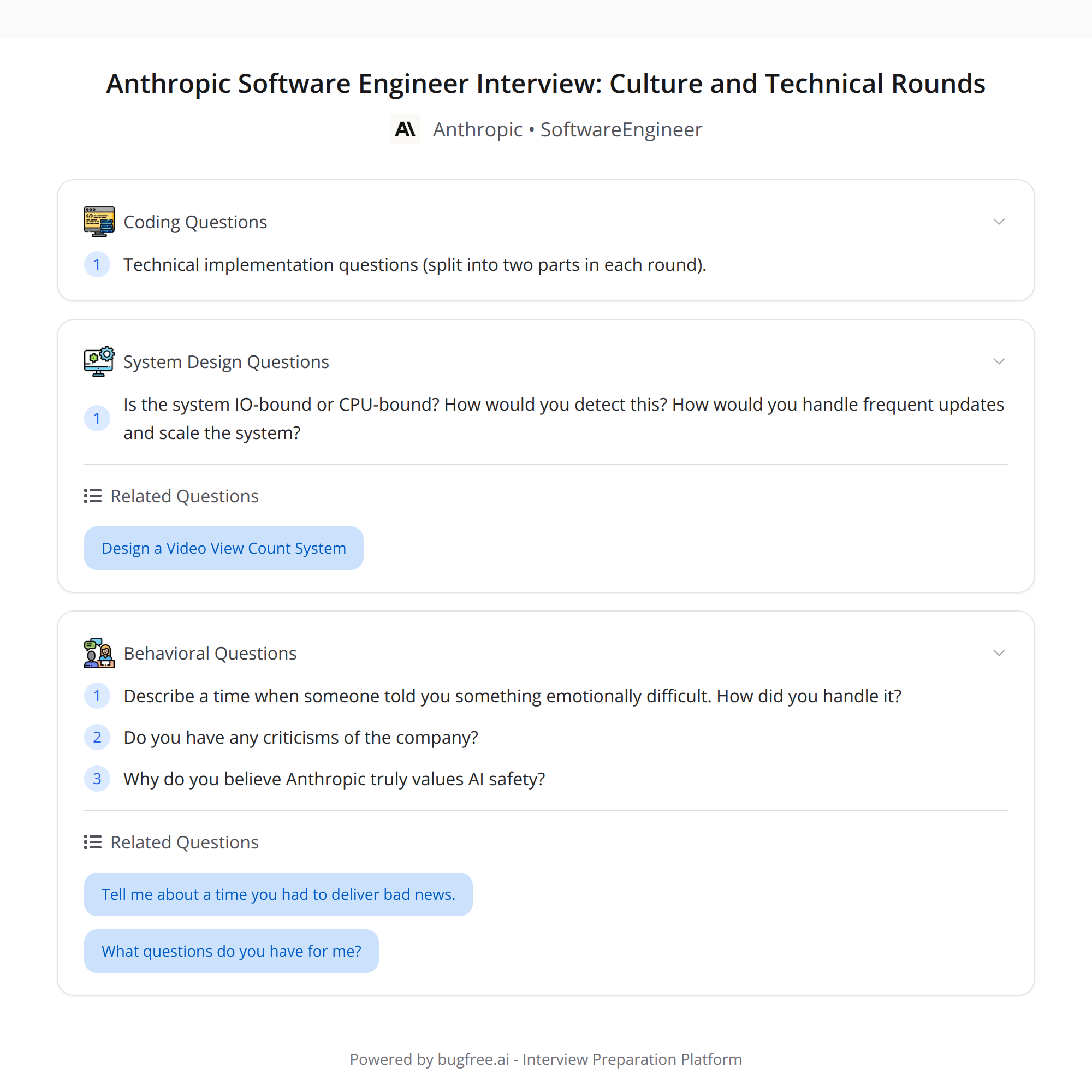
- Technical rounds split into three practical pieces: implementation, reasoning about performance (IO vs CPU bound), and pragmatic system design questions (how to measure, update, and scale).
Culture round — how to prepare
Anthropic cares about mission alignment and safety-minded thinking. The culture round was deeper than “tell me about yourself.” Prepare to discuss:
- Coordinator materials: re-read any prep or onboarding packets the recruiter provides.
- Anthropic newsroom and founder podcasts: know current priorities, recent research, product direction, and public positioning.
- Your AI-safety stance: describe concrete principles you follow (e.g., robustness, interpretability, monitoring, conservative deployment), and how they shape trade-offs.
- Why Anthropic is credible: cite specific evidence—public research, hiring choices, safety investments, partnerships, or product examples.
- Thoughtful critiques: have 1–2 constructive suggestions or questions (e.g., on deployment safeguards, evaluation strategies, or research directions). Critique should be informed, respectful, and solution-oriented.
Quick checklist for culture prep:
- Read recent Anthropic posts and research papers relevant to the team you’re interviewing with.
- Prepare a short, coherent AI-safety position (1–2 minutes) with examples from your experience.
- Draft 1–2 thoughtful, constructive critiques or questions about Anthropic’s approach.
Behavioral curveballs — what they’re testing
Expect emotionally difficult scenarios designed to probe:
- Self-awareness: recognizing mistakes and taking ownership.
- Conflict resolution: navigating disagreements with peers or managers.
- Communication under stress: how you explain trade-offs and de-escalate.
How to answer these effectively:
- Use STAR-ish structure: Situation, Task, Action, Result — and include what you learned.
- Name your emotions briefly if relevant (e.g., “I was frustrated because…”), then pivot to actions and outcomes.
- Highlight processes you used to repair trust or prevent recurrence.
Example prompt + approach:
- Prompt: “Tell me about a time you strongly disagreed with a technical decision that shipped.”
- Response guide: succinctly explain the disagreement, what you tried (data, prototypes, experiments), how you escalated or documented the risk, the final outcome, and the preventive steps you proposed.
Technical format — three practical pieces
The technical portion is pragmatic and systems-focused. I saw three main threads:
1) Implementation & correctness
- Solve for correctness, clarity, and edge cases.
- Write readable code that’s easy to test; explain complexity.
2) Performance reasoning (IO vs CPU bound)
- Be ready to identify whether a workload is IO-bound or CPU-bound.
- Explain how you’d measure: latency P50/P95/P99, throughput, CPU utilization, I/O wait, profiler reports, and end-to-end traces.
- Suggest targeted optimizations (e.g., batching, caching, async IO, vectorized ops) tied to the root cause.
3) Practical system design: updates, metrics, and scaling
- Frequent updates: explain deployment strategies such as feature flags, canary/rolling deploys, blue/green, and database migration patterns (backwards-compatible schema changes, double writes, etc.).
- Measuring success: define metrics (latency, error rate, traffic, resource utilization), set SLOs, and describe alerting thresholds and dashboards.
- Scaling: cover vertical vs. horizontal scaling, caching layers, sharding strategies, autoscaling policies, and load balancing. Discuss consistency, latency, and fault-tolerance trade-offs.
Example mini-question and how to approach it:
- Prompt: “You have a model-serving pipeline that intermittently spikes latency. How do you debug and mitigate?”
- Approach:
- Observe: collect metrics (P95/P99 latencies, CPU, memory, queue lengths, GC, model load times).
- Hypothesize: is it IO (disk, network, model loading) or CPU (inference cost, serialization)?
- Experiment: add tracing, reproduce with load test, test smaller batch sizes.
- Mitigate: add caching, pre-load models, increase concurrency or batch adaptively, set backpressure, or route to a fallback model.
Prep resources & timeline
- Short-term (2–3 weeks): focus on systems design basics, profiling tools, and rehearsal of culture/behavior answers.
- Medium-term (4–6 weeks): implement a few end-to-end prototypes (a microservice with instrumented metrics, a deployment flow with canary tests), and practice timed coding questions.
- Read/listen: Anthropic newsroom, relevant blog posts, founder interviews/podcasts, and safety-focused research papers.
Suggested concrete resources:
- Distributed systems/readings: design of large-scale systems, SRE practices, and monitoring books/articles.
- Tools: learn to interpret traces (OpenTelemetry), profilers, and basic load testing tools.
Final takeaway
Anthropic’s interview process blends mission alignment with practical engineering depth. Don’t treat the culture round as a perfunctory check—prepare informed views on AI safety and Anthropic’s work. For technical rounds, emphasize measurement-first troubleshooting and realistic system design decisions that show you can ship, observe, and iterate safely.
Good luck—prepare both your values and your tooling mindset.
#SoftwareEngineering #AI #InterviewPrep
About the author
bugfree.ai is an advanced AI-powered platform designed to help software engineers master system design and behavioral interviews. Whether you’re preparing for your first interview or aiming to elevate your skills, bugfree.ai provides a robust toolkit tailored to your needs. Key Features:
150+ system design questions: Master challenges across all difficulty levels and problem types, including 30+ object-oriented design and 20+ machine learning design problems. Targeted practice: Sharpen your skills with focused exercises tailored to real-world interview scenarios. In-depth feedback: Get instant, detailed evaluations to refine your approach and level up your solutions. Expert guidance: Dive deep into walkthroughs of all system design solutions like design Twitter, TinyURL, and task schedulers. Learning materials: Access comprehensive guides, cheat sheets, and tutorials to deepen your understanding of system design concepts, from beginner to advanced. AI-powered mock interview: Practice in a realistic interview setting with AI-driven feedback to identify your strengths and areas for improvement.
bugfree.ai goes beyond traditional interview prep tools by combining a vast question library, detailed feedback, and interactive AI simulations. It’s the perfect platform to build confidence, hone your skills, and stand out in today’s competitive job market. Suitable for:
New graduates looking to crack their first system design interview. Experienced engineers seeking advanced practice and fine-tuning of skills. Career changers transitioning into technical roles with a need for structured learning and preparation.
Comments
Join the discussionNo comments yet. Be the first to comment.