
High-Score Amazon SWE Interview Experience (Bugfree Users)
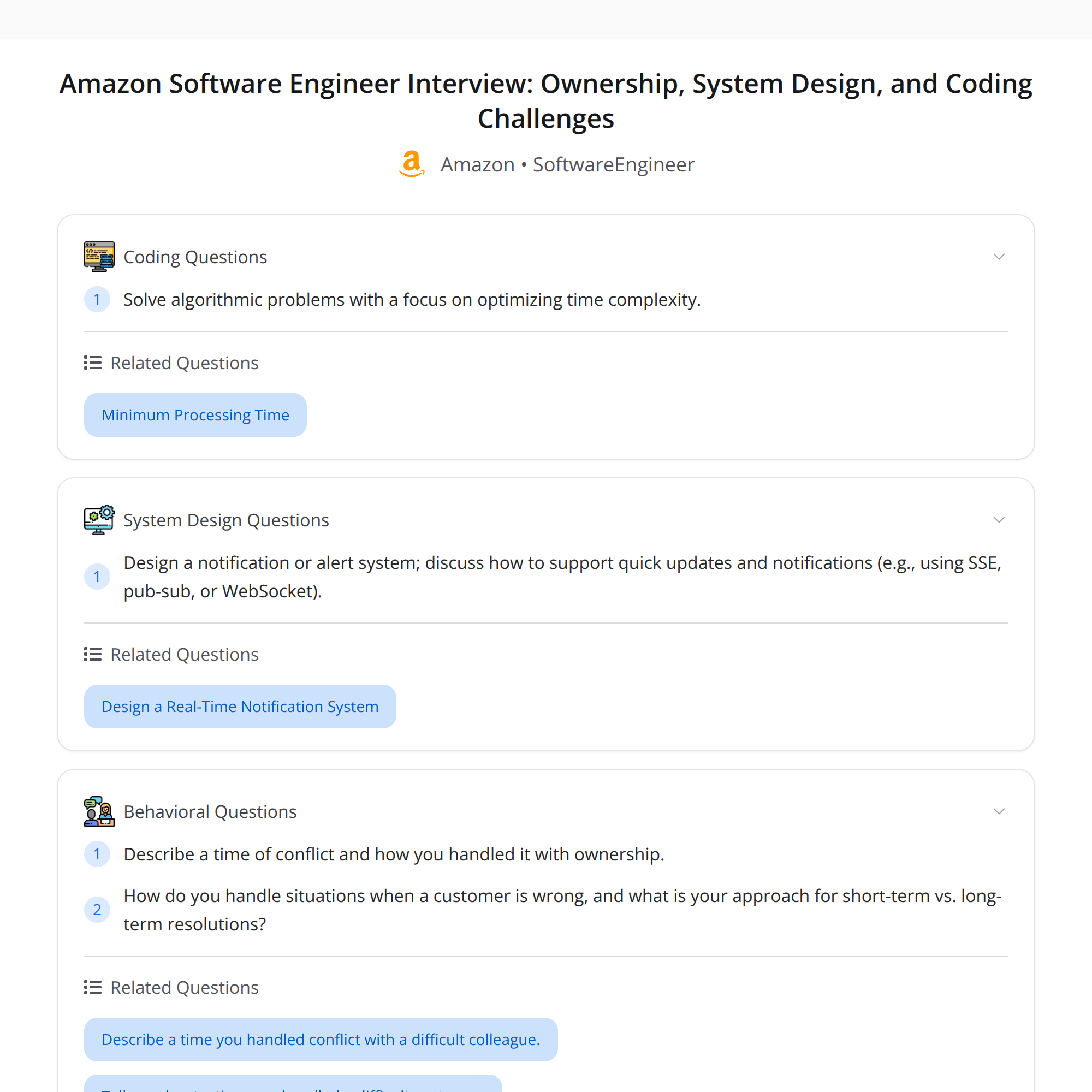
Posted by Bugfree users — a concise, high-impact breakdown of a successful Amazon Software Engineer interview. This write-up covers the full process: the online assessment (OA), behavioral rounds focused on Amazon Leadership Principles, a system design centered on a notification/alert service, and coding expectations across onsite rounds.
Overview
The interview emphasized three consistent themes:
- Ownership and customer impact — align answers with Amazon Leadership Principles.
- System design — build scalable, low-latency notification/alert systems with pub/sub, SSE, and WebSockets in mind.
- Coding — clean, efficient implementations with clear tradeoffs and complexity analysis.
Below are expanded notes and practical tips to help you prepare.
1) Online Assessment (OA)
The OA opened the process with algorithmic problems where asymptotic performance mattered. Key takeaways:
- Expect a mix of array/string manipulation, hash maps, two-pointer/sliding-window, graph/tree traversals, and dynamic programming.
- Time complexity matters. Optimize brute-force solutions and explain improvements.
- Write correct, readable code first; then optimize while communicating tradeoffs.
Practice: timed problems on LeetCode/HackerRank focused on medium/medium-hard difficulty and reviewing common patterns under time pressure.
2) Behavioral Rounds (Leadership Principles)
Behavioral questions tested conflict management, ownership, bias for action, and customer obsession. Interviewers look for real examples demonstrating impact.
Tips:
- Use the STAR framework (Situation, Task, Action, Result).
- Emphasize ownership: what you did end-to-end, how you prioritized, and the measurable impact.
- Discuss tradeoffs and lessons learned when asked about mistakes or conflicts.
Sample prompts to prepare for:
- Tell me about a time you took ownership of a failing project.
- Describe a disagreement with a peer and how you resolved it.
- Give an example of a decision that prioritized customer impact over internal convenience.
3) System Design — Notification / Alert System
One onsite design prompt asked to design a real-time notification/alert system. The interview explored delivery guarantees, latency, scaling, and tradeoffs between streaming technologies (SSE, WebSockets, long polling).
Important components and considerations:
High-level components:
- API Gateway / Load Balancer
- Auth service (tokens/session management)
- Notification service (ingest, validation, personalization)
- Message broker / pub-sub (Kafka, Amazon SNS/SQS, Redis Streams)
- Delivery layer (WebSockets, Server-Sent Events (SSE), or push notifications)
- Persistent storage (for audit/history) and cache (for quick lookups)
- Monitoring & alerting, metrics, and backpressure handling
Delivery choices:
- WebSockets: full-duplex, low-latency two-way communication; good for interactive clients and bi-directional flows.
- Server-Sent Events (SSE): simpler one-way server-to-client stream; auto-reconnect helpful for event streams.
- Long polling: simple but less efficient at scale — useful as a fallback.
Scalability & reliability:
- Partitioning (topic sharding) for horizontal scale.
- Fan-out strategies: broker-based fan-out (Kafka-like) vs. application-level push.
- Persistence for at-least-once delivery; deduplication at consumer for idempotency.
- Backpressure handling: drop policy, queue throttling, or client-side rate limits.
Latency & consistency:
- Favor eventual consistency for scale; design for ordering per user or per topic if required.
- For critical alerts, include acknowledgements and retry logic, and consider synchronous paths for high-priority messages.
Security & cost:
- Authenticate clients and authorize topic subscriptions.
- Consider message size, retention, and archival to control costs.
When discussing design, show diagrams (or describe them clearly), call out scaling bottlenecks, and present concrete choices (e.g., Kafka for durable pub-sub, Redis for ephemeral state, AWS SNS for broadcast).
4) Coding Rounds (onsite)
Every onsite round included coding. Interviewers expect:
- Correct, clean solutions with clear time/space complexity analysis.
- Edge-case handling and brief tests or examples.
- Clear explanation of tradeoffs (e.g., memory vs. speed), alternatives, and possible optimizations.
Practical checklist for a coding round:
- Clarify requirements & constraints up front.
- State your approach, then code a simple, correct version.
- Optimize only after correctness; highlight complexity.
- Walk through an example and mention edge cases.
Preparation Tips & Checklist
- Practice timed algorithm problems (pattern recognition over rote solving).
- Mock behavioral answers tied to Leadership Principles using the STAR format.
- Review system design fundamentals: messaging systems, load balancing, caching, databases, CAP theorem, and common tradeoffs.
- Practice designing small, focused services like a notification system; be prepared to explain component choices.
- Communicate clearly in interviews: describe assumptions, tradeoffs, and failure modes.
Quick checklist before interview day:
- Brush up on medium-hard LeetCode problems.
- Prepare 6–8 STAR stories highlighting ownership and impact.
- Sketch a notification system and a couple of alternate architectures.
- Sleep well and practice concise explanations.
Final Thoughts
Amazon interviews reward clarity, ownership, and pragmatic design. Demonstrate customer focus in behavioral answers, design systems with clear scaling and failure handling, and write code that balances correctness and efficiency. Communicate each step and justify your choices.
Good luck — practice deliberately, iterate on feedback, and focus on storytelling for impact.
#SoftwareEngineering #SystemDesign #InterviewPrep
About the author
bugfree.ai is an advanced AI-powered platform designed to help software engineers master system design and behavioral interviews. Whether you’re preparing for your first interview or aiming to elevate your skills, bugfree.ai provides a robust toolkit tailored to your needs. Key Features:
150+ system design questions: Master challenges across all difficulty levels and problem types, including 30+ object-oriented design and 20+ machine learning design problems. Targeted practice: Sharpen your skills with focused exercises tailored to real-world interview scenarios. In-depth feedback: Get instant, detailed evaluations to refine your approach and level up your solutions. Expert guidance: Dive deep into walkthroughs of all system design solutions like design Twitter, TinyURL, and task schedulers. Learning materials: Access comprehensive guides, cheat sheets, and tutorials to deepen your understanding of system design concepts, from beginner to advanced. AI-powered mock interview: Practice in a realistic interview setting with AI-driven feedback to identify your strengths and areas for improvement.
bugfree.ai goes beyond traditional interview prep tools by combining a vast question library, detailed feedback, and interactive AI simulations. It’s the perfect platform to build confidence, hone your skills, and stand out in today’s competitive job market. Suitable for:
New graduates looking to crack their first system design interview. Experienced engineers seeking advanced practice and fine-tuning of skills. Career changers transitioning into technical roles with a need for structured learning and preparation.
Comments
Join the discussionNo comments yet. Be the first to comment.


