
High-Score Interview Experience: Amazon SDE-2 Onsite — Behavioral + Tree & String Coding
A Bugfree-user shared a high-scoring Amazon SDE-2 onsite (Round 1) experience that blended leadership-oriented behavioral questions with core DS&A problems. Below is a concise, actionable summary you can use to prepare.
Quick overview
- Format: Leadership-style behavioral + 2 coding problems (tree + string).
- Behavioral emphasis: ownership, trade-offs, measurable impact.
- Coding emphasis: clear BFS/stack patterns and explaining complexity.
Behavioral highlights & how to answer
Focus on clarity, ownership, and measurable outcomes. Use STAR (Situation, Task, Action, Result) but be ready to dive deep into decisions and trade-offs.
Tight deadline question
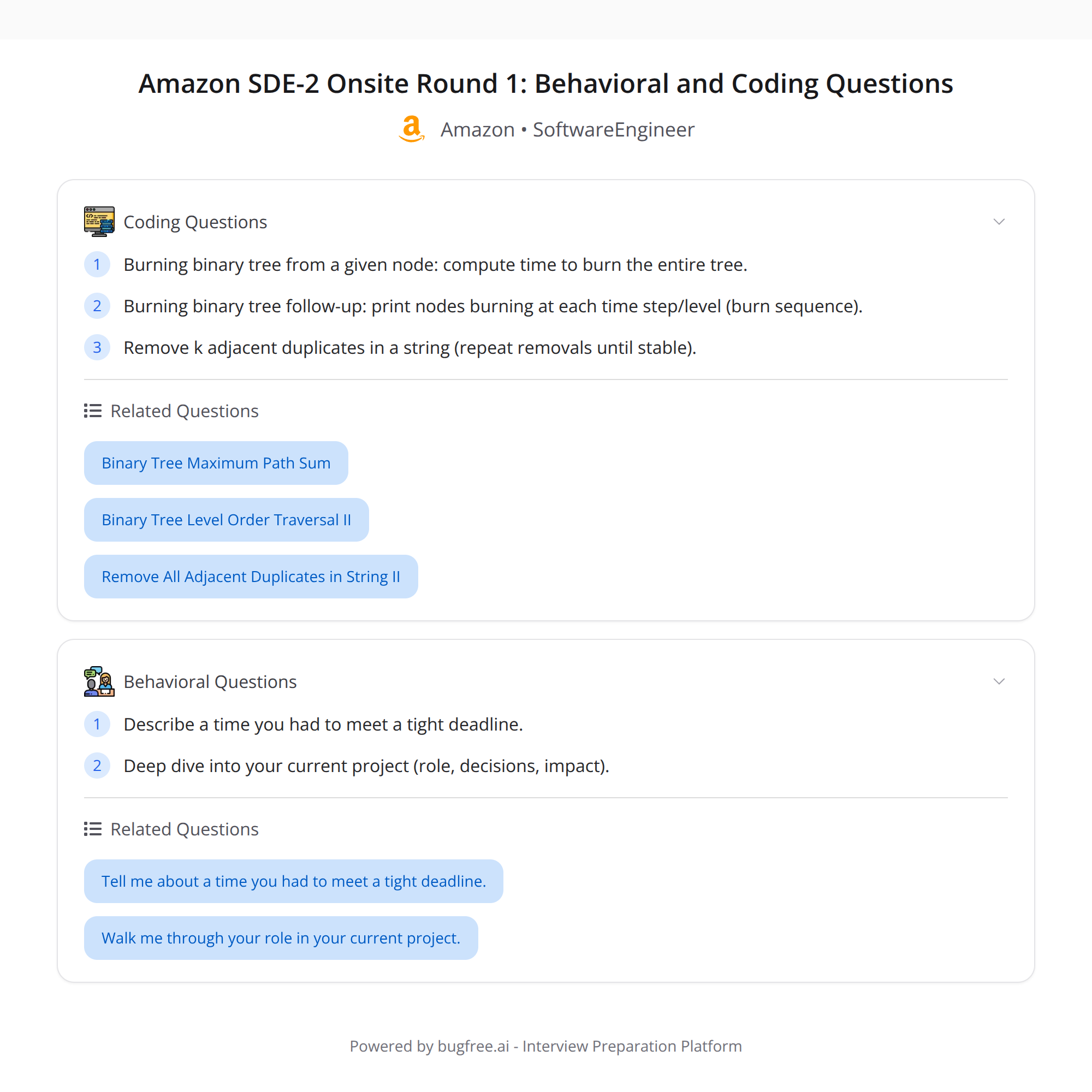
- What they asked: Explain how you handled a tight deadline — what you did, what you sacrificed, and the outcome.
- How to answer: Be concrete. State the timeline, the deliverables you prioritized, why you chose that scope, the technical trade-offs (e.g., temporary coupling vs. long-term maintainability), and the quantifiable result (e.g., "shipped feature X in 3 days, 20% reduced latency, follow-up refactor planned").
Deep dive on current project
- What they asked: Explain your role, decisions you made, and the impact.
- How to answer: Explain the architecture, your responsibility, key technical decisions, the reason behind those decisions, observed impact (metrics), and the follow-ups or improvements you planned.
Behavioral tips:
- Own the decision — describe why your choice was pragmatic.
- Be crisp about trade-offs and mitigation plan.
- If you don’t know something, say how you’d find out and whom you’d involve.
Coding focus — problems and approaches
Two core problems surfaced in this interview:
- Burning a binary tree from a target node (time to burn whole tree). Follow-up: print burning sequence per time unit.
- Remove k adjacent duplicates in a string (repeat until stable).
Below are clear approaches you can use in the interview.
Problem 1 — Burning Binary Tree from a Target Node
Problem summary:
- Given a binary tree and a target node, fire spreads to parent and children each unit time. Compute the time to burn the whole tree.
- Follow-up: print nodes burned at each time unit (the burning sequence by level/time).
Approach (standard and robust):
- Build a parent map for every node by traversing the tree (DFS/BFS). This lets you treat the tree as an undirected graph.
- Start a BFS from the target node. Use a queue for current frontier and a visited set.
- Each BFS level corresponds to one time unit. The number of BFS levels until the queue is empty is the time to burn the whole tree.
- To print the burning sequence, record the nodes processed at each BFS level (e.g., append them to a list for that time unit).
Pseudo-steps:
- parentMap = {} ; build via DFS
- queue = [target]
- visited = {target}
- time = 0
- while queue not empty:
- size = queue.size
- nodesThisTime = []
- for i in 0..size-1:
- node = queue.pop
- nodesThisTime.append(node.val)
- for neighbor in [node.left, node.right, parentMap[node]]:
- if neighbor and neighbor not visited:
- visited.add(neighbor)
- queue.push(neighbor)
- if neighbor and neighbor not visited:
- record nodesThisTime (for printing sequence)
- time += 1
- answer = time - 1 (since last increment happens after final level)
Complexity: O(n) time, O(n) space.
Edge cases & notes:
- If nodes can have duplicate values, identify the target node by reference or by path, not just value.
- If target might be null, handle early return.
Problem 2 — Remove K Adjacent Duplicates in String (repeat until stable)
Problem summary:
- Given a string s and integer k, repeatedly remove groups of k identical adjacent characters until no more such groups exist, and return the final string.
Approach (stack of (char, count)):
- Use a stack that stores pairs: (character, current consecutive count).
- Iterate through characters of s:
- If stack is empty or current char != stack.top.char, push (char, 1).
- Else increment stack.top.count.
- If stack.top.count == k, pop it (removes those k chars).
- At the end, rebuild the string by repeating each char by its count in the stack order.
This single-pass stack approach inherently handles repeated removals because popping may expose a previous run that can merge with future characters.
Example:
- s = "deeedbbcccbdaa", k = 3
- Process yields final string "aa".
Complexity: O(n) time, O(n) space.
Implementation note:
- For performance, store counts as integers and build result using a list/buffer instead of concatenating strings repeatedly.
Key takeaways
- Behavioral: Be crisp about ownership, trade-offs, and measurable results. Prepare 2–3 deep-dive stories you can discuss for 10+ minutes.
- Coding: Know BFS on trees (including parent mapping) and stack/count techniques for string reductions.
- Explain complexity and edge cases out loud; interviewers care about thought process as much as the final code.
Quick prep checklist
- Prepare STAR stories focusing on impact and follow-ups.
- Practice tree BFS where parent links are needed (burning tree pattern).
- Practice string-stack patterns like "remove k adjacent duplicates."
- Time-box practice problems and verbalize trade-offs.
Good luck—focus on ownership in behavioral answers and clear BFS/stack patterns for coding.
#SoftwareEngineering #InterviewPrep #DataStructures
About the author
bugfree.ai is an advanced AI-powered platform designed to help software engineers master system design and behavioral interviews. Whether you’re preparing for your first interview or aiming to elevate your skills, bugfree.ai provides a robust toolkit tailored to your needs. Key Features:
150+ system design questions: Master challenges across all difficulty levels and problem types, including 30+ object-oriented design and 20+ machine learning design problems. Targeted practice: Sharpen your skills with focused exercises tailored to real-world interview scenarios. In-depth feedback: Get instant, detailed evaluations to refine your approach and level up your solutions. Expert guidance: Dive deep into walkthroughs of all system design solutions like design Twitter, TinyURL, and task schedulers. Learning materials: Access comprehensive guides, cheat sheets, and tutorials to deepen your understanding of system design concepts, from beginner to advanced. AI-powered mock interview: Practice in a realistic interview setting with AI-driven feedback to identify your strengths and areas for improvement.
bugfree.ai goes beyond traditional interview prep tools by combining a vast question library, detailed feedback, and interactive AI simulations. It’s the perfect platform to build confidence, hone your skills, and stand out in today’s competitive job market. Suitable for:
New graduates looking to crack their first system design interview. Experienced engineers seeking advanced practice and fine-tuning of skills. Career changers transitioning into technical roles with a need for structured learning and preparation.
Comments
Join the discussionNo comments yet. Be the first to comment.


