What this post covers
A high-score interview experience from Bugfree users breaks down what Amazon’s SDE I final loop actually tested. Below is a concise, practical summary of each round, what interviewers were looking for, and how to prepare — distilled into actionable takeaways.
Quick summary
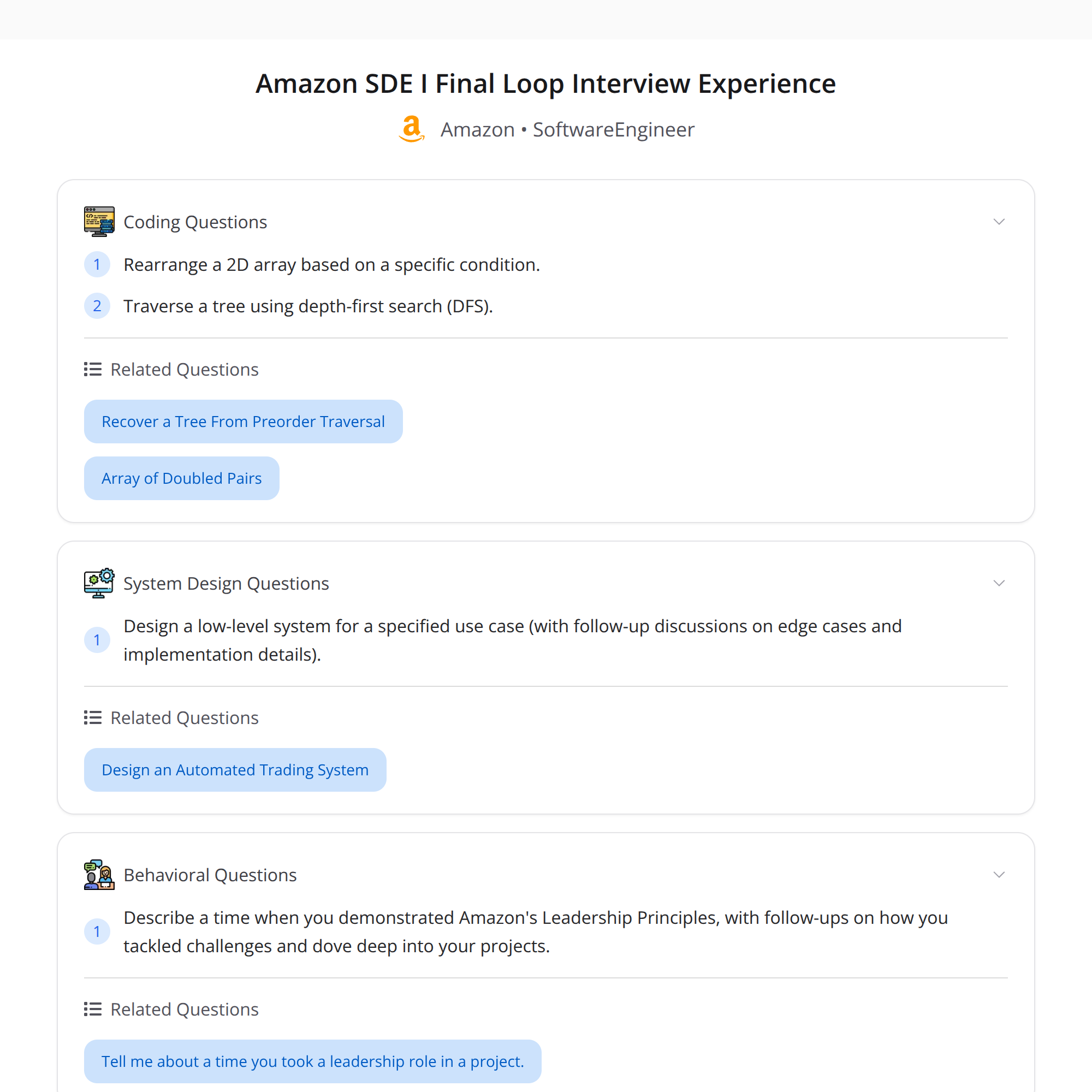
- Round 1: Mix of Leadership Principles (LPs) + coding + low-level design. Expect probing into your design thinking — not just the "right" answer.
- Round 2: Pure coding (array manipulation + DFS tree traversal were called out). Finishing early often opens time for culture/LP conversation.
- Round 3: Deep dive on LPs — interviewers pushed for detailed STAR stories from real projects and assessed communication and ownership.
What each round tested (detailed)
Round 1 — Hybrid: LPs + Coding + Low-Level Design
- Coding: algorithm correctness and clarity, likely medium difficulty.
- Low-level design: component choices, data structures, and trade-offs (think how you'd implement a specific feature or module, not a full distributed architecture).
- LPs: interviewers probe decision-making, trade-offs, and thought process. Even if your design isn’t "perfect," they evaluate how you justify and iterate on it.
What they want to see:
- Structured design thinking (requirements → constraints → options → chosen solution)
- Awareness of edge cases and cost trade-offs
- Clear communication while designing
Example prompt types: design a subsystem for fetching and caching data, or design an API + data model for a feature.
Round 2 — Pure Coding
- Problem types mentioned: array manipulation and DFS tree traversal.
- Time management matters: finishing early often leads to follow-up questions about optimizations or culture-focused discussion.
What they want to see:
- Correctness and robust handling of edge cases
- Clean, testable code and verbalized thought process
- Complexity analysis and small optimizations when prompted
Example prompt types: transform/aggregate arrays, tree traversal variations, recursive DFS with constraints.
Round 3 — Deep Leadership Principles (Behavioral)
- Expect in-depth STAR stories (Situation, Task, Action, Result) from real projects or research experiences.
- Interviewers pressed for details: metrics, specific actions you took, trade-offs, and what you’d do differently.
What they want to see:
- Ownership and impact (quantified where possible)
- Clear examples of leadership, collaboration, learning from failure
- Strong communication and the ability to narrate complex work succinctly
What they were really testing (themes)
- Technical problem-solving: algorithms and data structures
- Design judgment: pragmatic choices and trade-offs in a low-level design context
- Leadership Principles: ownership, customer obsession, bias for action, dive deep
- Communication and storytelling: clear explanations and measurable impact
- Time management: finish coding problems and use spare time productively (e.g., discuss trade-offs)
Practical prep checklist
- Practice medium/hard LeetCode problems focusing on arrays and tree DFS.
- Do timed mock interviews to practice finishing with minutes to spare.
- Prepare 6–8 STAR stories that highlight leadership, ownership, ambiguity handling, and technical impact. For each story, be ready to:
- State the measurable outcome (metrics, performance improvements, deadlines met)
- Describe trade-offs you considered and why you chose your approach
- Explain what you learned and what you would do differently
- Brush up on low-level design patterns (data structures, API input/output, caching strategies, concurrency basics).
- Practice articulating your design choices and complexity trade-offs out loud.
Quick dos and don’ts
- Do: quantify impact in STAR stories, talk through edge cases, and ask clarifying questions early.
- Don’t: over-engineer low-level designs — focus on pragmatic solutions that meet requirements.
- Do: use spare time after coding to explain optimizations or discuss trade-offs.
- Don’t: give vague behavioral answers — be specific about your role and measurable results.
Final tips
- Treat the loop as a combined assessment: technical skill + culture fit. If you’re struggling on code, strong LP stories and communication can still make a difference.
- Mock interviews that mix coding and behavioral rounds will give the best rehearsal for this format.
Good luck — focus on clean problem solving, clear design thinking, and concrete behavioral stories.
#SoftwareEngineering #InterviewPrep #Amazon
About the author
bugfree.ai is an advanced AI-powered platform designed to help software engineers master system design and behavioral interviews. Whether you’re preparing for your first interview or aiming to elevate your skills, bugfree.ai provides a robust toolkit tailored to your needs. Key Features:
150+ system design questions: Master challenges across all difficulty levels and problem types, including 30+ object-oriented design and 20+ machine learning design problems. Targeted practice: Sharpen your skills with focused exercises tailored to real-world interview scenarios. In-depth feedback: Get instant, detailed evaluations to refine your approach and level up your solutions. Expert guidance: Dive deep into walkthroughs of all system design solutions like design Twitter, TinyURL, and task schedulers. Learning materials: Access comprehensive guides, cheat sheets, and tutorials to deepen your understanding of system design concepts, from beginner to advanced. AI-powered mock interview: Practice in a realistic interview setting with AI-driven feedback to identify your strengths and areas for improvement.
bugfree.ai goes beyond traditional interview prep tools by combining a vast question library, detailed feedback, and interactive AI simulations. It’s the perfect platform to build confidence, hone your skills, and stand out in today’s competitive job market. Suitable for:
New graduates looking to crack their first system design interview. Experienced engineers seeking advanced practice and fine-tuning of skills. Career changers transitioning into technical roles with a need for structured learning and preparation.
Comments
Join the discussionNo comments yet. Be the first to comment.