
A high-score interview loop from Bugfree users that tested core coding fundamentals and culture fit. This breakdown highlights what mattered technically and behaviorally — and how to prepare.
Overview
This interview experience followed the typical funnel: online application → a coding assessment focusing on core data structures & algorithms (DSA) → on-site/virtual interview loop. The loop put strong emphasis on algorithmic thinking (especially binary search patterns and binary search trees), optimization (time/space trade-offs), and behavioral alignment with Amazon’s leadership principles.
Clear, structured communication and the ability to explain trade-offs separated high scorers from the rest.
Interview flow (what to expect)
- Initial application and automated coding assessment centered on core DSA problems.
- Interview loop with multiple rounds: each round combined a coding problem plus follow-up questions about complexity, alternatives, and design trade-offs.
- Behavioral rounds focused on examples of handling blockers, going beyond role expectations, receiving and acting on critical feedback, and self-driven learning.
Technical focus
The strongest themes in the coding rounds were:
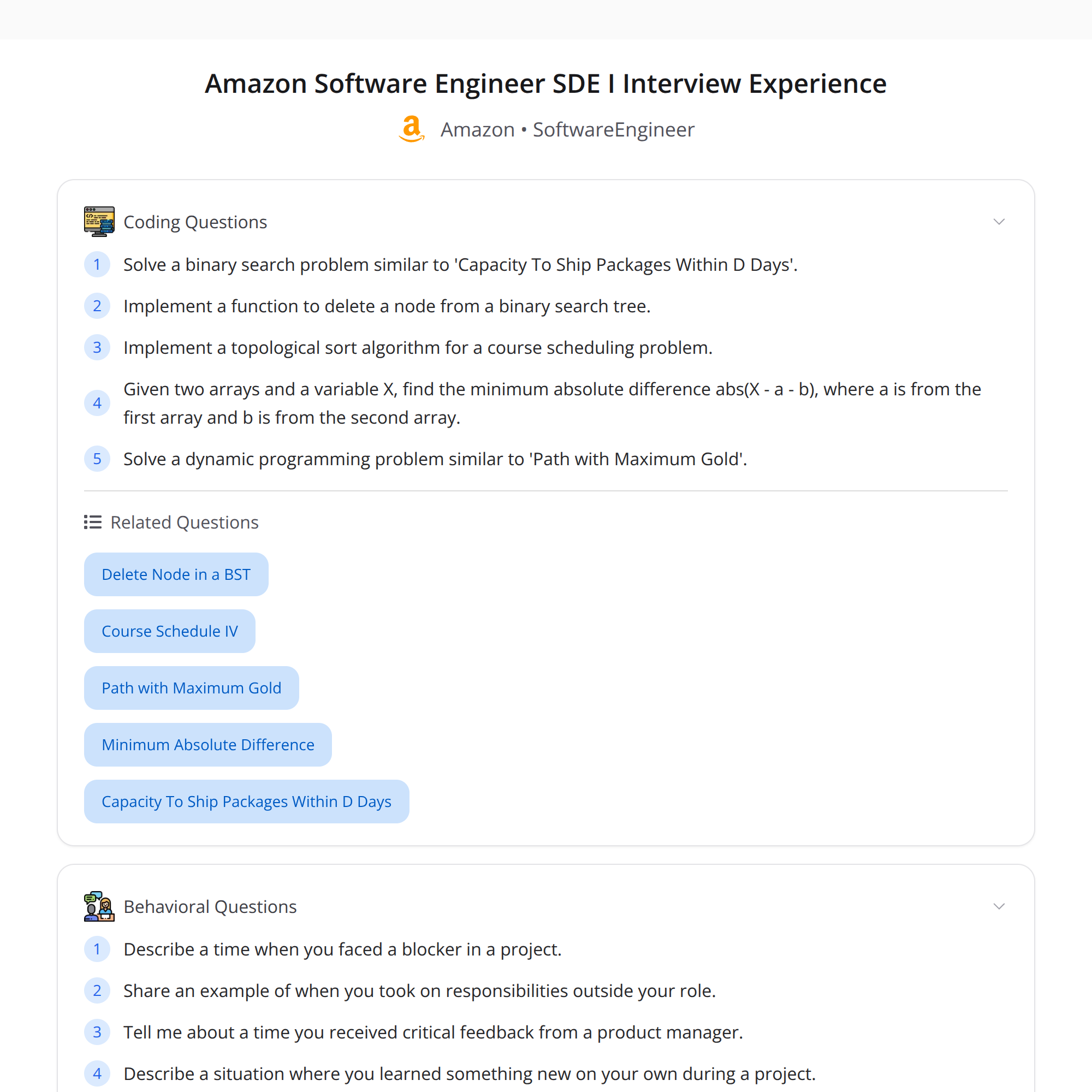
- Binary search patterns: variations beyond simple find-index — e.g., searching in rotated arrays, finding boundaries, predicate-based binary search, and using binary search on the answer space.
- Binary Search Trees (BSTs): operations, recursion vs. iteration, balancing concerns, and traversal patterns used in solving range queries, k-th element problems, and deletion/insertion edge cases.
- Optimization: interviewers probed for reducing time complexity, lowering extra space usage, and explaining trade-offs when choosing one approach over another.
What you’ll be evaluated on:
- Correctness and robustness (edge cases and tests)
- Time and space complexity reasoning
- Choosing and justifying trade-offs (readability vs. performance, iterative vs. recursive)
- Clear step-by-step communication while coding
Behavioral rounds — what to prepare
Behavioral questions were tightly aligned with Amazon’s leadership principles. Expect probes like:
- Describe a blocker you faced and how you removed it.
- Give an example where you stepped outside your role to help the team.
- Tell us about receiving critical feedback and how you responded.
- Explain a time you learned a skill on your own to solve a problem.
How to answer:
- Use STAR (Situation, Task, Action, Result) and keep the narrative focused and measurable.
- Explicitly map your story to a leadership principle (e.g., Dive Deep, Ownership, Learn and Be Curious).
- Show impact: what changed because of your action, and quantify when possible.
Practical preparation checklist
- Master binary search variants: practice predicate-based searches, boundary finding, and search-on-answer problems.
- Deep-dive into BST problems: insert/delete edge cases, in-order/DFS/BFS traversals, and problems using tree recursion.
- Time/space trade-offs: practice rewriting solutions to improve complexity and be ready to compare them.
- Mock interviews: get real-time feedback on communication and thought process.
- Prepare 6–8 behavioral stories mapped to leadership principles using STAR.
- During practice, always verbalize assumptions, walk through test cases, and discuss edge cases.
Day-of-interview tips
- Ask clarifying questions before coding.
- Outline your approach and complexity upfront.
- Start with a correct (even if not optimal) solution, then iteratively optimize.
- Run through test cases and edge cases aloud.
- If stuck, state your thought process and trade-offs you’re considering.
Example problem types to prioritize
- Find first/last occurrence using binary search
- Binary search on answer (e.g., minimum capacity to ship within D days)
- BST kth smallest/largest, range sum, validate BST
- Rotated sorted array search and variants
Key takeaways
- The loop rewards core fundamentals: solid DSA knowledge, careful handling of edge cases, and clear complexity reasoning.
- Communication and structured thinking (explain your approach, justify trade-offs, and walk through tests) are as important as getting the right code.
- For behavioral rounds, concrete STAR stories mapped to Amazon leadership principles make answers crisp and compelling.
Good luck — focus on a small set of high-impact topics (binary search patterns and BSTs), practice clear communication, and prepare leadership-aligned stories.
#SoftwareEngineering #InterviewPrep #DataStructures
About the author
bugfree.ai is an advanced AI-powered platform designed to help software engineers master system design and behavioral interviews. Whether you’re preparing for your first interview or aiming to elevate your skills, bugfree.ai provides a robust toolkit tailored to your needs. Key Features:
150+ system design questions: Master challenges across all difficulty levels and problem types, including 30+ object-oriented design and 20+ machine learning design problems. Targeted practice: Sharpen your skills with focused exercises tailored to real-world interview scenarios. In-depth feedback: Get instant, detailed evaluations to refine your approach and level up your solutions. Expert guidance: Dive deep into walkthroughs of all system design solutions like design Twitter, TinyURL, and task schedulers. Learning materials: Access comprehensive guides, cheat sheets, and tutorials to deepen your understanding of system design concepts, from beginner to advanced. AI-powered mock interview: Practice in a realistic interview setting with AI-driven feedback to identify your strengths and areas for improvement.
bugfree.ai goes beyond traditional interview prep tools by combining a vast question library, detailed feedback, and interactive AI simulations. It’s the perfect platform to build confidence, hone your skills, and stand out in today’s competitive job market. Suitable for:
New graduates looking to crack their first system design interview. Experienced engineers seeking advanced practice and fine-tuning of skills. Career changers transitioning into technical roles with a need for structured learning and preparation.
Comments
Join the discussionNo comments yet. Be the first to comment.