High-Score (Bugfree Users) Amazon SDE I Final Loop: What Really Got Tested
This concise, experience-based breakdown from Bugfree users explains what the Amazon SDE I final loop actually tested and how to prepare. I’ve reorganized the raw notes into a clearer guide with practical takeaways you can act on before your interview.
Quick summary
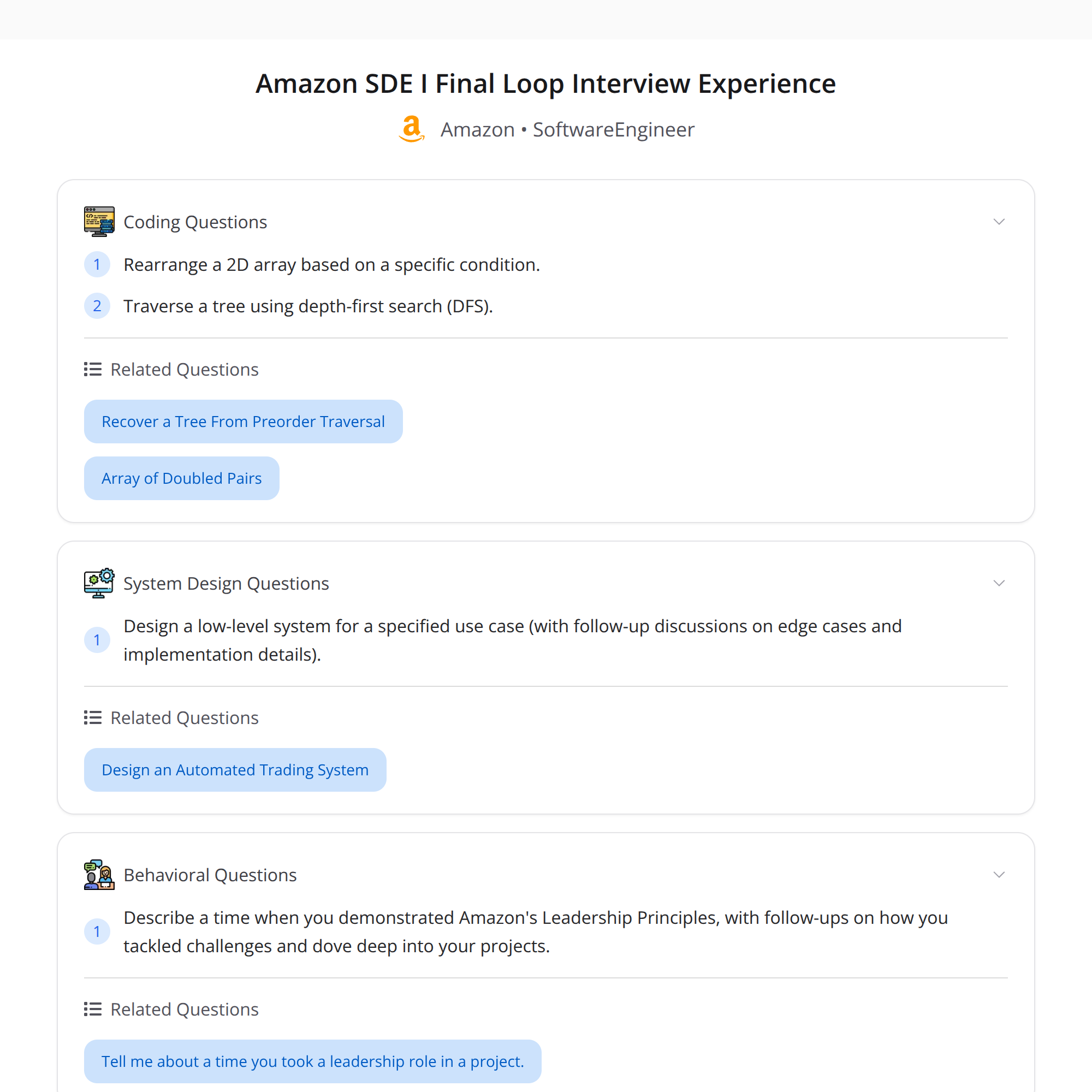
- Round 1: A hybrid of Leadership Principles (LPs), coding, and low-level design (LLD). Expect probing about design thinking and trade-offs—not just a perfect solution.
- Round 2: Pure coding focused on array manipulation and DFS/tree traversal. Finishing early often leads to culture/LP conversation.
- Round 3: Deep LP focus. Interviewers pushed for detailed STAR stories drawn from real research or project work, plus strong communication skills.
What each round really tested (detailed)
Round 1 — LPs + Coding + Low-Level Design
- Format: A mix of behavioral (Leadership Principles), at least one coding question, and a low-level design prompt.
- What they looked for:
- How you reason about system structure and trade-offs in LLD (even if you don’t produce a perfect design).
- Clear design thinking: state assumptions, break problems into components, pick trade-offs, and justify choices.
- Behavioral alignment with Amazon’s LPs during design discussion.
- Prep tips:
- Practice small LLD problems (design a cache, rate limiter, or simple notification system).
- Narrate your thought process and trade-offs; interviewers expect reasoning more than a bug-free diagram.
Round 2 — Pure Coding (Array ops + DFS/Tree)
- Format: Algorithmic problems—array manipulation and DFS/tree traversal were called out.
- What they looked for:
- Correct and efficient code; edge-case handling.
- Ability to explain complexity and approach concisely.
- If you finish early, expect cultural/behavioral follow-ups—use that time to highlight LP examples.
- Prep tips:
- Drill array problems (two pointers, sliding window, in-place transforms) and DFS variants (recursive and iterative, tree traversals, backtracking).
- Time yourself and practice explaining solutions clearly as you code.
Round 3 — Deep Dive on Leadership Principles
- Format: Behavioral, heavy on LPs. Interviewers asked follow-up questions that required specific, detailed STAR stories.
- What they looked for:
- Concrete evidence: measurable impact, trade-offs you made, obstacles and how you overcame them.
- Strong communication and ownership—can you teach back what you learned?
- Prep tips:
- Prepare 6–8 STAR stories tied to specific LPs (Ownership, Customer Obsession, Dive Deep, etc.).
- Quantify results where possible and be ready to go multiple levels deep into technical details.
Common themes across rounds
- Leadership Principles are woven through technical and behavioral questions—not isolated to one round.
- Interviewers value clear communication, trade-off analysis, and real examples over “perfect” answers.
- Finishing tasks early creates opportunity: use extra time to surface LP stories and context about your decisions.
Practical preparation checklist
- Coding: 2–3 weeks of focused practice on arrays, trees, DFS, and typical Amazon-style problems.
- Low-Level Design: Walk through small-system designs and practice sketching components + APIs.
- LP Stories: Prepare STAR examples for Ownership, Customer Obsession, Dive Deep, Deliver Results, and Learn & Be Curious.
- Mock interviews: Simulate a mixed loop with timed coding + a design discussion and a behavioral deep dive.
Quick tips for the interview
- Structure first: restate the problem, outline assumptions, then dive into solutions.
- Voice trade-offs and alternatives when presenting a design.
- Use metrics and outcomes in behavioral answers: “reduced latency by X%,” “improved throughput by Y,” etc.
- If you don’t know something, say so and explain how you’d find the answer or mitigate risk.
If you focus on concise technical solutions, clear design trade-offs, and deep, measurable LP stories, you’ll be prepared for the kinds of questions Bugfree users reported in the Amazon SDE I final loop.
#SoftwareEngineering #InterviewPrep #Amazon
About the author
bugfree.ai is an advanced AI-powered platform designed to help software engineers master system design and behavioral interviews. Whether you’re preparing for your first interview or aiming to elevate your skills, bugfree.ai provides a robust toolkit tailored to your needs. Key Features:
150+ system design questions: Master challenges across all difficulty levels and problem types, including 30+ object-oriented design and 20+ machine learning design problems. Targeted practice: Sharpen your skills with focused exercises tailored to real-world interview scenarios. In-depth feedback: Get instant, detailed evaluations to refine your approach and level up your solutions. Expert guidance: Dive deep into walkthroughs of all system design solutions like design Twitter, TinyURL, and task schedulers. Learning materials: Access comprehensive guides, cheat sheets, and tutorials to deepen your understanding of system design concepts, from beginner to advanced. AI-powered mock interview: Practice in a realistic interview setting with AI-driven feedback to identify your strengths and areas for improvement.
bugfree.ai goes beyond traditional interview prep tools by combining a vast question library, detailed feedback, and interactive AI simulations. It’s the perfect platform to build confidence, hone your skills, and stand out in today’s competitive job market. Suitable for:
New graduates looking to crack their first system design interview. Experienced engineers seeking advanced practice and fine-tuning of skills. Career changers transitioning into technical roles with a need for structured learning and preparation.
Comments
Join the discussionNo comments yet. Be the first to comment.