High-Score (Bugfree Users) Interview Experience: Amazon SDE I — DSA + Behavioral Wins
This write-up condenses a high-score Amazon SDE I loop shared by Bugfree users. It highlights what the process tested, the technical patterns that came up repeatedly, and how behavioral rounds mapped directly to Amazon’s leadership principles. If you're preparing for Amazon, this focused breakdown helps you prioritize practice and framing.
Quick summary of the process
- Application → coding assessment (core DSA) → onsite/loop interviews.
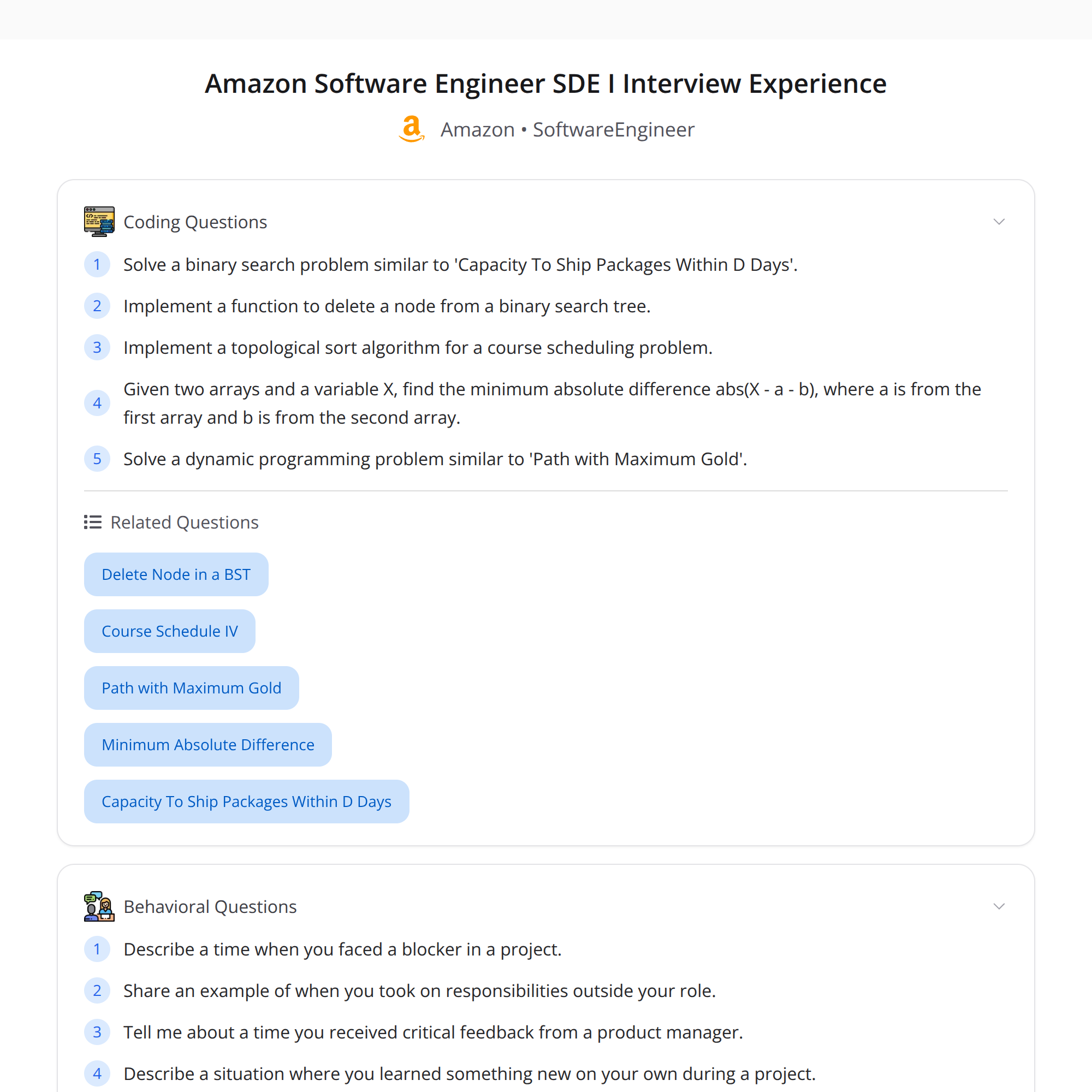
- Technical rounds emphasized binary-search patterns and Binary Search Tree (BST) problems.
- Behavioral rounds tested how you handle blockers, feedback, ownership, and learning—closely aligned to Amazon Leadership Principles (LPs).
- Differentiators: clear communication, structured thinking, complexity trade-offs, and concise STAR-style behavioral answers.
What the loop really tested
- Core algorithmic fundamentals (binary search variants, tree traversals, BST properties).
- Ability to reason about time and space complexity and explain trade-offs.
- Structured problem-solving and communication (high-level approach, then detail).
- Cultural fit—ownership, bias for action, learn-and-be-curious, insist on the highest standards.
Technical focus: Binary search patterns
Binary search shows up more often than you might expect. The tests looked for candidates who:
- Identify binary-search-able search spaces (not just sorted arrays).
- Correctly maintain and prove invariants (lo, hi, mid update rules).
- Handle off-by-one and mid computation issues robustly.
Common problem types and tips:
- "Find first/last occurrence": Use left/right-biased binary search. Always test with small arrays and duplicates.
- "Search in rotated sorted array": Locate pivot or adapt comparisons around mid.
- "Search for smallest/largest satisfying predicate": Convert problem into boolean predicate over monotonic search space.
- "Integer square root" / "minimum maximum partition" problems: transform into a monotonic decision and binary search over answer.
Practical tips:
- State the invariant explicitly (e.g., "answer in [lo, hi)").
- Use while (lo < hi) with consistent mid formula to avoid infinite loops: mid = lo + (hi - lo) / 2.
- Walk through edge cases: empty, single-element, all duplicates, worst-case bounds.
Technical focus: Binary Search Trees (BSTs)
BST problems tested knowledge of BST invariants and tree algorithms. Interviewers expected candidates to choose between recursion and iterative solutions and to discuss complexity trade-offs.
Common problem types and tips:
- "Kth smallest in BST": in-order traversal with early stop; iterative stack to control space.
- "Lowest Common Ancestor (LCA)": use BST property for O(height) solution; explain balanced vs unbalanced implications.
- "Recover BST" (swapped nodes): detect two nodes during in-order traversal and swap them back.
- "Serialize/Deserialize" and subtree checks: discuss traversal order and boundary markers.
Complexity trade-offs to call out:
- Recursion vs iteration: recursion is concise but risks stack overflow on skewed trees; iterative uses explicit stack memory.
- Balanced (AVL/Red-Black) vs plain BST: balanced trees keep height O(log n); plain BST can degrade to O(n).
- In-order stream vs full list: streaming traversal reduces peak memory.
How to structure your technical answer (what interviewers liked)
- Clarify the problem and constraints (n, memory limits, input characteristics).
- Propose a high-level approach and complexity before coding.
- Walk through an example and edge cases.
- Implement clearly, narrating choices.
- Analyze complexity and discuss trade-offs and optimizations.
- Run quick tests and handle corner cases.
Clear, step-by-step communication and saying what you assume (or asking) helps interviewers follow you and gives points for structured thinking.
Behavioral rounds: what to prepare and how to answer
Behavioral rounds strongly map to Amazon Leadership Principles. Expect questions around ownership, dealing with blockers, feedback, and learning.
Framework: Use STAR (Situation, Task, Action, Result). Tie your story explicitly to an LP.
Key question themes and sample pointers:
- "Tell me about a time you overcame a blocker": emphasize diagnosing root cause, communicating with stakeholders, and steps you took to resolve it.
- "Describe when you went beyond your role": show measurable impact and why you took ownership.
- "A time you received critical feedback": explain what you learned and how you changed behavior.
- "How did you learn a new skill independently?": show initiative, resources you used, and how you applied the knowledge.
What interviewers look for:
- Concrete outcomes and metrics when possible (reduced latency by X%, shipped feature by Y date).
- Reflection: what you’d do differently.
- Alignment to LPs like Ownership, Learn and Be Curious, Dive Deep, and Earn Trust.
Quick preparation checklist
- Practice binary search variants and prove invariants for each.
- Solve common BST problems and be ready to discuss recursion vs iteration.
- Rehearse 6–8 STAR stories mapped to Amazon LPs with metrics if possible.
- Practice explaining complexity and trade-offs out loud; mock interviews help.
- During the interview: clarify, propose, code, test, iterate—communicate every step.
If you focus on those algorithmic patterns, practice explaining trade-offs, and prep behavioral stories tied to Amazon LPs, you'll cover the core expectations of this loop. Good luck!
#Resources
- Binary Search patterns: practice problems on leetcode/educative.io
- BST problems: in-order traversal, LCA, recover BST
- Behavioral prep: map STAR stories to Amazon Leadership Principles
About the author
bugfree.ai is an advanced AI-powered platform designed to help software engineers master system design and behavioral interviews. Whether you’re preparing for your first interview or aiming to elevate your skills, bugfree.ai provides a robust toolkit tailored to your needs. Key Features:
150+ system design questions: Master challenges across all difficulty levels and problem types, including 30+ object-oriented design and 20+ machine learning design problems. Targeted practice: Sharpen your skills with focused exercises tailored to real-world interview scenarios. In-depth feedback: Get instant, detailed evaluations to refine your approach and level up your solutions. Expert guidance: Dive deep into walkthroughs of all system design solutions like design Twitter, TinyURL, and task schedulers. Learning materials: Access comprehensive guides, cheat sheets, and tutorials to deepen your understanding of system design concepts, from beginner to advanced. AI-powered mock interview: Practice in a realistic interview setting with AI-driven feedback to identify your strengths and areas for improvement.
bugfree.ai goes beyond traditional interview prep tools by combining a vast question library, detailed feedback, and interactive AI simulations. It’s the perfect platform to build confidence, hone your skills, and stand out in today’s competitive job market. Suitable for:
New graduates looking to crack their first system design interview. Experienced engineers seeking advanced practice and fine-tuning of skills. Career changers transitioning into technical roles with a need for structured learning and preparation.
Comments
Join the discussionNo comments yet. Be the first to comment.