
A Bugfree user shares a high-scoring Amazon SDE-2 interview experience — from a tough coding phone screen to system design and behavioral rounds. Here are the key takeaways and actionable prep tips.
Interview at a glance
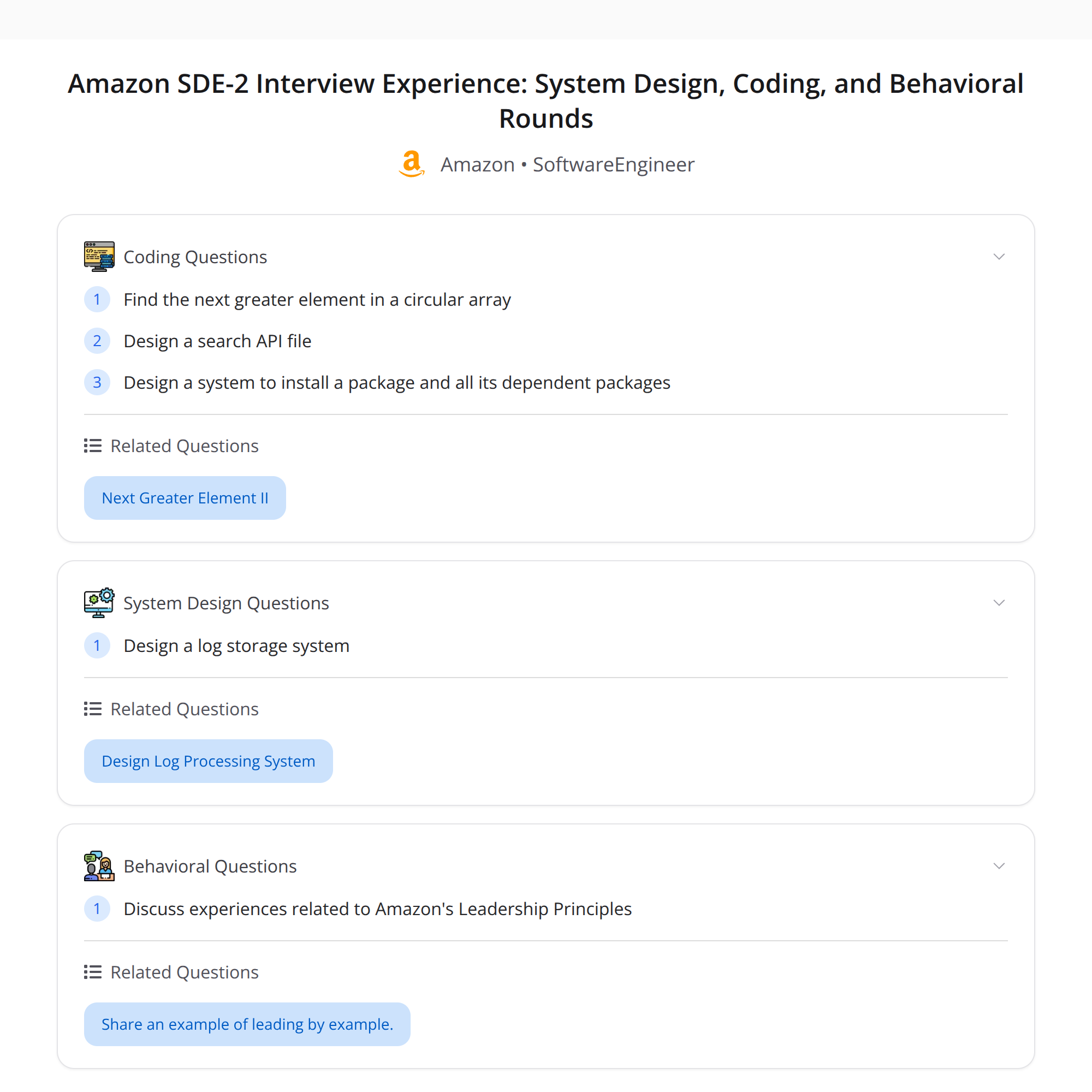
- Phone screen: coding — "next greater element in a circular array" solved with a monotonic stack.
- Onsite technical rounds: Search API design and package dependency problems (topological sort, cycle detection, version conflicts).
- System design: architecting a scalable, cost-effective log storage and query solution.
- Behavioral: focused heavily on Amazon's Leadership Principles; strong stories and STAR-format answers mattered.
1) Coding phone screen — Next Greater Element in a Circular Array
Problem summary: for each number in a circular array, find the next greater number to its right (wrapping around). If none exists, return -1.
Recommended approach (monotonic stack):
- Traverse the array twice (or simulate circularity with modulo) so each element can find a next greater in the wrap-around part.
- Maintain a stack of indices whose next greater hasn't been found yet. When current value > value at stack top, pop and set result.
- Time complexity: O(n). Space complexity: O(n).
Pseudocode:
res = [-1] * n
stack = []  # stores indices
for i in range(2*n):
  val = nums[i % n]
  while stack and nums[stack[-1]] < val:
    res[stack.pop()] = val
  if i < n:
    stack.append(i)
Tips for coding interviews:
- Clarify constraints and expected outputs before coding.
- Explain your approach out loud and discuss trade-offs.
- Start with a brute force idea if unsure, then optimize.
- Write clean, correct code and handle edge cases (all equal elements, single element).
2) Onsite technical rounds — Search API & Package Dependency Problems
Search API round (what to consider):
- API contract: request/response shapes, query params (q, filters, sort, pagination).
- Backing systems: inverted index (Elasticsearch / custom), ranking, caching (CDN / cache layer), and rate limits.
- Scalability: sharding by document id or inverted index terms; partitioning and replication for availability.
- Performance: pagination strategy (cursor vs. offset), result size limits, circuit breakers.
Package dependency round (common themes & solutions):
- Dependency resolution: model as a directed graph; detect cycles with DFS or Kahn's algorithm.
- Topological sort to compute a valid installation order.
- Handling version conflicts: constraint satisfaction, semantic versioning rules, or SAT-solvers for complex constraints.
- Edge cases: optional dependencies, peer dependencies, and concurrent updates.
Interview tips for technical rounds:
- Ask clarifying questions (expected scale, latency targets, failure modes).
- Talk through examples and edge cases; write a small example graph or request/response.
- If stuck, outline high-level solution and trade-offs rather than getting bogged in syntax.
3) System design — Scalable Log Storage & Query System
Goal: design a log ingestion and storage system that supports high write throughput, efficient queries, retention policies, and cost-effective storage.
Core components and considerations:
Ingestion Layer
- Agents (Fluentd/Logstash) push logs to a load-balanced ingestion tier.
- Use a write buffer/streaming system (Kafka/Kinesis) to absorb spikes and decouple producers from consumers.
Processing & Indexing
- Stream processors transform, enrich, and route logs to appropriate storage indexers.
- For queryable logs, index relevant fields into a search engine (Elasticsearch/OpenSearch) for fast ad-hoc queries.
Storage
- Hot storage: indexed, replicated shards for recent logs requiring fast queries.
- Cold storage: compressed object storage (S3 or equivalent) for older logs with infrequent access.
- Partitioning: time-based sharding (daily/hourly) and key-based partitioning to limit query scope.
Query Service
- Frontend API that parses queries, selects appropriate shards/time ranges, and aggregates results.
- Support pagination, streaming results, and rate limiting.
Retention & Lifecycle
- Automated policies to roll indices to cold storage, compress, or delete after retention windows.
- Compaction and TTL to manage cost.
Scalability & Reliability
- Replication, leader election, and careful resource sizing for indexing nodes.
- Backpressure and retry strategies for ingestion if downstream is slow.
Observability & Security
- Metrics, tracing, and alerting for ingestion rates, indexing lag, and query latencies.
- Authentication, authorization, and encryption in flight/at rest.
Design trade-offs to discuss during interviews:
- Consistency vs. availability for indexing and replication.
- Indexing every field (fast queries) vs. storage and ingestion cost.
- Real-time indexing (lower latency) vs. batching for throughput and cost efficiency.
4) Behavioral interviews — Amazon Leadership Principles
Amazon places heavy weight on Leadership Principles. Interviewers expect concrete stories showing how you applied principles like Customer Obsession, Ownership, Dive Deep, Bias for Action, and Earn Trust.
How to prepare:
- Use the STAR format (Situation, Task, Action, Result) for each story.
- Prepare multiple examples that show impact, technical depth, and collaboration.
- For each principle, have 1–2 stories ready; adapt details to the prompt.
- Be honest about mistakes and highlight what you learned and changed.
Example prompt and approach:
- Prompt: "Tell me about a time you took ownership of a failing project."
- Answer structure: quickly set the scene, quantify the problem (metrics), explain actions taken (technical and people), and close with measurable results and lessons.
Final takeaways & prep checklist
- Balance depth: prepare both technical problem-solving (algorithms, systems, coding) and behavioral stories mapped to Leadership Principles.
- Practice the typical phone-screen pattern: clarify, propose, optimize, implement, and test.
- For system design, practice end-to-end architecture, trade-offs, scaling strategies, and operations concerns.
- Mock interviews: timed coding rounds and design walkthroughs with feedback.
- Communication: narrate your thought process, and ask clarifying questions early.
Good luck! Prepare thoroughly, focus on clear communication, and back your behavioral answers with measurable impact.
About the author
bugfree.ai is an advanced AI-powered platform designed to help software engineers master system design and behavioral interviews. Whether you’re preparing for your first interview or aiming to elevate your skills, bugfree.ai provides a robust toolkit tailored to your needs. Key Features:
150+ system design questions: Master challenges across all difficulty levels and problem types, including 30+ object-oriented design and 20+ machine learning design problems. Targeted practice: Sharpen your skills with focused exercises tailored to real-world interview scenarios. In-depth feedback: Get instant, detailed evaluations to refine your approach and level up your solutions. Expert guidance: Dive deep into walkthroughs of all system design solutions like design Twitter, TinyURL, and task schedulers. Learning materials: Access comprehensive guides, cheat sheets, and tutorials to deepen your understanding of system design concepts, from beginner to advanced. AI-powered mock interview: Practice in a realistic interview setting with AI-driven feedback to identify your strengths and areas for improvement.
bugfree.ai goes beyond traditional interview prep tools by combining a vast question library, detailed feedback, and interactive AI simulations. It’s the perfect platform to build confidence, hone your skills, and stand out in today’s competitive job market. Suitable for:
New graduates looking to crack their first system design interview. Experienced engineers seeking advanced practice and fine-tuning of skills. Career changers transitioning into technical roles with a need for structured learning and preparation.
Comments
Join the discussionNo comments yet. Be the first to comment.