High Score Amazon SDE-1 Interview Experience — Bangalore (Bugfree User)
I’m excited to share my Amazon SDE-1 interview journey in Bangalore as a Bugfree user. The process was structured, challenging, and ultimately rewarding — I received an offer. Below I break down the online assessment, the three interview rounds, what interviewers cared about, and tips that helped me succeed.
Overview
- Format: Online assessment followed by three interview rounds.
- Focus areas: Algorithms (greedy, sliding window, binary search, DFS), data-structure design, algorithmic complexity, and Amazon Leadership Principles (behavioral questions).
- Key success factors: clear communication, discussing time/space complexity, and performing dry runs.
Online Assessment
What I faced:
- Greedy algorithm problems — identify a local optimum that leads to a global solution.
- Sliding window problems — typical pattern recognition for subarray/subsequence work.
- Behavioral questions — short answers tied to Amazon’s Leadership Principles.
Tips:
- Practice common greedy and sliding-window patterns (interval scheduling, max-subarray variants, min-length subarray).
- For behavioral prompts, have concise STAR-format stories mapped to specific Leadership Principles (Customer Obsession, Ownership, Dive Deep, Bias for Action).
Interview Rounds — What I Got and How I Approached Each
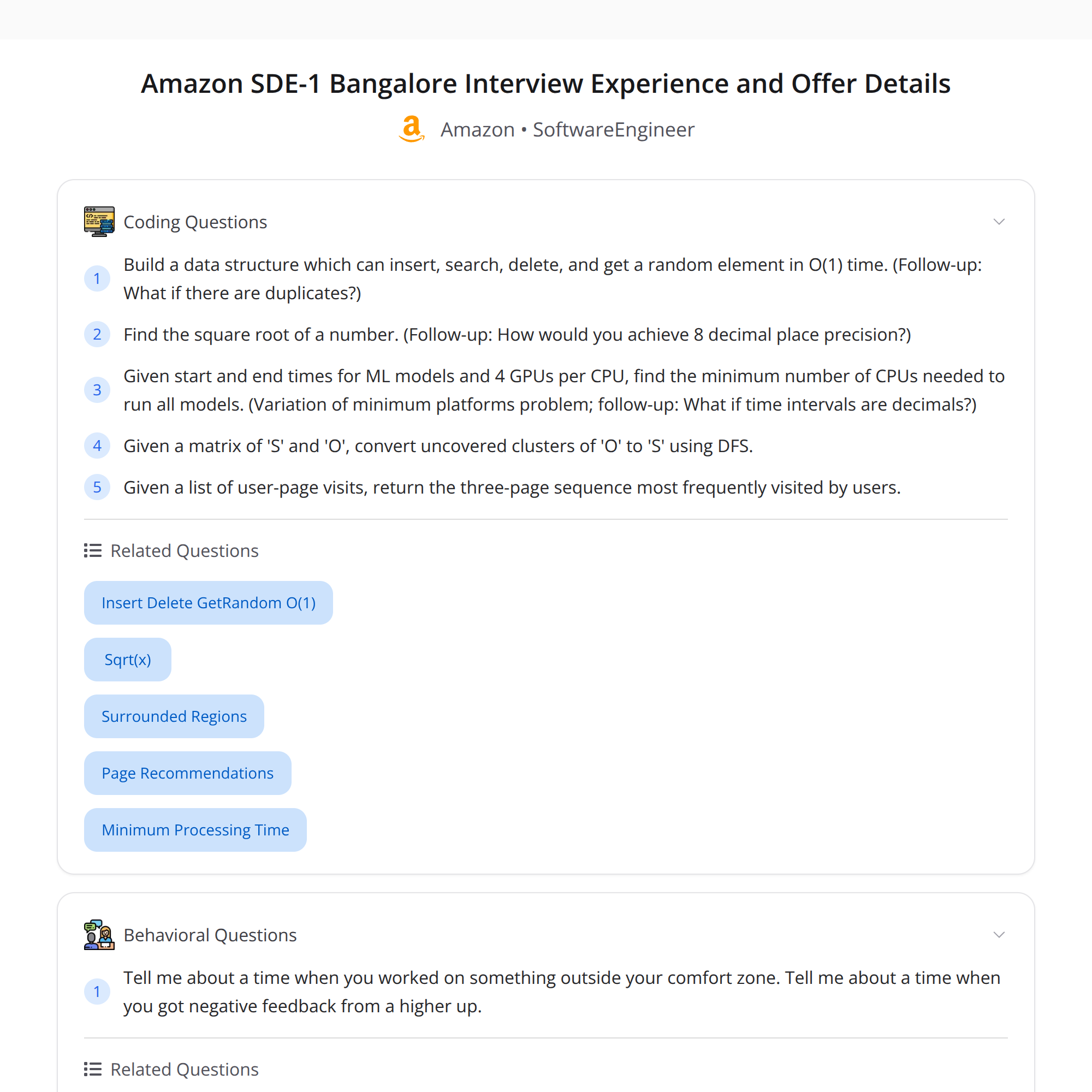
Round 1 — O(1) Data Structure Design
- Problem theme: design a data structure with O(1) operations (e.g., insert, delete, get-random, or get-min).
- What to show: clear API, choice of underlying structures (hashmap + doubly linked list, array + hash), edge cases and invariants.
- Tip: explain how each operation hits O(1) and demonstrate state updates with a small example.
Round 2 — Binary Search for Square Root (and Similar Problems)
- Problem theme: using binary search for numeric answers (e.g., integer square root) or search over monotonic continuous/discrete space.
- What to show: correct bounds, loop invariants, termination conditions, and handling overflow or precision.
- Tip: write the condition carefully and dry-run with edge cases (0, 1, perfect squares, very large numbers).
Round 3 — Line Sweep & DFS Matrix Transformation + Behavioral Deep Dive
- Line Sweep (resource allocation): typical task is processing events (start/end) to calculate concurrent usage or allocate resources.
- What to show: sorting events, using counters or heaps for active resources, correctness for ties/edge times.
- DFS for matrix transformation: transform or mark regions using DFS/BFS (island counting, connected components, transformation in place).
- What to show: recursion vs iterative stack, visited marking to avoid cycles, complexity analysis.
- Behavioral deep-dives: interviewers probed Leadership Principles with follow-ups to gauge depth and ownership.
Across rounds, interviewers expected:
- Clear complexity analysis (time and space). I explicitly stated O(...) for each approach.
- A dry run on sample inputs to show correctness and catch edge cases.
- Good communication: narrate your thought process, ask clarifying questions, and confirm assumptions.
What Helped Me Nail It
- Always start by restating the problem and constraints to ensure alignment.
- Consider multiple approaches and explain trade-offs before coding.
- Discuss time and space complexity out loud — interviewers consistently cared about this.
- Do a quick dry run on sample inputs (including edge cases) after coding.
- For behavioral questions, follow the STAR format and tie stories to specific Leadership Principles.
Resources & Practice Suggestions
- Practice pattern-based problems: sliding window, greedy, binary search on answer, DFS/BFS matrix templates.
- Mock interviews (pair-programming) to practice narration and live coding.
- Prepare 4–6 behavioral stories mapped to common Amazon Leadership Principles.
Final Thoughts
This was a structured, focused interview loop. The combination of algorithmic questions, data structure design, and deep behavioral probes made preparation both broad and targeted. Discussing complexities and performing dry runs were particularly important to convince interviewers of correctness and efficiency. I’m thrilled to have received an offer — hope these insights help others preparing for Amazon SDE-1.
Good luck! #AmazonInterview #SoftwareEngineering #BugfreeExperience #CareerGrowth
About the author
bugfree.ai is an advanced AI-powered platform designed to help software engineers master system design and behavioral interviews. Whether you’re preparing for your first interview or aiming to elevate your skills, bugfree.ai provides a robust toolkit tailored to your needs. Key Features:
150+ system design questions: Master challenges across all difficulty levels and problem types, including 30+ object-oriented design and 20+ machine learning design problems. Targeted practice: Sharpen your skills with focused exercises tailored to real-world interview scenarios. In-depth feedback: Get instant, detailed evaluations to refine your approach and level up your solutions. Expert guidance: Dive deep into walkthroughs of all system design solutions like design Twitter, TinyURL, and task schedulers. Learning materials: Access comprehensive guides, cheat sheets, and tutorials to deepen your understanding of system design concepts, from beginner to advanced. AI-powered mock interview: Practice in a realistic interview setting with AI-driven feedback to identify your strengths and areas for improvement.
bugfree.ai goes beyond traditional interview prep tools by combining a vast question library, detailed feedback, and interactive AI simulations. It’s the perfect platform to build confidence, hone your skills, and stand out in today’s competitive job market. Suitable for:
New graduates looking to crack their first system design interview. Experienced engineers seeking advanced practice and fine-tuning of skills. Career changers transitioning into technical roles with a need for structured learning and preparation.
Comments
Join the discussionNo comments yet. Be the first to comment.